Saturnia pyri (original) (raw)
From Wikipedia, the free encyclopedia
Species of moth
| Giant peacock moth | |
|---|---|
 |
|
Scientific classification  |
|
| Kingdom: | Animalia |
| Phylum: | Arthropoda |
| Class: | Insecta |
| Order: | Lepidoptera |
| Family: | Saturniidae |
| Genus: | Saturnia |
| Species: | S. pyri |
| Binomial name | |
| Saturnia pyri(Denis & Schiffermüller, 1775) | |
| Synonyms | |
| Bombyx pyri [Denis & Schiffermüller], 1775 |
Saturnia pyri, the giant peacock moth, great peacock moth, giant emperor moth or Viennese emperor, is a Saturniid moth which is native to Europe. The species was first described by Michael Denis and Ignaz Schiffermüller in 1775. It is the largest European moth, with a wingspan reaching 15–20 cm (6–8 in).
The giant peacock moth has a range that includes the Iberian Peninsula, southern France, northern Hungary, central and southern Serbia, Croatia, Montenegro, southern and eastern Bulgaria, southern Greece southern Turkey, south Kyrgyzstan, western Syria, Lebanon, north Israel, southern Romania, Russia, Ukraine, Czech Republic, Slovak Republic, Slovenia, North Macedonia and Italy and extends into Siberia and North Africa. It is absent from the UK, though a small handful of individuals have been recorded, likely of captive origin.[1]

Hatching, with the egg still attached - on an almond leaf
Caterpillar
Caterpillar - high resolution
Caterpillar - detail
Cocoon

Female
On a hand showing its large size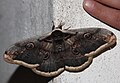
In the Czech Republic

On Mount Meron in northern Israel


Giant Peacock Moth on Arum by Vincent van Gogh, 1889
- ^ "Hants Moths". Retrieved 15 September 2014.