StarGraph—Wolfram Documentation (original) (raw)
StarGraph[n]
gives the star graph with n vertices  .
.
Details and Options
Examples
open all close all
Basic Examples (2)
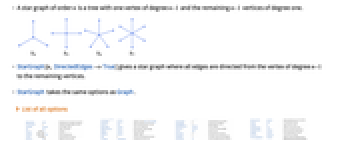
The first few star graphs  :
:
Directed star graphs:
Options (81)
AnnotationRules (3)
Specify an annotation for vertices:
Edges:
Graph itself:
DirectedEdges (1)
By default, an undirected graph is generated:
Use DirectedEdges->True to generate a directed graph:
EdgeLabels (7)
Label the edge 12:
Label all edges individually:
Use any expression as a label:
Use Placed with symbolic locations to control label placement along an edge:
Use explicit coordinates to place labels:
Vary positions within the label:
Place multiple labels:
Use automatic labeling by values through Tooltip and StatusArea:
EdgeShapeFunction (6)
Get a list of built-in settings for EdgeShapeFunction:
Undirected edges including the basic line:
Lines with different glyphs on the edges:
Directed edges including solid arrows:
Line arrows:
Open arrows:
Specify an edge function for an individual edge:
Combine with a different default edge function:
Draw edges by running a program:
EdgeShapeFunction can be combined with EdgeStyle:
EdgeShapeFunction has higher priority than EdgeStyle:
EdgeStyle (2)
Style all edges:
Style individual edges:
EdgeWeight (2)
Specify a weight for all edges:
Use any numeric expression as a weight:
GraphHighlight (3)
Highlight the vertex 1:
Highlight the edge 13:
Highlight vertices and edges:
GraphHighlightStyle (2)
GraphLayout (5)
PlotTheme (4)
Base Themes (2)
Use a common base theme:
Use a monochrome theme:
Feature Themes (2)
Use a large graph theme:
Use a classic diagram theme:
VertexCoordinates (3)
By default, any vertex coordinates are computed automatically:
Extract the resulting vertex coordinates using AbsoluteOptions:
Specify a layout function along an ellipse:
Use it to generate vertex coordinates for a graph:
VertexCoordinates has higher priority than GraphLayout:
VertexLabels (13)
Use vertex names as labels:
Label individual vertices:
Label all vertices:
Use any expression as a label:
Use Placed with symbolic locations to control label placement, including outside positions:
Symbolic outside corner positions:
Symbolic inside positions:
Symbolic inside corner positions:
Use explicit coordinates to place the center of labels:
Place all labels at the upper-right corner of the vertex and vary the coordinates within the label:
Place multiple labels:
Any number of labels can be used:
Use the argument to Placed to control formatting including Tooltip:
Or StatusArea:
Use more elaborate formatting functions:
VertexShape (5)
VertexShapeFunction (10)
VertexSize (8)
By default, the size of vertices is computed automatically:
Specify the size of all vertices using symbolic vertex size:
Use a fraction of the minimum distance between vertex coordinates:
Use a fraction of the overall diagonal for all vertex coordinates:
Specify size in both the  and
and  directions:
Specify the size for individual vertices:
VertexSize can be combined with VertexShapeFunction:
VertexSize can be combined with VertexShape:
VertexStyle (5)
VertexWeight (2)
Set the weight for all vertices:
Use any numeric expression as a weight:
Applications (7)
The GraphCenter of star graphs:
The GraphPeriphery:
The VertexEccentricity:
Highlight the vertex eccentricity path:
The GraphRadius:
Highlight the radius path:
The GraphDiameter:
Highlight the diameter path:
Highlight the vertex degree for StarGraph:
Highlight the closeness centrality:
Highlight the eigenvector centrality:
Vertex connectivity from  to
to  is the number of vertex-independent paths from
  to
to  :
:
The vertex connectivity for a star is 1 for all vertex pairs:
Properties & Relations (6)
StarGraph[n] has  vertices:
StarGraph[n] has  edges:
The complete bipartite graph  is a star graph with
  vertices:
A star graph is a tree:
A star graph is bipartite:
The line graph of the star graph  is a complete graph
  :
:
Neat Examples (1)
Random collage of star graphs:
Wolfram Research (2010), StarGraph, Wolfram Language function, https://reference.wolfram.com/language/ref/StarGraph.html.
Text
Wolfram Research (2010), StarGraph, Wolfram Language function, https://reference.wolfram.com/language/ref/StarGraph.html.
CMS
Wolfram Language. 2010. "StarGraph." Wolfram Language & System Documentation Center. Wolfram Research. https://reference.wolfram.com/language/ref/StarGraph.html.
APA
Wolfram Language. (2010). StarGraph. Wolfram Language & System Documentation Center. Retrieved from https://reference.wolfram.com/language/ref/StarGraph.html
BibTeX
@misc{reference.wolfram_2025_stargraph, author="Wolfram Research", title="{StarGraph}", year="2010", howpublished="\url{https://reference.wolfram.com/language/ref/StarGraph.html}", note=[Accessed: 17-May-2026]}
BibLaTeX
@online{reference.wolfram_2025_stargraph, organization={Wolfram Research}, title={StarGraph}, year={2010}, url={https://reference.wolfram.com/language/ref/StarGraph.html}, note=[Accessed: 17-May-2026]}