2017 CppCon - Mix Tests and Production Code With Doctest (original) (raw)
Mix Tests and Production Code With Doctest - Implementing and Using the Fastest Modern C++ Testing Framework


About me
- my name is Viktor Kirilov
- from Bulgaria
- 3.5 years of professional C++ in the games / VFX industries
- working on personal projects since 01.01.2016 (almost 2 years)
Tools of the trade
- compilers: Visual Studio, GCC, Clang, Emscripten
- tools: CMake, Python, git, clang-format, valgrind, sanitizers
- services: GitHub, Travis CI, AppVeyor
Passionate about
- game development and game engines
- data-oriented design and HPC
- good software development practices
The lightest feature-rich C++ single-header testing framework
Inspired by the ability of compiled languages such as D / Rust / Nim
to write tests directly in the production code
Project mantra:
Tests can be considered a form of documentation and should be able to reside near the code which they test
Nothing is better than documentation with examples.
Nothing is worse than outdated examples that don't actually work.
Some info
Interface and functionality modeled mainly after Catch and Boost.Test / Google Test
Currently some big things which Catch has are missing:
- reporter system - to file, to xml, user defined
- matchers
but doctest is catching up - and is adding some of its own -
like test suites and templated test cases


This presentation
- Introduction to the framework
- Implementation details - cool C++ stuff
- Automatic test registration
- The preprocessor and silencing warnings
- Removing testing-related stuff from the binary
- Expression decomposition with templates
- Exception translation
- Other notable things
- Compile time and runtime benchmarks
- Examples of integration with production code
- Not covered: How to do testing - there are plenty of talks on that topic
Single header with 2 parts
#ifndef GUARD_FWD
#define GUARD_FWD
// fwd stuff...
#endif // GUARD_FWD


#if defined(DOCTEST_CONFIG_IMPLEMENT)
#ifndef GUARD_IMPL
#define GUARD_IMPL

#include <vector>
// test runner stuff...

#endif // GUARD_IMPL
#endif // DOCTEST_CONFIG_IMPLEMENT- no inline functions and leaked dependencies / headers
- no skyrocketing compile / link times
A complete example
#define DOCTEST_CONFIG_IMPLEMENT_WITH_MAIN
#include <doctest.h>

int fact(int n) { return n <= 1 ? n : fact(n - 1) * n; }

TEST_CASE("testing the factorial function") {
    CHECK(fact(0) == 1); // will fail
    CHECK(fact(1) == 1);
    CHECK(fact(2) == 2);
    CHECK(fact(10) == 3628800);
}
Example output
[doctest] doctest version is "1.2.4"
[doctest] run with "--help" for options
========================================================
main.cpp(6)
testing the factorial function

main.cpp(7) FAILED!
  CHECK( fact(0) == 1 )
with expansion:
  CHECK( 0 == 1 )

========================================================
[doctest] test cases:    1 |    0 passed |    1 failed |
[doctest] assertions:    4 |    3 passed |    1 failed |
What makes doctest different
In 2 words: light and unintrusive (transparent):
- The smallest possible footprint on compile times
- Can remove everything testing-related from the binary
- No namespace pollution
- All macros are (or can be) prefixed
- Doesn't drag any headers with it
- 0 warnings
- Easy integration with user code
Unnoticeable even if included in every source file of a project
Very reliable - per commit tested
All tests are built in Debug / Release and in 32 / 64 bit modes.
- GCC: 4.4 / 4.5 / 4.6 / 4.7 / 4.8 / 4.9 / 5 / 6 / 7 (Linux / OSX)
- Clang: 3.5 / 3.6 / 3.7 / 3.8 / 3.9 / 4 / 5 (Linux / OSX)
- MSVC: 2008 / 2010 / 2012 / 2013 / 2015 / 2017
- warnings as errors - on the most aggressive levels
- output compared to one from a previous known good run
- ran through valgrind (Linux only)
- ran through address and UB sanitizers (Linux / OSX)
- C++98 and C++11, -fno-exceptions, -fno-rtti
- analyzed with 5 different static analyzers
A total of 300+ different configurations are built and tested.
Using travis and appveyor for CI - integrated with GitHub.
All this makes writing tests in the production code feasible!
This leads to:
- lower barrier for writing tests (no separate .cpp files)
- tests can be viewed as up-to-date comments
- easier testing unexposed internals through public API / headers
- TDD in C++ has never been easier!
The framework can still be used like any other even if the idea of writing tests in the production code doesn't appeal to you.
Other most notable features
CHECK(a == 666);
CHECK(b != 42);
CHECK_EQUAL(a, 666);
CHECK_NOT_EQUAL(b, 42);Other most notable features
TEST_CASE("name") {
    // asserts
}
Automatic test case registration
TEST_CASE(unique_identifier, "name") {
    // asserts
}

void some_function_called_from_main() {
    doctest::register(unique_identifier);
}
Other most notable features
TEST_CASE("db") {
    auto db = open("...");

    SUBCASE("first tests") {
        // asserts 1 with db
    }

    SUBCASE("second tests") {
        // asserts 2 with db
    }

    close(db);
}
Subcases for shared setup/teardown
TEST_CASE("db - first tests") {
    auto db = open("...");

    // asserts 1 with db

    close(db);
}

TEST_CASE("db - second tests") {
    auto db = open("...");

    // asserts 2 with db

    close(db);
}
Other most notable features
for(int i = 0; i < 100; ++i) {
    INFO("the value of i is " << i);
    CHECK(a[i] == b[i]);
}
logging facilities with lazy stringification for performance
test.cpp(10) ERROR!
  CHECK( a[i] == b[i] )
with expansion:
  CHECK( 0 == 32762 )
with context:
  the value of i is 75
will output the following:
Other most notable features
translation of exceptions
int func() { throw MyType(); return 0; }

REG_TRANSLATOR(const MyType& e) {
    return String("MyType: ") + toString(e);
}

TEST_CASE("foo") {
    CHECK(func() == 42);
}
main.cpp(34) ERROR!
CHECK( func() == 42 )
threw exception:
MyType: contents...will output the following:
Other most notable features
stringification of user types
struct type { bool data; };
bool operator==(const type& lhs, const type& rhs) {
    return lhs.data == rhs.data;
}
doctest::String toString(const type& in) {
    return in.data ? "true" : "false";
}

TEST_CASE("stringification") {
    CHECK(type{true} == type{false});
}
test.cpp(15) ERROR!
  CHECK( type{true} == type{false} )
with expansion:
  CHECK( true == false )
will output the following:
Other most notable features
typedef doctest::Types<int, char, myType> types;

TEST_CASE_TEMPLATE("serialization", T, types) {
    auto var = T{};
    json state = serialize(var);
    T result = deserialize(state);
    CHECK(var == result);
}
will result in the creation of 3 test cases:
- serialization
- serialization
- serialization
Other most notable features
asserts for exceptions and floating point
void throws() { throw 5; }

TEST_CASE("stringification")
{
    CHECK_THROWS(throws());
    CHECK_THROWS_AS(throws(), int);
    CHECK_NOTHROW(throws());

    CHECK(doctest::Approx(5.f) == 5.001f);
}
Other most notable features
decorators for test cases and test suites
bool is_slow() { return true; }

TEST_CASE("should be below 200ms"
    * doctest::skip(is_slow())
    * doctest::timeout(0.2))
{}
- may_fail(bool)
- should_fail(bool)
- expected_failures(int)
- description(const char*)
- test_suite(const char*)
Other most notable features
- crash handling with signals (Unix) / SEH (Windows)
- failures can break into the debugger
- command line with lots of options - filtering, colors, etc.
- tests.exe --list-test-cases // list test case names
- tests.exe --test-case=*math*,util_* // execute only matching
- tests.exe --test-suite-exclude=*deprecated* // skip these
- tests.exe --abort-after=10 // stop tests after 10 failures
- tests.exe --order-by=rand // can also give seed
- tests.exe --no-breaks // don't break in debugger
- range-based execution of tests - for parallelization
- tests.exe --count // get the number of tests
- tests.exe --first=0 --last=9 // execute first range
- tests.exe --first=10 --last=19 // execute second range
Let's get into details
Code is simplified for simplicity
Unique anonymous variables
#define CONCAT_IMPL(s1, s2) s1##s2
#define CONCAT(s1, s2) CONCAT_IMPL(s1, s2)

#define ANONYMOUS(x) CONCAT(x, __COUNTER__)

int ANONYMOUS(ANON_VAR_); // int ANON_VAR_5;
int ANONYMOUS(ANON_VAR_); // int ANON_VAR_6;
__COUNTER__ yields a bigger integer each time it gets used
non-standard but present in all modern compilers
Auto registration
TEST_CASE("math") {
    // asserts
}
static void ANON_FUNC_24(); // fwd decl
static int ANON_VAR_25 = regTest( // register
ANON_FUNC_24, "main.cpp", 56, "math", ts::get());
void ANON_FUNC_24() { // the test case
// asserts
}static to not clash during linking with other symbols
Auto registration
std::set<TestCase>& getTestRegistry() {
    static std::set<TestCase> data; // static local
    return data; // return a reference
}

int regTest(void (*f)(void) f, const char* file, int line
            const char* name, const char* test_suite)
{
    TestCase tc(name, f, file, line, test_suite);
    getTestRegistry().insert(tc);
    return 0; // to initialize the dummy int
}
Test Suites
namespace ts { inline const char* get() { return ""; } } // default

TEST_SUITE("math") {
    TEST_CASE("addition") { // calls ts::get()
        // ...
    }
}
namespace ts { inline const char* get() { return ""; } } // default
namespace ANON_TS_45 {
namespace ts { static const char* get() { return "math"; } }
}
namespace ANON_TS_45 {
TEST_CASE("addition") { // calls ts::get() ==> ANON_TS_45::ts::get()
// ...
}
}Lets talk about warnings
The framework and it's tests are clean from these:
- -Weverything for Clang
- /W4 for MSVC - /Wall is madness...
- -Wall -Wextra -pedantic for GCC - and over 37 other unique flags not covered by these!
The additional GCC flags
| -Wswitch-default-Wconversion-Wold-style-cast-Wfloat-equal-Wlogical-op-Wundef-Wredundant-decls-Wshadow-Wstrict-overflow=5-Wwrite-strings-Wpointer-arith-Wcast-qual | -Wmissing-include-dirs-Wcast-align-Wswitch-enum-Wnon-virtual-dtor-Wctor-dtor-privacy-Wsign-conversion-Wdisabled-optimization-Weffc++-Wdouble-promotion-Winvalid-pch-Wmissing-declarations-Woverloaded-virtual | -Wnoexcept-Wtrampolines-Wzero-as-null-pointer-constant-Wuseless-cast-Wshift-overflow=2-Wnull-dereference-Wduplicated-cond-Wduplicated-branches-Wformat=2-Walloc-zero-Walloca-Wrestrict |
|---|
Silencing warnings in the header
Every (decent) compiler can do this.
#if defined(__clang__)
#pragma clang diagnostic push
#pragma clang diagnostic ignored "-Wpadded"
#endif // __clang__

// ... header stuff

#if defined(__clang__)
#pragma clang diagnostic pop
#endif // __clang__
Warnings in user code?
The TEST_CASE macro produces warnings because of the anonymous dummy int:
- clang: -Wglobal-constructors
- gcc: -Wunused-variable
We cannot ask the user to use pragmas to silence warnings....
What to do?
The preprocessor
// test.cpp
#include "test.h"
int main() {}

#pragma pack(2)
struct T { char c; short s; };
// test.h
#define val(x) x
int a = val(5); // comment
int a = 10; // will get error
# 1 "test.h" 1
int a = 5;
int a = 10;
# 3 "test.cpp" 2
int main() {}
#pragma pack(2)
struct T { char c; short s; };
And after the preprocessor:
Embedding a pragma in a macro
// test.cpp
#include <cmath>

#define myParallelTransform(op)   \
    _Pragma("omp parallel for")   \
    for(int n = 0; n < size; ++n) \
      data[n] = op(data[n])

int main() {
    float data[] = {0, 1, 2, 3, 4, 5};
    int size = 6;

    myParallelTransform(sin);
    myParallelTransform(cos);
}
...

int main() {
    float data[] = {0, 1, 2, 3, 4, 5};
    int size = 6;

#pragma omp parallel for
    for(int n = 0; n < size; ++n)
        data[n] = sin(data[n]);

#pragma omp parallel for
    for(int n = 0; n < size; ++n)
        data[n] = cos(data[n]);
}
_Pragma() was standardized in C++11 but compilers support it for many years (__pragma() for MSVC)
Silencing warnings in macros
#define TEST_CASE_IMPL(f, name)                                   \
    static void f();                                              \
                                                                  \
    _Pragma("clang diagnostic push")                              \
    _Pragma("clang diagnostic ignored \"-Wglobal-constructors\"") \
                                                                  \
    static int ANONYMOUS(ANON_VAR_) =                             \
            regTest(f, __FILE__, __LINE__, name, ts::get());      \
                                                                  \
    _Pragma("clang diagnostic pop")                               \
                                                                  \
    void f()

#define TEST_CASE(name) TEST_CASE_IMPL(ANONYMOUS(ANON_FUNC_), name)
Macro indirection needed so the same anon name is used.
Silencing warnings in macros
#define TEST_CASE_IMPL(f, name)                                \
    static void f();                                           \
                                                               \
    static int ANONYMOUS(ANON_VAR_) __attribute__((unused)) =  \
            regTest(f, __FILE__, __LINE__, name, ts::get());   \
                                                               \
    void f()

#define TEST_CASE(name) TEST_CASE_IMPL(ANONYMOUS(ANON_FUNC_), name)
Subcases - a DFS traversal
TEST_CASE("nested subcases") {
    out("setup");

    SUBCASE("") {
        out("1");

        SUBCASE("") {
            out("1.1"); // leaf
        }
    }
    SUBCASE("") {
        out("2");

        SUBCASE("") {
            out("2.1"); // leaf
        }
        SUBCASE("") {
            out("2.2"); // leaf
        }
    }
}
// THE OUTPUT
setup
1
1.1
setup
2
2.1
setup
2
2.2Subcase macro expansion
SUBCASE("foo") {
    // ...
    SUBCASE("bar") {
        // ...
    }
    SUBCASE("baz") {
        // ...
    }
}
if(const Subcase& ANON_2 = Subcase("foo", "a.cpp", 4)) {
// ...
if(const Subcase& ANON_3 = Subcase("bar", "a.cpp", 6)) {
// ...
}
if(const Subcase& ANON_4 = Subcase("baz", "a.cpp", 9)) {
// ...
}
}- The lifetime of each Subcase is only in the "then" blocks.
- The magic happens in the Ctor / Dtor of the Subcase class.
- operator bool() is used to decide whether to enter the "if".
- Subcases are lazily discovered - unlike test cases.
- The DFS traversal is done using globals (hash tables, etc.)
- Can be nested infinitely - and the entered ones are in a stack
The main() entry point
#define DOCTEST_CONFIG_IMPLEMENT_WITH_MAIN
#include <doctest.h>
#define DOCTEST_CONFIG_IMPLEMENT
#include <doctest.h>
int main(int argc, char** argv) {
doctest::Context context;
// default
context.setOption("abort-after", 5); // stop after 5 failed asserts
// apply argc / argv
context.applyCommandLine(argc, argv);
// override
context.setOption("no-breaks", true); // don't break in the debugger
// run queries or test cases unless with --no-run
int res = context.run();
if(context.shouldExit()) // query flags (and --exit) rely on this
return res; // propagate the result of the tests
// your program
return res; // + your_program_res
}Removing everything testing-related from the binary
#define DOCTEST_CONFIG_DISABLE // the magic identifier
#include <doctest.h>
#define TEST_CASE(name) \
template <typename T> \
static inline void ANONYMOUS(ANON_FUNC_)()So all test cases are turned into uninstantiated templates.
The linker doesn't even lift its finger.
Removing everything testing-related from the binary
The DOCTEST_CONFIG_DISABLE identifier affects all macros - asserts and logging macros are turned into a no-op with ((void)0) - to require a semicolon - and subcases just vanish.
- It should be defined everywhere in a module (exe / dll)
- Compilation and linking become lightning fast
- Most of the test runner is also removed
Expression decomposition
In C++ the << operator has higher precedence over ==
That is how the decomposer captures the left operand "a".
Also the "Owl" technique (0,0) used to silence C4127 in MSVC
Gets (sort of) expanded to:
do {
    ResultBuilder rb("CHECK", "main.cpp", 76, "a == b");
    try {
        rb.setResult(ExpressionDecomposer() << a == b);
    } catch(...) { rb.exceptionOccurred(); }
    if(rb.log()) // returns true if the assert failed
        BREAK_INTO_DEBUGGER();
} while((void)0, 0); // no "conditional expression is constant"
Expression decomposition
struct ExpressionDecomposer {
    template <typename L>
    LeftOperand<const L&> operator<<(const L& operand) {
        return LeftOperand<const L&>(operand);
    }
};
template <typename L>
struct LeftOperand{
L lhs;
LeftOperand(L in) : lhs(in) {}
template <typename R> Result operator==(const R& rhs) {
return Result(lhs == rhs, stringify(lhs, "==", rhs));
}
};Expression decomposition
struct Result {
    bool   passed;
    String decomposition;

    Result(bool p, const String& d) : passed(p) , decomposition(d) {}
};
template <typename L, typename R>
String stringify(const L& lhs, const char* op, const R& rhs) {
return toString(lhs) + " " + op + " " + toString(rhs);
}The default stringification of types is "{?}".
Translating exceptions
try {
    rb.setResult(ExpressionDecomposer() << func() == 42);
} catch(...) { rb.exceptionOccurred(); }
int func() { throw MyType(); return 0; }
CHECK(func() == 42);main.cpp(34) ERROR!
CHECK( func() == 42 )
threw exception:
MyType: contents...Translating exceptions
struct ITranslator { // interface
    virtual bool translate(String&) = 0;
};

template<typename T>
struct Translator : ITranslator {
    String(*m_func)(T); // function pointer
    Translator(String(*func)(T)) : m_func(func) {}

    bool translate(String& res) override {
        try {
            throw; // rethrow
        } catch(T ex) {
            res = m_func(ex); // use the translator
            return true;
        } catch(...) {
            return false; // didn't catch by T
        }
    }
};
Translating exceptions
void reg_in_test_runner(ITranslator* t); // fwd decl

template<typename T>
int regTranslator(String(*func)(T)) {
    static Translator<T> t(func); // alive until the program ends
    reg_in_test_runner(&t);
    return 0;
}
// REG_TRANSLATOR gets expanded to:
static String ANON_TR_76(const MyType& e); // fwd decl
static int ANON_TR_77 = regTranslator(ANON_TR_76); // register
static String ANON_TR_76(const MyType& e) {
return String("MyType: ") + toString(e);
}REG_TRANSLATOR(const MyType& e) {
return String("MyType: ") + toString(e);
}String translate() {
// try translators
String res;
for(size_t i = 0; i < translators.size(); ++i)
if(translators[i]->translate(res)) // if success
return res;
// proceed with default translation
try {
throw; // rethrow
} catch(std::exception& ex) {
return ex.what();
} catch(std::string& msg) {
return msg.c_str();
} catch(const char* msg) {
return msg;
} catch(...) {
return "Unknown exception!";
}
}
void ResultBuilder::exceptionOccurred() { /* use translate() */ }The Lippincott function
Major C++ issue - compile times
Compile times - header cost
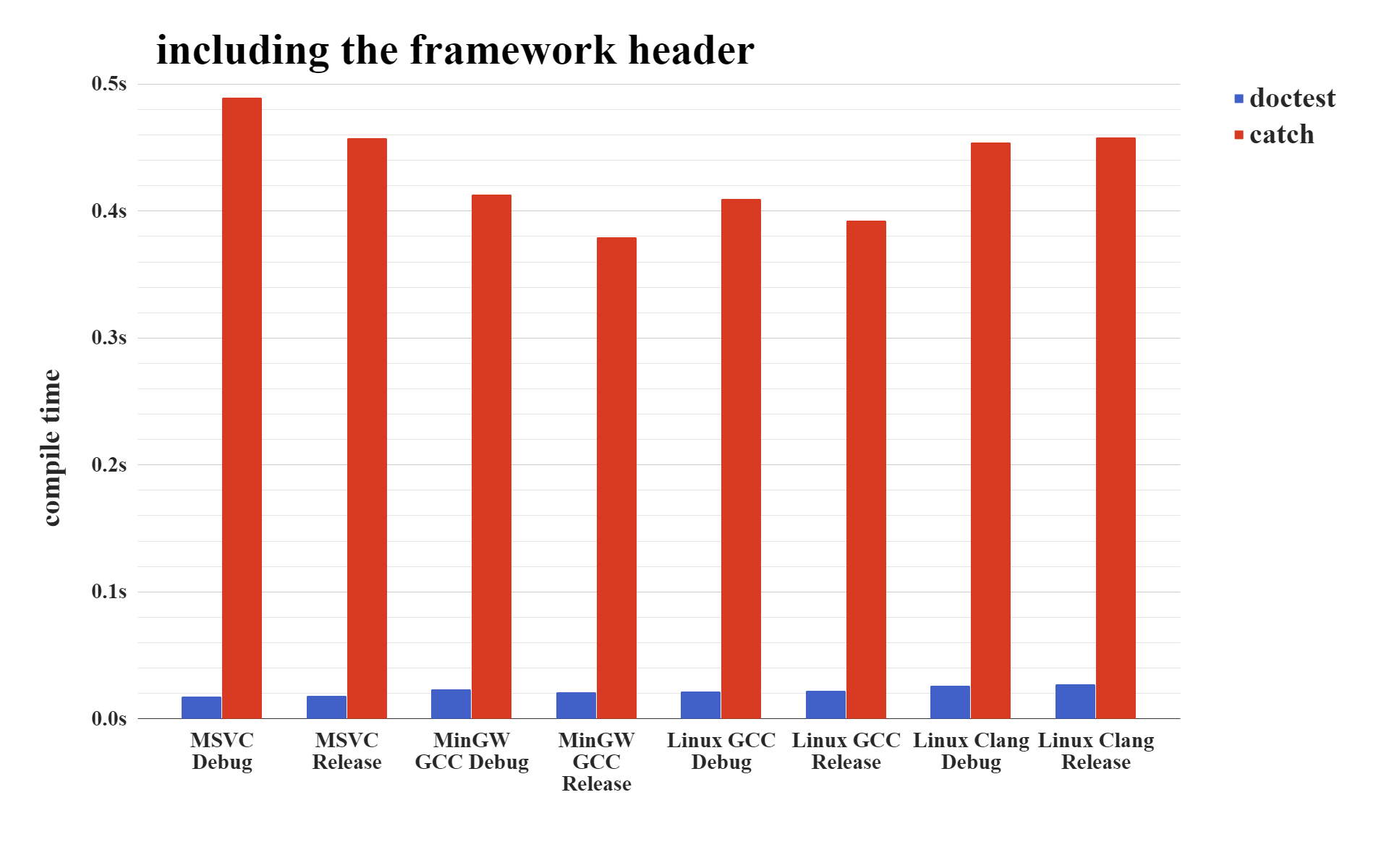
Compile times - header cost
The doctest header is less than 1200 lines of code after the MSVC preprocessor (whitespace removed)
compared to 41k for Catch - 1.4 MB (Catch2 is 36k - 1.3 MB)
This is because doctest doesn't include anything in its forward declaration part.
The idea is not to bash Catch - it's an amazing project that continues to evolve and deserves its reputation.
Using Boost.Test in its single header form is A LOT slower...
Forward declaring std::ostream
namespace std // forbidden by the standard but works like a charm
{
    template <class charT>                struct char_traits;
    template <>                           struct char_traits<char>;
    template <class charT, class traits>   class basic_ostream;
    typedef basic_ostream<char, char_traits<char> > ostream;
}
This is how the doctest header doesn't need to include headers for std::nullptr_t or std::ostream.
Just including the header with MSVC leads to 9k lines of code after the preprocessor - 450kb...
Boost.DI does the same - forward declares stuff from std and doesn't include anything
Compile times - implementation cost

Compile times - assert macros
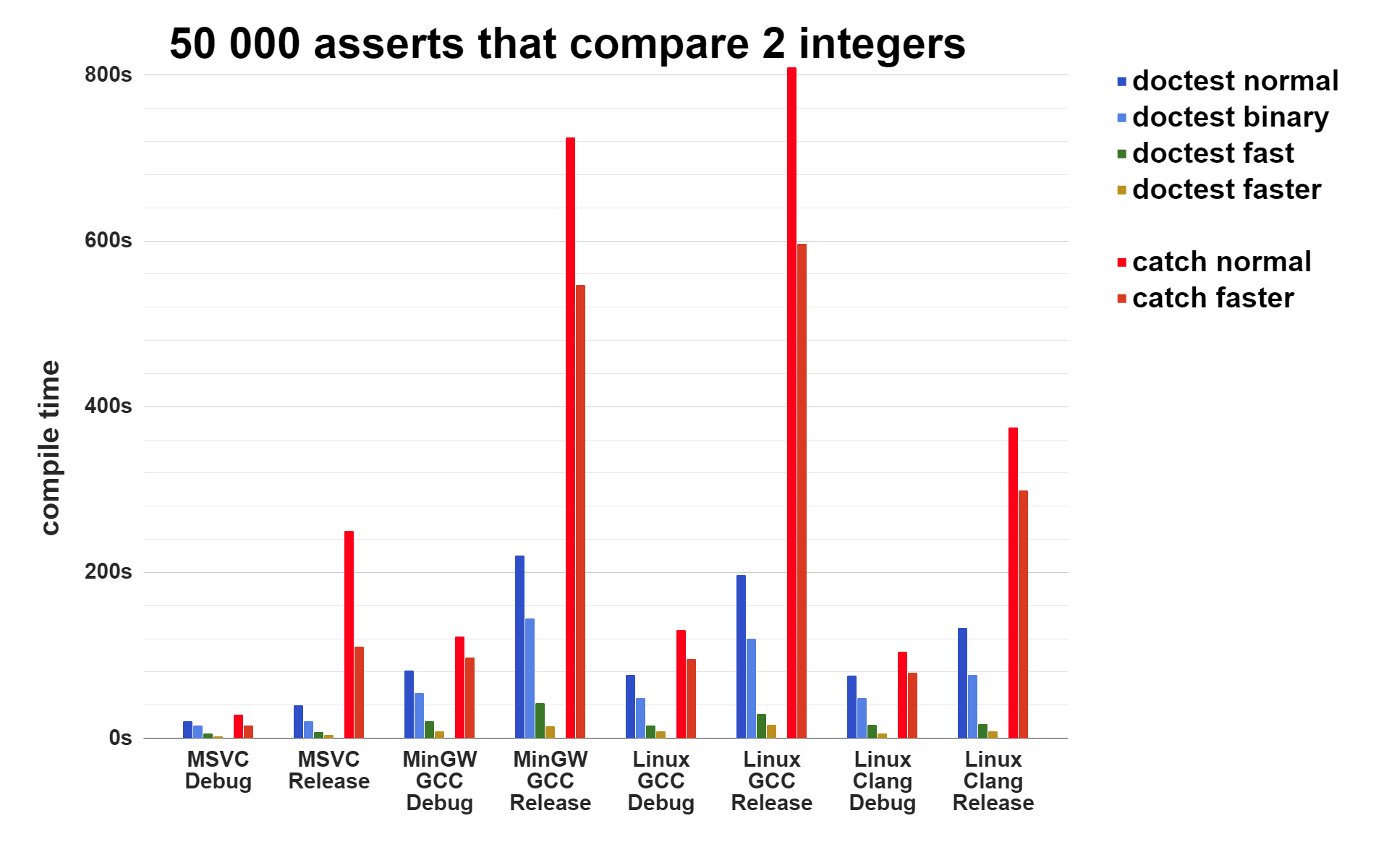
500 test cases with 100 asserts in each - 50k CHECK(a==b)
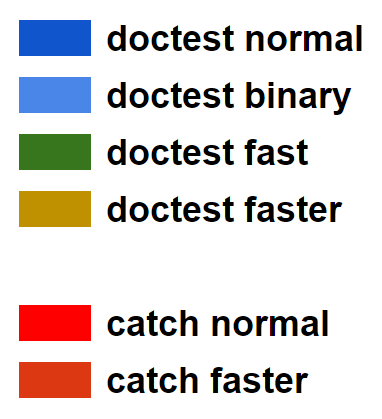
CHECK_EQ(a, b); // no expression decompositionFAST_CHECK_EQ(a, b); // not evaluated in a try {} blockFAST_CHECK_EQ(a, b); // DOCTEST_CONFIG_SUPER_FAST_ASSERTSCHECK(a == b); // CATCH_CONFIG_FAST_COMPILECompile times - assert macros
doctest 1.0 - CHECK(a == b);
do {
    Result res;
    bool threw = false;
    try {
        res = ExpressionDecomposer() << a == b;
    } catch(...) { threw = true; }
    if(res || GCS()->success) {
        do {
            if(!GCS()->hasLoggedCurrentTestStart) {
                logTestStart(GCS()->currentTest->m_name,
                             GCS()->currentTest->m_file,
                             GCS()->currentTest->m_line);
                GCS()->hasLoggedCurrentTestStart = true;
            }
        } while(false);
        logAssert(res.m_passed, res.m_decomposition.c_str(),
                  threw, "a == b", "CHECK", "a.cpp", 76);
    }
    GCS()->numAssertionsForCurrentTestcase++;
    if(res) {
        addFailedAssert("CHECK");
        BREAK_INTO_DEBUGGER();
    }
} while(doctest::always_false());
doctest 1.1 asserts
// CHECK(a == b)               << THIS EXPANDS TO:
do {
    ResultBuilder rb("CHECK", "a.cpp", 76, "a == b");
    try {
        rb.setResult(ExpressionDecomposer() << a == b);
    } catch(...) { rb.exceptionOccurred(); }
    if(rb.log()) BREAK_INTO_DEBUGGER();
} while((void)0, 0)
// FAST_CHECK_EQ(a, b) << THIS EXPANDS TO:
do {
int res = fast_binary_assert<equality>("FAST_CHECK_EQ", "a.cpp",
76, "a", "b", a, b);
if(res) BREAK_INTO_DEBUGGER();
} while((void)0, 0)// FAST_CHECK_EQ(a, b) with #define DOCTEST_CONFIG_SUPER_FAST_ASSERTS
fast_binary_assert<equality>("FAST_CHECK_EQ", "a.cpp", 76, "a", "b", a, b);Compile times - assert macros
The benchmarks were done on 2017.09.10 with versions:
- doctest: 1.2.2 (released on 2017.09.05)
- Catch: 2.0.0-develop.3 (released on 2017.08.30)
50 000 asserts spread in 500 test cases compile for:
- normal: 20-220 secs (roughly 30-75% faster than Catch)
- fastest: 3-16 secs 10-15 times faster than the normal
Runtime performance

for(int i = 0; i < 10000000; ++i)
    CHECK(i == i);
Runtime performance
doctest 1.2 is more than 30 times faster than doctest 1.1
(talking only about the common case where all tests pass)
- constructs strings only if asserts fail (big gains)
- small string optimization for doctest::String (huge gains)
- move semantics (doesn't matter if nothing fails though...)
- not accessing local statics on the hot path (<1% gain)
CppCon 2016: Nicholas Ormrod “The strange details of std::string at Facebook"
When developing end products (not libraries for developers):
- just mix code and tests
- supply your own main() with DOCTEST_CONFIG_IMPLEMENT
- build the final release version with DOCTEST_CONFIG_DISABLE
**OR ship the tests in the binary:
- disabled by default by setting the no-run option to true
#define DOCTEST_CONFIG_IMPLEMENT
#include <doctest.h>

// later in main()
context.setOption("no-run", true); // don't run by default
context.applyCommandLine(argc, argv); // parse command line
Tests in header-only libraries
add a tag in your test case names if shipping a library
// fact.h

#pragma once
inline int fact(int n) {
    return n <= 1 ? n : fact(n - 1) * n;
}

#ifdef FACT_WITH_TESTS
#ifndef DOCTEST_LIBRARY_INCLUDED
#include <doctest.h>
#endif // DOCTEST_LIBRARY_INCLUDED

TEST_CASE("[fact] testing fact") {
    CHECK(fact(0) == 1);
    CHECK(fact(1) == 1);
}
#endif
// fact_usage.cpp
#include "fact.h"// fact_tests.cpp
//#define DOCTEST_CONFIG_IMPLEMENT
#define FACT_WITH_TESTS
#include "fact.h"// fact_tests.cpp
//#define DOCTEST_CONFIG_IMPLEMENT
#include <doctest/doctest.h>
#define FACT_WITH_TESTS
#include "fact.h"--test-case-exclude=*[fact]*Tests in compiled libraries
Many binaries (shared objects and executables) can share the same test runner - a single test case registry
#define DOCTEST_CONFIG_IMPLEMENTATION_IN_DLL
Getting the most out of the framework
// doctest_proxy.h - use this header instead of doctest.h

#define DOCTEST_CONFIG_NO_SHORT_MACRO_NAMES // prefixed macros
#define DOCTEST_CONFIG_SUPER_FAST_ASSERTS   // speed junkies
#include <doctest.h>

#define test_case       DOCTEST_TEST_CASE
#define subcase         DOCTEST_SUBCASE
#define test_suite      DOCTEST_TEST_SUITE
#define check_throws    DOCTEST_CHECK_THROWS
#define check_throws_as DOCTEST_CHECK_THROWS_AS
#define check_nothrow   DOCTEST_CHECK_NOTHROW

#define check_eq        DOCTEST_FAST_CHECK_EQ
#define check_ne        DOCTEST_FAST_CHECK_NE
#define check_gt        DOCTEST_FAST_CHECK_GT
#define check_lt        DOCTEST_FAST_CHECK_LT
#define check           DOCTEST_FAST_CHECK_UNARY
#define check_not       DOCTEST_FAST_CHECK_UNARY_FALSE
Where most of the effort went
- Familiarizing myself with testing and other frameworks
- Not dragging any headers
- The 300+ different CI builds (and the .travis.yml file...)
- The usual suspects (problematic warnings):
- -Winline - especially with gcc 4.7
- -Wstrict-overflow (level 5 - without real file/line in release)
- -Weffc++
- Took me 3-4 days to track down and workaround a valgrind error - only with g++4.8 in Release
- My first unique compiler bug report in GCC (sanitizer related)
- Hit MANY other toolchain problems
Roadmap
- reporters - xml, xUnit, compact and user defined
- logging levels
- test execution in separate processes - UNIX fork()
- death tests
- symbolizer for stack traces
- generators for data-driven testing
- matchers
- more command line options
- IDE integration (VS (MSTest), XCode...)
- thread safe assertions / subcases / logging
- spreading the word about doctest - marketing
- and many many other small things!
History of doctest
- August 2014 - initial concept
- 01.01.2016 - development accelerated
- 22.05.2016 - released 1.0 - focus on compile time of the header
- 21.09.2016 - released 1.1 - compile time of asserts, bug fixes
- 16 .05.2017 - released 1.2 - features and runtime performance
Such results would not have been possible without starting from scratch.
A "modest" goal for doctest - make it the de-facto standard for unit testing in C++ (almost as a language feature).
A bit late to the party...