Taipei Times (original) (raw)
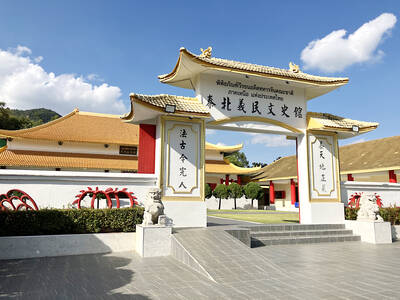
A battle for historical memory in Thailand’s “Little Taiwan”
Among Thailand’s Chinese Nationalist Party (KMT) villages, a certain rivalry exists between Arunothai, the largest of these villages, and Mae Salong, which is currently the most prosperous. Historically, the rivalry stems from a split in KMT military factions in the early 1960s, which divided command and opium territories after Chiang Kai-shek (蔣介石) cut off open support in 1961 due to international pressure (see part two, “The KMT opium lords of the Golden Triangle,” on May 20). But today this rivalry manifests as a different kind of split, with Arunothai leading a pro-China faction and Mae Salong staunchly aligned to Taiwan. Last spring at Arunothai’s Jiaolian School, principal Wang Mingming (王明明) had forewarned me of the division between villages, saying, “We are not like the people in Mae Salong. They are rich. Because of the Taiwanese.” Arunothai has in recent years become split in its loyalties between Taiwan and China (see part one, “A tale of two schools,” on May 15), but in Mae Salong, links to Taiwan remain strong. Taiwan-funded monuments pay homage to the Lost Army, villagers wear T-shirts emblazoned with the Republic of China (ROC) flag and tea plantations grown Taiwan’s most famous tea varieties, including Dong Ding (“frozen peak”) Oolong, Oriental Beauty and Jin Xuan (Golden Daylily or Milk Oolong). Even the numerical classifications of the teas — Oolong No. 12 or No. 17, for example — are the same, and the shops resemble those found on Alishan. At the tomb of General Tuan Hsi-wen (段希文) — perched on a Mae Salong hilltop with a view of his ancestral homeland in China’s Yunnan province — a third generation villager wearing a vintage KMT army uniform, Yan Si-Chung (岩思中), greets visitors with sharp military salutes. “Both my father and my grandfather were soldiers in the KMT army,” the 44-year-old