King David in Art (original) (raw)
The story of King David is recounted in 1 Samuel 16-31 and 2 Samuel 1-24.
PORTRAITS
King David's attributes are a harp and whatever signifies royalty at the time of the painting. For most of the high middle ages the latter will be a crown, usually pictured as a low and spiky diadem as in the first image at right. The choice of a mere diadem rather than a more elaborate crown is probably due to the Latin of 2 Samuel 1:10, where an Amalekite takes the diadema from the dead Saul and passes it on David as Saul's successor.
Before the medieval period David's kingship is expressed not by a crown but by such signifiers as an imperial arch (example) or his sitting on a throne (as in the second picture at right, which bears a strong resemblance to[this 2nd/3rd century image](Edited in 2013/Italy/davidHarpSarcophagus.html) on a probably non-Christian sarcophagus).
As for the harp, David uses it to comfort King Saul in I Samuel 16:14-23 and to accompany the ark on its way to Jerusalem in II Samuel 6:5. Scripture credits David as the author of many of the individual Psalms, and in the Middle Ages it was believed that he had composed all of them. The harp is often pictured as the kind of lyre seen in the second picture at right. Sometimes it can be a "psaltery," a box with strings over a sound hole as in the first picture at right orthis Renaissance example.
Instead of a harp, [this Romanesque ivory](Edited in 2013/2013 trip/davidDictateIvory.html) asserts his authorship by placing him on a throne dictating to four scribes, and [this 18th-century portrait](Europe 2017/Seville/davidVenerables.html) places a quotation from the Psalms on his shield.
King David is often seen in Orthodox images of the Anastasis (example) and, less often, in western "Harrowing of Hell" images ([example](Europe 2017/Oviedo/midRightCapital.rightFace.html)).
Many passages from the Psalms have been taken to be David's prophesying events of the New Testament. Thus, for example, he may sometimes figure among the prophets believed to have foretold the Annunciation ([example](Europe 2017/Salamanca/catherineDoorBello.prophets.html)) or the Crucifixion (example). In the great mosaic of the Virgin and Prophets along the south wall of the nave at St. Mark's, Venice (14th century), he holds a scroll that reads de fructu ventris tui ponam super sedem tuam (Vulgate Psalm 131:11b), "of the fruit of thy womb I will set upon thy throne." In this context the quotation refers both to David as ancestor of Jesus and to the words in the "Ave Maria" prayer: "blessed is the fruit of thy womb, Jesus."
Many of the psalms were believed to be spoken in the person of Christ. Thus, for example, this illumination for Psalm 68 pairs David with a crowned griffin symbolizing Christ.
NARRATIVE IMAGES
David and Goliath
In 1 Samuel 17:4-48 a huge Philistine named Goliath challenges the Israelites to send a champion against him. The young shepherd David meets him at the stream between the two camps, without armor and carrying only a staff, a sling, and a sack with five stones. He slays Goliath with the first shot from his sling and uses the man's sword to cut off his head.
David's victory is commemorated in some of the earliest Christian images. In them he holds a long, baglike sling in his right hand. He wears a cape over the simple tunic of a shepherd, in contrast with the heavily armed Goliath. The silver plate shown below adds a scene at the top where David answers Goliath's taunts by pointing heavenward to God his protector. Another scene at the bottom pictures the decapitation.
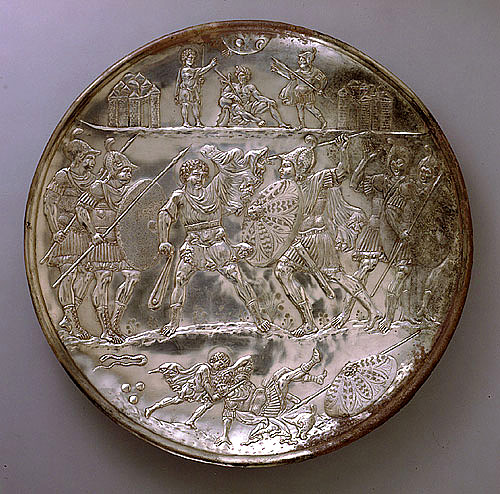
Silver plate from Constantinople, 7th century. See the description page for further details.
Another early example is this wall painting in the Catacombs of Domatilla, simpler than the silver plate and somewhat obscured by time, but with the same type of sling, the same simple tunic with a (much simpler) cape, and possibly also the stream and the decapitated head.
The baptistery at Dura-Europos had what may be the earliest known image of David's victory. Although it is now very faint and difficult to make out, it pictures the same type of sling and the same short tunic as the other examples. It was painted about the year 250 just above what appears to have been the platform where initiates were anointed. Peppard (46-85) posits its appropriateness to a Christian initiation rite on the basis of a number of texts in early Syrian Christianity. Some analogize the soldier's task to that of the Christian confronting evil. Others speak of the initiate's anointment as one with the anointments of David and Jesus. His point is well taken, although clearly initiation was not the only context in which this iconography was considered appropriate.
Other Narrative Images
Through the years many other episodes in David's life have been illustrated in various genres. A few examples are listed at right.
Prepared in 2014 by Richard Stracke, Emeritus Professor of English, Augusta University.
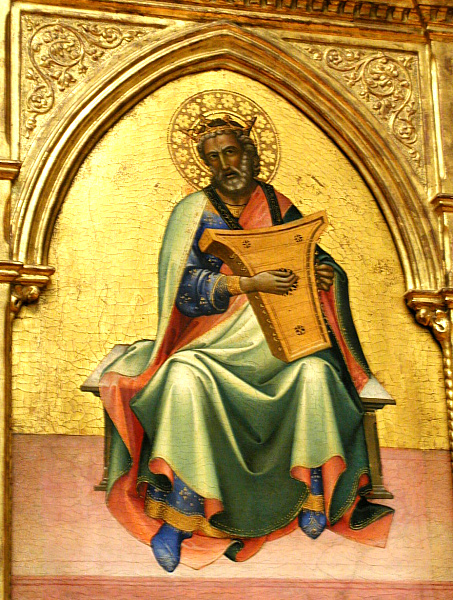
Lorenzo Monaco, David, circa 1408/1410 (See the description page)
[  ](Wikimedia Commons/davidVespasian.html)
Anglo-Saxon manuscript illustration, 8th century (See the [description page](Wikimedia Commons/davidVespasian.html))
ATTRIBUTES
- Harp in various shapes
- Diadem or small crown
MORE PORTRAITS
- Early 14th century: [King David's portrait](Florence/Santa Maria Novella/bardiSaintStrips.html) is included with Aretino's panels of New Testament saints in Santa Maria Novella, Florence.
- 1475: The [David panel](Venice 2021/Frari/screenMauroceno.david.html) in the rood screen at Santa Maria Gloriosa dei Frari, Venice.
NARRATIVE IMAGES
- David and Goliath (1 Samuel 17:1-54):
- [Sculpture, 19th century](Milan/Milan Duomo/davidGoliathDuomoMilan.html)
- Six silver plates from the 7th century follow the story from beginning to end.
- The calling of David to kingship (1 Samuel 16:1-13):
- Abigail intercedes with David for her husband Nabal (I Samuel 25):
- [Painting, 18th century](Venice 2021/Ca Rezzonico/abigailNabalBattaglioli.html)
- David is Anointed King (2 Samuel 5:1-4 and 2:4):
- David's Sin and Repentance: (2 Samuel 11:1-5, 12:1-15; Vulgate Psalm 50:1-21):
- David Sends for Bathsheba
- [Portrait of Uriah](Venice 2018/santaMariaMiracoli/uriahPennacchi.html), killed at David's behest
- David's Prayer of Repentance
- Entry Into Jerusalem with the Ark (2 Samuel 6:1-5)
- Mosaic (?) in Santa Maria Maggiore, Rome.
PORTRAIT IMAGES
- Second half of the 13th century: This manuscript illumination puts David (with a harp) beside a Nativity scene and another prophet below it.
- Late 15th / Early 16th century: [Ceiling panel](Venice 2018/santaMariaMiracoli/davidPennacchi.html) in Santa Maria dei Miracoli, Venice.
- Date unknown: [Statue](Europe 2017/Seville/davidSevilleCathedral.html) of David standing with both crown and harp.
DATES
- King David's reign is traditionally dated as beginning in 1000 BC.
BIOGRAPHY