Enigma (original) (raw)
The Enigma was one of the best of the new electromechanical cipher machines produced for the commercial market in the 1920s. Hugo Koch, a Dutchman, conceived of the machine in 1919. Arthur Scherbius first produced it commercially in 1923. Impressed by its security, which was based on statistical analysis, the German government acquired all rights to the machine and adapted it to the needs of its new, modern military forces. It became the standard cipher machine of the military services, of German agents, and of the secret police. It was also used at all echelons from high command to front-line tactical units including individual airplanes, tanks, and ships. An ordinary three-wheel Enigma with reflector and six plug connections generated the following number of theoreticalcoding combinations:
3,283,883,513,796,974,198,700,882,069,882,752,878,379,955,261,095,623,685,444,055,315,226,006,
433,616,627,409,666,933,182,371,154,802,769,920,000, 000,000
That is roughly the same as 3.283 x 10114 .
Given this statistical capability, proper communications procedures and practices, and the fact that solving the Enigma on a timely basis would require rapid analytic machinery which did not exist, the Germans regarded the Enigma as impenetrable even if captured. The Germans, however, did not always practice proper communications security, and, more importantly, the Allies, even in 1938-39, were on the verge of creating the necessary cryptanalytic machinery which would unlock the Enigma's secrets. The evolution of this technology and its application were major contributing factors to the ultimate Allied victory in World War II.
 |
|---|
| Nigel West, an leading author specializing in security and intelligence issues, is also an Enigma collector and has this Wehrmacht three rotor Enigma in his collection. He would be pleased to supply other Enigma photographs to anyone who needs them. E-mail: nigel(at)westintel.co.uk_(Photo courtesy of Craig Longhurst)_ |
 |
|---|
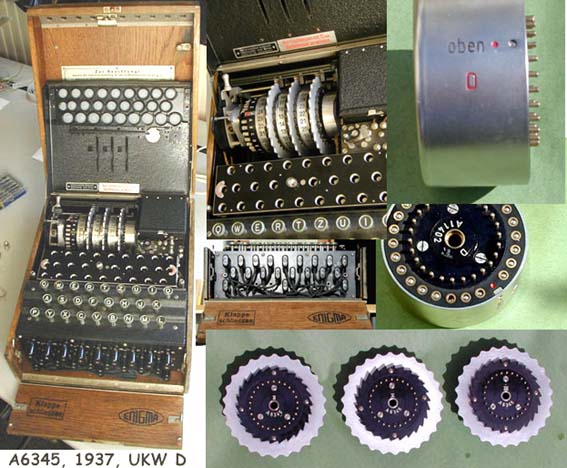
| Here is a fine example of a pre-WWII built Luftwaffe Enigma machine (serial A6345 dated 1937) with the added benefit of three high-quality, matched, rotors and the Umkehrwalze D option. The German designation is Chiffriermaschine Gesellschaft and it was made by Heimsoeth und Rinke of Berlin. (Photo courtesy John Alexander, G7GCK Leicester, England. |
The machine above carries serial number A6345 with matching serial numbers on all the rotors. Option Umkehrwalze (UKW) D is the unusual and rare part. Germany began to introduce the UKW D to make the Enigma even more complex and secure in 1944. A full description of the UKW D, by Philip Marks, can be found in CRYPTOLOGIA Vol XXV # 2 (Apr �01), Vol XXV # 3 (Jul �01) and Vol XXV # 4 (Oct �01) .
The importance of this UKW type is that it is re-wireable. Removing the outer case (a tight fit) reveals moveable plugs and their sockets. The UKW was introduced to the Luftwaffe and caused Bletchley Park some concern. There is a special Enigma at BP even now - one specifically modified to tackle UKW D. Fortunately, German operators in the field did not like the hassle involved in using this additional part so its use never became popular. See Museum Info section)
Enigma/NEMA type light bulbs (3.5v) can be found with 250, 300, 350 and 400 mA ratings. Most seem to be 300 or 350 mA.
 |
|---|
| A three rotor pre-war Enigma machine in operation. The man using the machine is a Waffen-SS NCO. An Enigma weighs around 30 pounds without the carrying case and 35 pounds with carrying case. (Photo courtesy of Synder's Treasures, Bowie, Maryland). |
 |
|---|
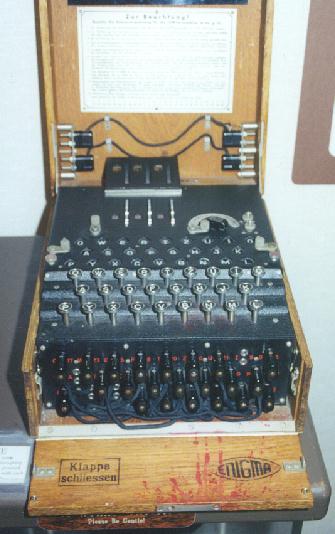
| This is no ordinary Enigma - this one's special because it is out in the open at the National Cryptologic Museum. Visitors can actually cipher and decipher messages and watch the machine in operation. A sign below the unit says "Please Be Gentle". (Photo by Jerry Proc) |