Basics: Tamagoyaki or Atsuyaki Tamago, Japanese sweet omelette (original) (raw)
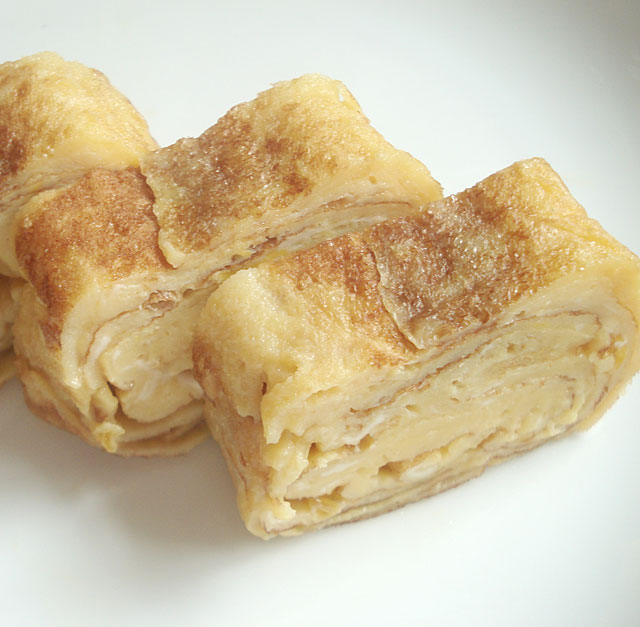
Tamagoyaki is such a integral part of Japanese food that I am rather kicking myself for not having posted a recipe for it before here. The name tamagoyaki means "fried egg", and the alternate name, atsuyaki tamago, means "thick fried egg". (Some books or restaurants erroneously called it just tamago, which just means "egg".) A slightly sweet, moist square-shaped egg concoction, tamagoyaki is a bento box staple, as well as being a popular sushi neta (topping). It's also great as a side dish for any meal.
You don't really need a special tamagoyaki pan for making this. A regular small non-stick frying pan will do. The one advantage of having a small tamagoyaki pan like this one is that the size is good for making small, thick tamagoyaki without using extra eggs. Conversely, a big square tamagoyaki/atsuyaki tamago pan is used for making those thick tamagoyaki served at better sushi restaurants. (Cheap sushi places use manufactured tamagoyaki, which is an abomination.) However, I'm assuming most people are likely to own a small frying pan, so that's what I've used for the photos here. The one I have is an ordinary (pretty cheap) Tefal model that I got at a sale somewhere.


Once you get the hang of making the multilayers of egg, it's very easy to do. A 2-egg tamagoyaki takes less than 5 minutes to cook, and a 4-egg one just a bit more. 4 eggs is the maximum that's practical to cook in a 20cm / 8 inch standard frying pan.
I prefer my tamagoyaki to not be too sweet so there isn't much sugar in this - I've seen recipes that add up to 3 tablespoons for 4 eggs. You can add more or less to your taste.
Tamagoyaki or Atsuyaki tamago
Halve the quantities for a 2-egg tamagoyaki
- 4 'large' eggs
- 1 Tbs. sugar
- 1 tsp. mirin
- 1/4 tsp. salt
- 1/2 tsp. light soy sauce (usukuchi shoyu); you can use regular soy sauce instead
- Oil for cooking
Equipment:
- 20cm / 8 inch (small) non-stick frying pan
- A heat resistant brush OR a wad of cotton wool or kitchen paper, for spreading the oil
- 1 or 2 forks, or 1 fork and a pair of chopsticks - or if you are skillful one pair of chopsticks
- Sushi rolling mat
- Optional: a fine-meshed sieve
Heat up the pan on medium-low heat. Make ready a small bowl of oil, and the brush or wad of cotton wool or kitchen paper.
Beat all the ingredients together with a fork or chopsticks. Don't use a whisk since you don't want it to get foamy.
Optionally, strain the egg mixture through a sieve to even it out. (I usually don't bother with this step but it does make for a finer and more even egg mix.)
 Brush the heated pan with a little oil. Put in about 2 to 3 tablespoons worth of egg mixture in the pan. Cook gently (lower the heat if necessary) until it's not quite set on top, but not runny. Roll it up with a fork or chopsticks to one side of the pan.
 Brush the exposed part of the pan with a little oil.
 Put another couple of tablespoons of egg mixture in the pan. Spread it around, lifting the cooked egg so that the uncooked egg flows below it.
 Cook until this layer is almost set, then roll the whole egg to the opposite side of where it is.
 Brush the pan again with oil. Add another couple of tablespoons of egg mixture in the pan, and spread around the pan and under the cooked egg.
 Keep repeating this procedure until the egg mixture is used up.
 Put the tamagoyaki on a moistened sushi rolling mat, seam side down.
 Roll it up tightly. If you are eating this right away you can take it out and serve immediately, but if you're making this for an (o)bento, leave the whole roll in the mat over a raised rim plate or bowl until it's cooled to room temperature. This allows air to pass under and over it, cooling it faster.
 And here is the finished tamagoyaki. Slice with a sharp knife and enjoy. (If you just want even pieces, just leave off the ends. These usually end up in my mouth right there.)
A 2-egg omelette is just thinner, making smaller bits, but is just as good. You will only probably need 3 layers of egg for 2 eggs, so it goes quickly. The picture here shows some slices of 2-egg tamagoyaki to the left, and 4 egg tamagoyaki to the right.

Notes
If you really want a purely yellow tamagoyaki, cook it over low heat and use light soy sauce. Using light soy sauce makes your omelette slightly lighter in color, if you want to avoid any browning. But I usually just use regular soy sauce since browning doesn't bother me. Keep in mind that light soy sauce is not lower in salt content, just lighter in color. (It's different from low-salt soy sauce.)
Vary the flavor and look by adding finely chopped green onion or garlic chives, or small bits of nori seaweed. To achieve a black-and-yellow spiral effect, put torn pieces of nori over each almost-set egg layer before rolling.
If your tamagoyaki seems a bit too runny, you can firm it up by nuking it in the microwave for about a minute. Don't over-nuke or you'll end up with a firm rubbery thing.
The ideal accompiment when serving piping hot tamagoyaki is some grated daikon radish, with a tiny bit of soy sauce.
A variant of tamagoyaki is dashimaki tamago, where some dashi stock is added to the egg mixture. This makes for very thin layers, and thus requires some patience.
See also
A simplified 1-egg tamagoyaki, a single portion that's perfect for a bento box.