All About Snails for kids and teachers (original) (raw)
Snails can be found in gardens, in ponds and even in the sea. They belong to a group of animals with a soft body called molluscs (mollusks) which are related to oysters, clams, and other shellfish. Characteristically they have soft, unsegmented bodies. Normally, their soft bodies are protected by a hard shell. The scientific name for the garden snail is Helix aspersa. It is a gastropod which in latin means, gastro for stomach and pod for foot or just "a belly footed animal". The body of the snail is long, moist and slimy. It has a shell to protect its soft body. When the snail is disturbed, it simply withdraws or pulls itself back into its shell. The snail also retreats into its shell and seals the entrance in dry weather to protect its body from drying up. A snail is most active at night and on cloudy days. It does not like the sunshine very much. During very cold weather or winter, it hibernates in the ground.

Snails have different shaped shells. It can be a single shell that is rounded, spiral high and pointed or it can be flat.
Some people keep snails in aquariums together with their fish. However, they must make sure that they control the number because snails reproduce rapidly !!
Snails do not like hot and dry conditions. They like it moist or humid and not too bright. You can collect some snails and put them into a transparent container. Put some leaves in it, keep it moist and you can observe and see how a snail moves and also its mouth part.
Snails can live up to 5 to 10 years. Some have been known to live up to 15 years.
Life History of the snail
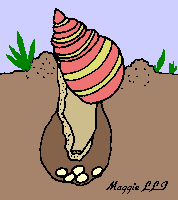 Snails spend many hours courting before they mate. They twist themselves around each other and cover themselves in frothy slime. After mating, each snail will go search for a soft ground to dig and lay its eggs. The snail lay its eggs in a nest, 2.5 to 4 cm deep in the soil. Each snail can lay an average of 85 eggs and they hatch in 2 to 4 weeks, depending on the temperature and moisture of the soil. The eggs are concealed with a mixture of soil and mucus. They are then covered with excrement. Low temperatures of less than 12C and low humidity inhibits laying eggs. Snails lay eggs most often during the warm and damp weather. It can be as often as once a month or every 6 weeks. Their most active months are from February to October.
The first thing that a newly hatched snail does is to find food. It will eat whatever that is left of its eggshell too. It will also eat any eggs that have not hatched yet. As the snail grows, its shell grows too in a spiral shape. The new shell is added at the opening of the shell. The part of the shell the baby snail was born with, ends up in the middle of the spiral.
The snails have enemies too
Snails have many natural enemies. They are the ground beetles, snakes, toads, turtles, and birds including chickens, ducks and geese.
How does the pond snail reproduce?
The pond snail reproduces just like the garden snail. It is a hermaphrodite. The only difference is that, unlike the garden snail, the pond snail carries its fertilized eggs with it. The baby snail will only leave its mother when it is hatched.
How to collect pond snails?
First of all, you will need a spade, fishing net, a container (to put your snails in). Make sure your container is not air tight so that the snails can breathe. You can do this by making tiny holes on the lid. You need a lid to cover your container because snails can crawl on any texture or surface. Choose a damp spot near the pond and then use your spade to loosen the ground and you will find many snails just beneath the surface.
| Snail Related Activities | |
|---|---|
| Storytime | Stories, Poems and Songs |
| Cliparts | Original cliparts of snails |
| Teachers | Lesson Plans and other resources |
| Art & Craft | Art & Craft activities relating to snails |
| Worksheets | Worksheets and Coloring Activities |
| SNAIL FACTS | More snail facts |
| FUN STUFF | Mancala Snails This is the famous Mancala Snails game based on an ancient African game of strategy. Your goal is to collect more snails than your opponent. |
IMPORTANT : COPYRIGHT : Please do not use any of the graphics here for your homepage. They are my own drawings unless otherwise stated. If you wish to have frog cliparts for your homepage, please get it from our clipart page. However, they are not for your homepage clipart collection. I would also like to give credit to Phillip Martin for using some of his cliparts.
DISCLAIMER : This is a disclaimer. We try to gather information that are as accurate as possible. However, if there are mistakes, we will not be held liable for anything. Use it at your own discretion.
IMPORTANT : We are not responsible for any links beyond our site.