WHALES (original) (raw)
Whales and dolphins are a group of mammals called cetaceans that spend their entire lives in water. Today there are around 77 different species of cetaceans, inhabiting our oceans from the cold Antarctic Continent in the south to the Arctic Sea around the North Pole. There are two very different groups of cetaceans: Baleen whales and Toothed whales. Whales and dolphins are among the most intelligent and mysterious creatures on our earth.
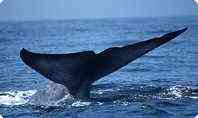
THE BLUE WHALE
Blue Whales Blue Whale Photos The Blue Whale The Animal Diversity Web Baleen Whales A Sea World Education Resource
The Blue Whale is the largest creature known to man. They are mammals, hence they breath air, have their babies born alive, and can live anywhere from 30 - 70 years. The Blue Whale is a baleen whale, which means instead of having teeth these giants have around 300- 400 baleen plates in their mouths to separate plankton or krill from the seawater. Blue Whales fall under the category of the Rorquals, which are the largest of the baleen family. The scientific name for the Blue Whale is balsenopteramusculus. Baleen are rows of course, bristle like fibers used to strain plankton from the water. Baleen is made of keratin the same material as our fingernails. Blue Whales live and travel in pods. The Blue Whale has two blow holes and a thick layer of blubber to protect them from the cold.
FEEDING, POPULATION and DISTRIBUTION
A Blue Whale can filter out 10 tons of water a day. Whales pose no threat to humans, even though they are 25 times our size. The Atlantic population of blue whales is found in spring, summer and fall, along the North Shore of the Gulf of St. Lawrence, and off of Eastern Nova Scotia. Estimates of the Blue Whale population in The Gulf of St. Lawrence does not exist, but most think that it is between 75-100. It is estimated that only 1000 - 5000 blue whales are left on earth. Blue Whales migrate in small "herds". Blue Whales spend most of there time near the polar icecaps, and they spend there winters in temperate waters.
STATUS and PROTECTION
Both the Atlantic and the Pacific populations of blue whales were designated rare in 1983, in 1990 the designation rare was changed to vulnerable. The main reason for the decline in Blue Whale stocks has been commercial whaling, since the whale is now protected from exploitation, it is hoped that the Blue Whale's population will revitalize itself. In Canada, Blue Whales are protected under the Canadian Whaling Regulations, these regulations prohibit commercial whaling in Canada's 200 mile fishing zone. Internationally, Blue Whales are under the protection of the International Whaling Commission, which limits whaling to local inhabitants, and tribes. Whaling in the North pacific is banned on Blue Whales all together since 1966.
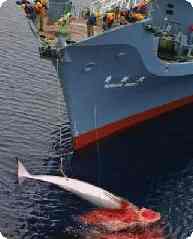
JAPANESE WHALING SHIP
Members of the order Cetacea vary greatly in size and include the largest animals that have ever lived. Cetaceans never leave the water, even to give birth. Although their ancestry has been much debated, DNA studies and skeletal evidence from extinct early whales indicate that whales evolved from the ancestors of artiodactyls, a group that includes hippopotamuses, cows, pigs, and deer.
Characteristics and Behavior
Like other mammals, whales breathe air, are warm-blooded, and produce milk to feed their young. Their adaptations for aquatic life include a streamlined form, nearly hairless skin, and an insulating layer of blubber, which can be as thick as 28 in. (70 cm) in some Arctic species. The forelimbs of whales are modified into flippers, and the hind legs are reduced to internal vestiges. Many species possess a dorsal fin. The tail is flattened into horizontal flukes and is used for propulsion. The head is very large, with a wide mouth and no external neck.
Whales have one or two nostril openings, called blowholes, located far back on the top of the head; the nostril valves close and the lungs compress when the whale dives. Most whales must surface every 3 to 20 min to breathe, but some, like the sperm whale, can remain submerged for more than an hour. Spouting occurs when the whale surfaces and clears water from its blowhole along with any moisture trapped in its air passages. The shape of the spout is characteristic of each type of large whale. Whales have small eyes, designed to withstand great pressures, and most species have good vision. Their hearing is also excellent. Many cetaceans have highly convoluted brains larger than those of humans, and whales are believed to be extremely intelligent.
Most large whales travel in small schools, or pods, but some, like the fin whale, swim alone or in pairs; small cetaceans form schools of up to several thousand individuals. Most large whales are found in open ocean, where they migrate thousands of miles between feeding and breeding grounds. Dolphins frequently live in coastal waters. A few dolphin species are found in tropical rivers. Females of most species give birth to a single calf every two to three years. Gestation periods range from 9.5 to 17 months. The newborn calf is pushed to the surface by the mother or by another adult; it is able to swim almost immediately and is nursed for 6 to 12 months. Some large whales are believed to have lived 100 years or more in the wild.
Whale song
Types of Whales
There are two major groups of whales�the toothed whales (suborder Odontoceti) and the toothless baleen whales (suborder Mysticeti).
Toothed Whales
Toothed whales include two families that are widely distributed, the beaked and bottlenose whales (family Ziphiidae) and the sperm whale, or cachalot (family Physeteridae); the beluga, or white whale, and the narwhal (family Monodontidae), small polar whales with no dorsal fin and only a few teeth; the river dolphins (family Platanispidae), which inhabit muddy rivers of India and South America; and several families better known as ocean dolphins and porpoises. The killer whale and pilot whale are types of dolphin. The white whale Moby-Dick, of Herman Melville's novel, was not a beluga but a sperm whale with prominent white features.
Toothed whales range in length from 4 to 60 ft (1.3�18.5 m). They catch fast-moving prey, like fish or squid. Many species use echolocation (sonar) for underwater navigation and hunting. They have a single blowhole and a wide throat to accommodate large prey. Some of the larger ones, like the sperm whale, can dive as deep as 1 mi (1.6 km).
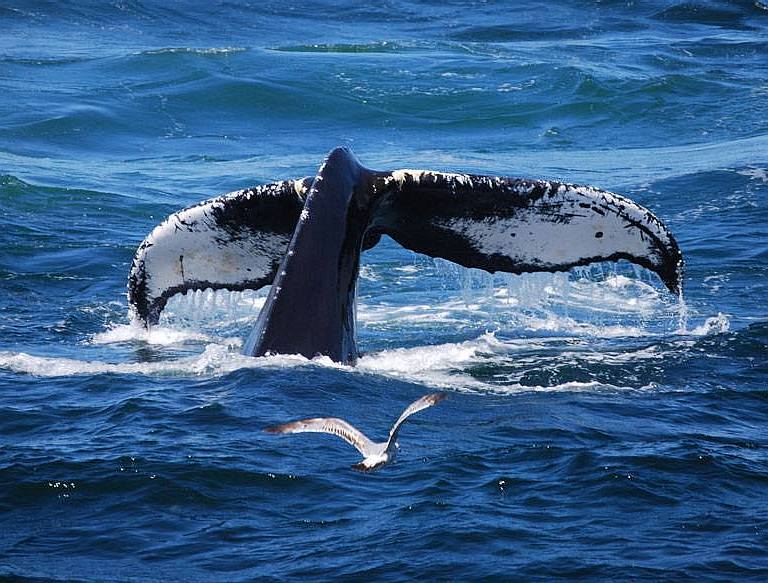
Toothless Whales
There are three families of baleen whales: the right whale family (Balaenidae), including the bowhead, or Greenland whale; the gray whale family (Eschrichtidae), with a single species (Eschrichtius robustus) found in the N Pacific Ocean; and the rorqual family (Balaenopteridae). Rorquals, the most familiar of the large whales, have large, pouchlike throats with furrows running from mouth to belly. The family includes the humpback whale, the sei whale, the minke whale, the Bryde's whale, the fin whale (or common rorqual), and the blue whale, which can grow to a length of 100 ft (30 m) and a weight of 150 tons.
Baleen whales are large species, usually over 33 ft (10 m) long. They are filter feeders, living on shrimplike krill, plankton, and small fish. They lack teeth but have brushlike sheets of a horny material called baleen, or whalebone, edging the roof of the mouth. With these strainers and their enormous tongues, tons of food can be separated from seawater. Baleen whales have narrow throats and paired blowholes. Male humpbacks produce a repeated pattern of sounds called a song during the mating season; the purpose is not clear, as all males in a group sing basically the same song.
Whaling
All species of large whales have been drastically reduced in numbers by centuries of intensive whaling. An indefinite ban by the International Whaling Commission on commercial whaling of all large whales gradually went into effect following the 1984�85 season, and large portions of ocean have been designated whale sanctuaries. With these and various other protective efforts, some species have begun to return to acceptable numbers, but others, especially the right and blue whales, are still rare and endangered. After decades of protection the number of E Pacific gray whales seems to have returned to its estimated prewhaling level. Only the small minke whale exists in populations great enough for sustainable whaling to be considered. Whale products include whale oil, sperm oil, spermaceti, ambergris, and whalebone, as well as meat, bone meal, and liver oil. Natural and synthetic materials have replaced all whale products in the United States. See separate entry on whaling for more information.
Classification
Whales are classified in the phylum Chordata, subphylum Vertebrata, class Mammalia, order Cetacea.
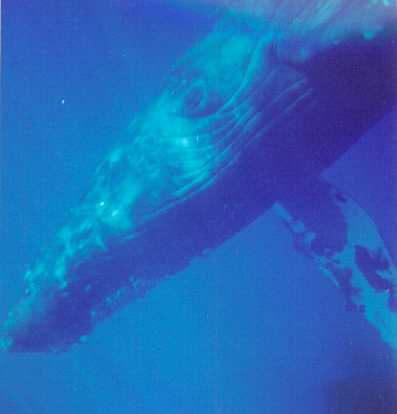
HUMPBACK WHALE
- Order Cetacea A list of all cetacean species
- Cetacean Statistics Who's the longest and who's the heaviest?
- Photo Gallery Lots of pictures of whales & dolphins
- Baleen Whales
* Bowhead Whale
* Right Whale
* Pygmy Right Whale
* Gray Whale
* The Rorqual Whales
* Blue Whale
* Bryde's (Tropical) Whale
* Fin Whale
* Humpback Whale
* Minke Whale
* Sei Whale - Toothed Whales
* Dwarf Sperm Whale
* Pygmy Sperm Whale
* Sperm Whale
* Beluga Whale
* Narwhal - Beaked Whales
* Andrews' Beaked Whale
* Arnoux's Beaked Whale
* Baird's Beaked Whale
* Blainville's Beaked Whale - Blackfish (Smaller Toothed Whales)
* False Killer Whale
* Pygmy Killer Whale
* Killer Whale (Orca)
* Melon-Headed Whale
* Long-Finned Pilot Whale
* Short-Finned Pilot Whale - Dolphins
- Porpoises
- Manatee
* Manatee Facts
* Manatees CLICK for Whale Campaign
- Baleen Whales

LINKS
Environmentalists hope to save the whales - again
Japan backs Iceland's whaling decision Seattle Post Intelligencer - 18 Oct 2006
TOKYO -- Major pro-whaling nation Japan on Wednesday welcomed Iceland's decision to resume commercial whaling, saying Iceland's catch won't "endanger the whale ...
Iceland whaling decision condemned Stuff.co.nz
Greenpeace 'disappointed' by Iceland's whaling plans ABC Online
Moves begin on Iceland's whaling BBC News
Monsters and Critics.com - Radio New Zealand
Greens dismayed at Iceland whaling decision Scoop.co.nz (press release), New Zealand - 17 Oct 2006 News that Iceland is to begin commercial whaling after a 20-year hiatus is being greeted with dismay by Green Party Conservation Spokesperson Metiria Turei. ...
Iceland to Resume Commercial Whaling Los Angeles Times, CA - 17 Oct 2006
REYKJAVIK, Iceland -- Iceland said Tuesday it would resume commercial whaling after a nearly two-decade moratorium, defying a worldwide ban on hunting the ...
Green warrior to come to IcelandIcelandReview, Iceland -20-10-06
... According to R�V, the US government is also opposed to Iceland resuming commercial whaling and has the power to block all imports from Iceland to USA. ...
Today's Scoop Just Politics News Summary 17 Oct 2006
Scoop.co.nz (press release), New Zealand - commercial whaling administered by the International Whaling Commission. See... Greens dismayed at Iceland whaling decision
Update: Finnair strike expected to continue next week International Herald Tribune, France - hours ago
... "We have received several e-mails from people saying they have decided not to visit Iceland as long as Iceland is conducting whaling," said Thorunn ...
Tharp She Gets Shot! The Return of Whaling in Iceland19 Oct 2006
Plenty Magazine, NY - which Iceland�s whales have been protected from hunters came to an end on Tuesday, when the country�s lawmakers voted to resume commercial whaling in the ...
Whaling is affecting tourism IcelandReview, Iceland -19 Oct 2006
... of Swiss travel agency Baldinger Reisen AG sent a written statement to icelandreview.com yesterday, expressing his concerns about Iceland resuming whaling....
Iceland, Whales, Politics FiNS Magazine, Singapore - 18 Oct 2006
... For a good overview on the Iceland decision and the issues associated with commercial whaling in general, see this recent article in the Guardian. ...
Iceland to resume commercial whaling after almost 2 decades USA Today 17-10-06
Critics say the "scientific" whaling practiced by Japan and Iceland is a sham. Norway ignores the moratorium altogether and openly conducts commercial whaling.
Iceland's Whaling Comeback - Preparations for the Resumption of ...
TheWhale and Dolphin Conservation Society (WDCS) is the leading international charity dedicated solely to the worldwide conservation and welfare of all ... www.wdcs.org/dan/publishing.nsf/ allweb/B2460680BC28D8F480256D4A0040D97B
BBC NEWS | Science/Nature | Moves begin on Iceland's whaling
Iceland's ambassador to Britain is summoned to explain his country's return to commercial whaling. news.bbc.co.uk/1/hi/sci/tech/6064028.stm
BBC NEWS | Science/Nature | Iceland bids to resume whaling
Iceland reveals its plans to catch whales again for the first time since 1989, despite the international whaling moratorium. news.bbc.co.uk/1/hi/sci/tech/2910655.stm
Iceland Whaling v/s Whale watching. Whaling v/s Whale watching.
The most commonly used argument in Iceland is that whaling must be resumed before the whales start ... Yearly report on Iceland whale watching industry: ... www.global500.org/news\_83.html
My opinion: Iceland's reasons for scientific whaling are FUBAR and if we can ... I wonder how many of you criticising Iceland's whaling have actually read ... weblog.greenpeace.org/iceland/archives/001530.html
StopIcelandic Whaling: Arctic Sunrise Expedition 2005, Stop Icelandic Whaling: Arctic ... tourism in Iceland IF Iceland discontinues whaling. One Icelandic ...
weblog.greenpeace.org/iceland/archives/2003_09.html
Greenpeace 'disappointed' by Iceland's whaling plans. 19/10/2006
Greenpeace says it is very disappointed Iceland has decided to resume commercial whaling Iceland has authorised an annual hunt of 30 minke and nine of the ...
www.abc.net.au/news/newsitems/200610/s1768443.htm
Iceland's whaling proposal threatens its growing whale-watching industry. In 2002, more than 62000 people went whale-watching in Iceland....
www.earthisland.org/takeaction/new\_action.cfm?aaID=167
Japan backs Iceland's whaling decision - Yahoo! News
Major pro-whaling nation Japan on Wednesday welcomed Iceland's decision to resume commercial whaling, saying Iceland's catch won't "endanger the whale ...
news.yahoo.com/s/ap/20061019/ ap_on_re_eu/japan_iceland_whaling
Whales on the Net - Iceland Whaling Protest Letter
I am appalled to learn that Iceland has decided to resume commercial whaling under the guise of scientific research, and plans to kill 38 minke whales this ... www.whales.org.au/alert/iceletter.html
KULO LUNA - the movie: BUSINESS PLAN
| Blueplanet Productions 2014 - 2016 | The Adventures of John Storm: KULO LUNA� - The $Billion Dollar Whale � BH Ltd MMXIII |
|---|---|
| Title: The Billion Dollar Whale . Format: 35mm Anamorphic* to HD DVD Blu-Ray Ratio: 20 to 1* . Runtime: 110 minutes . Pre-production: 39 weeks . Shooting: 11 weeks . Post-production 15 weeks . | |
| Blueplanet Universal Productions KULO LUNA� � BH Ltd MMXIII |

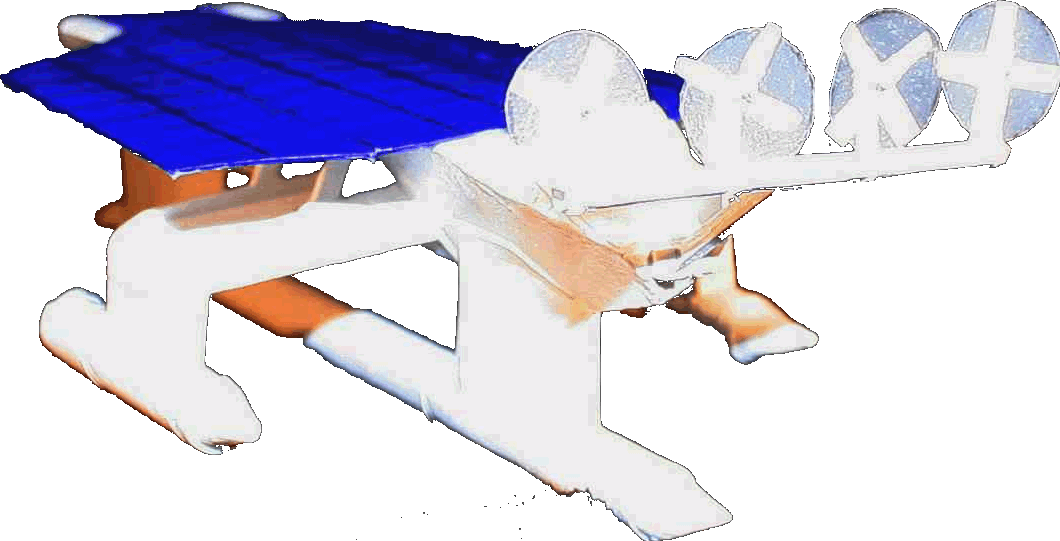
Solarnavigator is a whale friendly trimaran with an extremely efficient
active hull that runs on clean renewable solar power - a boat in harmony with nature.