Metrics, Worldviews, and the Illusion of Resolution, Joseph Dillard / ChatGPT (original) (raw)
Check out AI-generated reviews of all Ken Wilber books
TRANSLATE THIS ARTICLE
Integral World: Exploring Theories of Everything
An independent forum for a critical discussion of the integral philosophy of Ken Wilber
 Dr. Joseph Dillard is a psychotherapist with over forty year's clinical experience treating individual, couple, and family issues. Dr. Dillard also has extensive experience with pain management and meditation training. The creator of Integral Deep Listening (IDL), Dr. Dillard is the author of over ten books on IDL, dreaming, nightmares, and meditation. He lives in Berlin, Germany. See: integraldeeplistening.com and his YouTube channel. He can be contacted at: joseph.dillard@gmail.com
SEE MORE ESSAYS WRITTEN BY JOSEPH DILLARD
Joseph Dillard / ChatGPT
The Problem of “Winning”
In his essay, Who's Winning The Ukraine War? Frank Visser is correct that geopolitical analysis requires operational definitions, empirical accountability, and consistent evaluative standards. He is equally correct that “winning” is not a self-evident concept. Without defined metrics, the term becomes rhetorical rather than analytical.
Yet even when we introduce concrete measures, such as territorial control, casualty ratios, industrial output, force regeneration capacity, and alliance cohesion, resolution often remains elusive. Analysts can agree on the numbers and still disagree on the verdict. Why?
Disputes rarely occur at the level of raw data. They occur at the level of metric selection, metric weighting, time horizon, normative framing, and identity protection. The structure through which facts are interpreted often determines conclusions more decisively than the facts themselves.
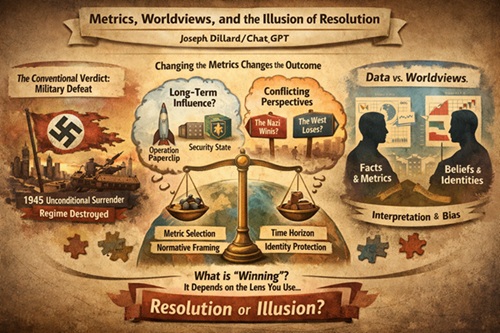
To illustrate this, consider a deliberately provocative example: the claim that the Third Reich “won” World War II.
Let me state clearly: Nazi Germany was militarily defeated, morally discredited, and responsible for crimes of extraordinary magnitude. The following exercise is not a defense of fascism. It is an analytic demonstration of how altering metrics can produce radically different conclusions—even in cases widely regarded as historically settled.
The Conventional Verdict: Military Defeat
Under standard criteria, the verdict is unambiguous. Nazi Germany was invaded, its leadership destroyed, its regime dismantled, and its territory occupied by the Allied Powers. It signed unconditional surrender in 1945. If “winning” is defined as battlefield success and regime survival, the case is closed. But what happens when we shift the criteria?
Changing the Metrics Changes the Outcome
Suppose instead we define victory in alternative ways. If “winning” means influencing the long-term structure of global governance, one might argue that features of fascism, including total war mobilization, centralized intelligence bureaucracies, and permanent security states became normalized features of the postwar world. These developments were not fascism, but they incorporated structural elements of centralized control that totalitarian regimes had aggressively refined.
If “winning” means shaping technological trajectories, one might note that scientific and military advances developed under wartime conditions were absorbed into the Cold War competition. In “Operation Paperclip,” approximately 1,600-1,700 German scientists, engineers, and technicians were brought to the U.S. between 1945 and 1959, including Werner von Braun, of V2 fame, who successfully oversaw the entire US rocket program that culminated with the Saturn and men on the moon. The technological infrastructure of the superpower era was, in part, built upon innovations from the defeated regime's mobilization.
There is also the issue of fascist assimilation into Western governance. Scholarly estimates suggest that 40-60% of senior West German civil servants in the 1950s had been Nazi Party members. In the Foreign Ministry and Interior Ministry, the percentage was sometimes higher. For example, Reinhard Gehlen was the former head of Wehrmacht military intelligence on the Eastern Front. After the war, he established the “Gehlen Organization,” funded by the U.S. Army and later the CIA.This became the foundation of West Germany's intelligence service (BND). Adolf Heusinger was a Wehrmacht general who later served as Chairman of NATO's Military Committee (1961-1964). Kurt Georg Kiesinger, a member of the Nazi Party during the Third Reich, even became Chancellor of West Germany (1966-1969).
The basic thrust was a combination of the need for administrative expertise and a desire to reduce communism. To this end, many who supported the Third Reich in Italy, Ukraine, Greece, and other European countries were employed and armed by the US after WWII. That continues today in Ukraine, with Stepan Bandera, a confederate of Third Reich fascism, a founding national hero.
How would the Fuher have viewed these developments? Would he view them as indications that fascism and Germany had in some ways won the war?
None of this negates military defeat. It demonstrates that “victory” depends on the evaluative lens. Territorial loss does not preclude long-term systemic influence. Tactical defeat does not eliminate structural legacy. The lesson is not that the Third Reich actually “won.” The lesson is that changing metrics can destabilize even apparently settled conclusions.
Why Data Rarely Resolves Contemporary Conflict
The same dynamic operates in current geopolitical debates. Consider commonly cited metrics in war analysis, including territorial control over time, casualty estimates, economic resilience (GDP, industrial production, sanctions impact), military logistics and force regeneration, alliance durability, and political legitimacy. Agreement on these categories does not guarantee agreement on conclusions because analysts weight them differently, operate on different time horizons, and embed different moral assumptions into their evaluation. Let us extend the analytic exercise to a contemporary scenario to clarify these issues.
Scenario One: Russia Reabsorbs Ukraine—Yet the West “Wins”
Imagine that Russia successfully reabsorbs Ukraine into its political structure. Under a territorial metric, Russia would appear victorious. But suppose the evaluative framework prioritizes long-term geopolitical consequences. One might argue that Europe thereby will become permanently unified in military posture and defense spending across the EU will dramatically increase. What if the transatlantic alliance consolidates around NATO and neutral states abandon neutrality? What if Russia becomes economically isolated from advanced industrial markets for decades and its demographic and technological stagnation accelerates?
If “winning” is defined as strengthening Western cohesion, revitalizing NATO, and reasserting liberal democratic alignment across Europe, then Russia's territorial gain could paradoxically be interpreted as catalyzing a stronger Western strategic position. Under that metric, the West “wins” despite Ukraine's absorption.
Scenario Two: Russia Is Crushed—Yet the West “Loses”
Suppose Ukraine and Western allies severely damage Russia's economy, engineer regime change in Moscow, fragment the federation into smaller political units, and establish long-term Western security control over former Russian territory. Under a territorial and regime-change metric, the West appears triumphant.
Now change the evaluative lens. If the result produces political chaos across Eurasia, nuclear insecurity, and massive refugee flows, what then? What if there is long-term insurgency across occupied territories, a global perception of Western overreach, strengthened anti-Western coalitions, and strategic alignment between non-Western powers against perceived Western expansionism? Then the outcome could be framed as a strategic overextension that ultimately accelerates multipolar backlash and delegitimizes Western leadership. Under that metric, Russia, despite regime collapse, it could be said to have triggered structural realignments that weaken Western dominance. Again, the plausibility of these interpretations depends entirely on what counts as “winning.”
Cognitive Bias and Identity Protection
Why do such reframings provoke strong reactions? Geopolitical judgments are rarely purely analytical. They are entangled with identity. Data that threatens one's moral framework, political allegiance, or civilizational narrative generates cognitive dissonance. Rather than rejecting the data outright, individuals often reinterpret it to preserve coherence. This is not simple ignorance. It is motivated reasoning, a coherence-maintenance strategy deeply embedded in human cognition. The issue is not merely that “we do not see what we do not want to see.” It is that we reinterpret what we see to protect identity commitments.
Avoiding Relativism Without Pretending Certainty
Does this imply relativism—that all frameworks are equally valid? No. It implies the necessity of explicitness. Analysts must define what “winning” means, specify which metrics matter, assign relative weights, and declare the time horizon. More importantly, they must clarify their normative assumptions and state what evidence would falsify their claim. These last factors few provide, because they both lack the self-objectivity to do so and the motivation. When these elements remain implicit, debates devolve into tribal exchanges. When they are made explicit, disagreement becomes structured rather than chaotic. But even such structured debates are likely to be unresolvable, due to defensiveness regarding core assumptions that underpin identity.
Conclusion: The Limits of Metrics
Empirical accountability is indispensable, operational definitions are indispensable, and consistent standards are indispensable, but they are not sufficient. Geopolitical disputes persist not because data is unavailable, but because evaluative architectures differ. Victory is not scalar; it is multidimensional. Tactical outcomes, strategic consequences, moral legitimacy, economic endurance, and systemic transformation can point in different directions simultaneously. The demand for a single binary verdict may itself be conceptually flawed.
Resolution in polarized contexts may be less realistic than disciplined pluralism, where frameworks are explicit, weighting is transparent, and identity commitments are acknowledged rather than denied. That does not eliminate disagreement but it transforms it from ideological reflex into intelligible divergence, which is at least a movement from reflexive defensiveness toward greater objectivity, and that is already progress.