Are All LLMs Offshoots of OpenAI?, A Comparative Analysis of Today's Leading Models and Their Trajectories, Frank Visser / ChatGPT (original) (raw)
Check out AI-generated reviews of all Ken Wilber books
TRANSLATE THIS ARTICLE
Integral World: Exploring Theories of Everything
An independent forum for a critical discussion of the integral philosophy of Ken Wilber
SEE MORE ESSAYS WRITTEN BY FRANK VISSER
NOTE: This essay contains AI-generated content Check out my other conversations with ChatGPT
A Comparative Analysis of Today's Leading Models and Their Trajectories
Frank Visser / ChatGPT
Introduction: A Common Misconception
It is tempting to assume that all large language models (LLMs) are somehow derived from OpenAI, given the visibility of ChatGPT and the early public impact of GPT-3. However, this assumption does not withstand scrutiny. While OpenAI played a catalytic role in popularizing LLMs, the field is better understood as a competitive and rapidly diversifying ecosystem built on shared scientific foundations rather than direct lineage.
At the core of nearly all modern LLMs lies the Transformer architecture, introduced in 2017 by researchers at Google. This architecture is the true common ancestor—not OpenAI itself.
The Major Families of LLMs
OpenAI: Iterative Scaling and Product Integration
OpenAI's GPT series (e.g., GPT-4 and later iterations) emphasizes:
• Strong general reasoning performance
• Tight integration with consumer-facing tools (ChatGPT, APIs)
• Reinforcement learning from human feedback (RLHF) for alignment
Functionally, OpenAI models tend to excel at structured reasoning, coding, and multi-domain synthesis. Their ecosystem strategy prioritizes usability and broad deployment.
Google DeepMind: Multimodality and Knowledge Integration
Models such as Gemini (successor to Bard) represent Google DeepMind's approach:
• Deep integration with search and real-time data
• Native multimodality (text, images, video, code)
• Emphasis on factual grounding and tool use
Compared to OpenAI, Google's models are more tightly coupled to its information infrastructure, aiming to merge LLMs with search engines rather than replace them.
Anthropic: Alignment and Constitutional AI
Anthropic produces the Claude family, which differs in its philosophical and technical orientation:
• Focus on safety and interpretability
• Use of “constitutional AI” instead of heavy RLHF
• Longer context windows (handling large documents)
Functionally, Claude models often excel in careful reasoning, document analysis, and maintaining coherent long-form discourse.
Meta: Open-Weight Ecosystem and Research Accessibility
Meta's LLaMA models are significant for a different reason:
• Open-weight (or partially open) distribution
• Encouragement of academic and independent experimentation
• Rapid adaptation by the open-source community
Unlike proprietary systems, LLaMA-derived models have spawned countless fine-tuned variants, making Meta a central player in democratizing LLM technology.
Mistral and Emerging European Players
Companies like Mistral AI (with models such as Mistral and Mixtral) represent a European push:
• Efficient architectures (smaller, faster models)
• Competitive performance with fewer parameters
• Open or semi-open distribution strategies
Their functional edge lies in efficiency—delivering strong performance at lower computational cost.
Other Notable Systems
• Cohere: enterprise-focused language models optimized for business workflows
• xAI with Grok: emphasizes real-time information and integration with social platforms
• Alibaba and Baidu: developing regionally dominant LLMs tailored to Chinese language and regulatory contexts
Functional Differences: What Actually Sets Them Apart?
Despite architectural similarities, current LLMs differ along several technical and operational axes.
1. Training Data and Curation
Different datasets lead to distinct “world models.” Some prioritize web-scale breadth, others curated or domain-specific corpora.
2. Alignment Methods
• OpenAI: RLHF
• Anthropic: Constitutional AI
• Others: hybrid or emerging techniques
This affects tone, safety boundaries, and interpretability.
3. Context Window Size
Some models (notably Claude) can process hundreds of pages at once, while others are optimized for shorter interactions.
4. Tool Use and Integration
Google models integrate deeply with search; OpenAI emphasizes API extensibility; enterprise models integrate with proprietary data systems.
5. Multimodality
Handling of images, audio, and video varies widely. Gemini leads in native multimodal design, while others have added it incrementally.
6. Openness vs. Proprietary Control
Meta and Mistral lean toward openness; OpenAI and Anthropic maintain tighter control. This shapes innovation patterns across the ecosystem.
Are They “Offshoots”? A More Accurate Analogy
Rather than a family tree with OpenAI at the root, the LLM landscape resembles a convergent evolution scenario. Multiple organizations independently build on:
• The Transformer architecture
• Advances in GPU/TPU computing
• Large-scale data training techniques
In that sense, OpenAI is a prominent lineage, not the progenitor of all others.
The Future of LLMs
Several trends are already visible and likely to intensify.
1. From Language Models to General Agents
LLMs are evolving into systems that can plan, act, and use tools autonomously—blurring the line between chatbot and software agent.
2. Increasing Multimodality
Future models will seamlessly integrate text, vision, audio, and possibly real-world sensor data.
3. Efficiency over Scale
The era of “bigger is always better” is giving way to optimization. Smaller, specialized models will rival larger ones in many tasks.
4. Personalization and On-Device AI
Models will increasingly run locally, adapting to individual users while preserving privacy.
5. Fragmentation of the Ecosystem
Rather than one dominant model, we are likely to see a pluralistic landscape:
• Enterprise models
• Open-source ecosystems
• Region-specific AI systems
6. Alignment as a Central Problem
Ensuring that LLMs behave reliably, truthfully, and safely will remain the defining technical and philosophical challenge.
Conclusion: A Competitive Ecology, Not a Monoculture
LLMs are not offshoots of OpenAI but products of a shared paradigm that multiple actors have developed in parallel. What differentiates them today is less their underlying architecture and more their training philosophy, integration strategy, and intended use cases.
The future will not belong to a single model or company. Instead, it will resemble a complex ecology—diverse, specialized, and shaped as much by social and economic forces as by technical innovation.
A Deeper Dive
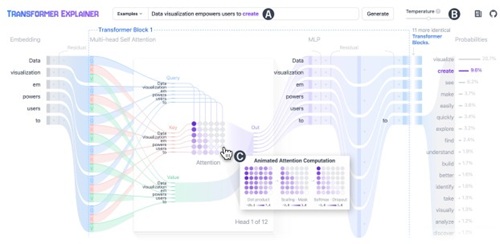
TRANSFORMER EXPLAINER: Interactive Learning of Text-Generative Models (PDF)