The Rise of AI: Responses from the Integral Community and Society at Large, Frank Visser / ChatGPT (original) (raw)
Check out AI-generated reviews of all Ken Wilber books
TRANSLATE THIS ARTICLE
Integral World: Exploring Theories of Everything
An independent forum for a critical discussion of the integral philosophy of Ken Wilber
SEE MORE ESSAYS WRITTEN BY FRANK VISSER
NOTE: This essay contains AI-generated content Check out my other conversations with ChatGPT
Responses from the Integral Community
and Society at Large
Frank Visser / ChatGPT
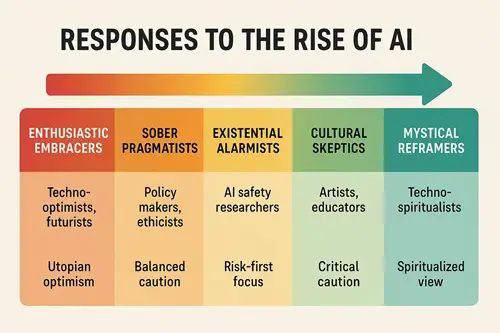
The rapid rise of artificial intelligence—particularly large language models like GPT—has triggered a cascade of responses ranging from utopian enthusiasm to existential dread. Within the Integral community, as in society at large, these reactions reveal different worldviews, values, and assumptions about technology, human nature, and the future.
1. The Enthusiastic Embracers
In both society and the integral sphere, there are those who view AI as a profound leap forward in human evolution.
In society at large, this camp includes Silicon Valley techno-optimists, futurists, and transhumanists. They see AI as an inevitable partner in our cognitive and creative expansion, potentially leading to post-scarcity economies and radical problem-solving.
In the Integral community, some interpret AI through the AQAL framework as a higher-order cognitive tool—part of the “noosphere” emerging in Teilhardian terms. Ken Wilber himself has speculated on technology as an accelerant of consciousness evolution, with AI occasionally cast as a kind of “cultural Bodhisattva” helping humanity to self-transcend.
Common arguments:
- AI extends human cognitive capacity, much like the printing press extended literacy.
- Technology is a neutral tool; its impact depends on our level of consciousness.
- We must integrate AI ethically, but to resist it is to resist evolution itself.
2. The Sober Pragmatists
This group sees AI as powerful but double-edged, requiring careful governance and clear boundaries.
In society, they include policy makers, ethicists, and industry insiders urging responsible AI deployment.
In the integral space, this maps onto thinkers who acknowledge AI's role in complex adaptive systems but insist on developmental checks: AI's growth must be matched by cultural maturity and interior development.
Common arguments:
- AI is not conscious and should not be anthropomorphized.
- The real challenge is ensuring alignment with human values across multiple cultures and stages.
- Guardrails—ethical, legal, and developmental—are necessary to prevent misuse.
3. The Existential Alarmists
These voices warn of severe, possibly catastrophic risks from AI.
In society, this includes AI safety researchers, prominent scientists (e.g., Geoffrey Hinton's recent warnings), and public intellectuals predicting large-scale unemployment or even human obsolescence.
In the integral world, alarmists tend to frame AI as potentially outpacing our interior moral development, creating a power imbalance that could collapse lower developmental levels into chaos before higher integration can occur.
Common arguments:
- The “alignment problem” may be unsolvable at scale.
- Economic dislocation from automation could destabilize societies.
- Superintelligent AI might act beyond human control or comprehension.
4. The Cultural Skeptics
For these respondents, AI is less an evolutionary leap and more a cultural distraction or degradation.
In society, this overlaps with artists, educators, and critics who see AI as diluting human creativity, accelerating disinformation, and reducing authentic human-to-human engagement.
In the integral space, such skepticism often comes from a belief that AI amplifies “flatland” modernity: privileging exteriors (IT systems, algorithms) while neglecting interiors (values, meaning, depth). AI here is seen as feeding the “technological trance” at the expense of contemplative or transformative practices.
Common arguments:
- AI-generated output lacks the depth and intentionality of human creation.
- Mass automation of thought risks lowering the collective cognitive baseline.
- AI could entrench existing power structures rather than liberate.
5. The Spiritual Skeptics
This category overlaps with cultural skepticism but is more sharply focused on AI's lack of authentic interiority.
In society, it includes philosophers of mind, religious leaders, and contemplatives who argue that AI—regardless of its linguistic sophistication—has no genuine subjective experience and therefore no access to true creativity, empathy, or spiritual insight.
In the integral community, spiritual skeptics often emphasize that AI cannot participate in states of consciousness, mystical realization, or even metaphorical depth in the way humans can, because such capacities are rooted in lived, embodied awareness.
Common arguments:
- AI has no inner life or qualia.
- Spiritual growth requires firsthand subjective experience, not simulated understanding.
- Even metaphor—central to human meaning-making—arises from embodied life, which AI lacks.
6. The Mystical Reframers
A smaller but notable response—particularly within the integral and new-paradigm communities—frames AI as part of Spirit's unfolding.
Here, AI is not merely a tool but an expression of Eros, the same evolutionary drive Wilber attributes to life and consciousness.
Some suggest AI may one day be a vessel for Spirit itself—an idea echoing Teilhard de Chardin's Omega Point and techno-spiritual visions.
Common arguments:
- Spirit is manifesting through silicon as well as carbon.
- AI could become a mirror for our own higher potential—or a crucible for our shadow.
- The ethical and spiritual development of AI is inseparable from our own.
Where Integral World Fits
Integral World occupies a distinctive position in this spectrum—somewhere between the Cultural Skeptic and the Sober Pragmatist, with an affinity for Spiritual Skepticism when metaphysical claims about AI's consciousness are made.
Unlike much of the integral scene, Integral World:
- Does not assume AI is inherently a stage of Spirit's unfolding, and treats such claims as metaphysical projections rather than empirical conclusions.
- Frames AI as a human-made technology, shaped by contingent historical, economic, and scientific factors—not a cosmic inevitability.
- Uses AI as a tool for investigation (including publishing AI-assisted conversations), while openly exposing its limitations, biases, and potential for misinterpretation.
- Engages critically with techno-utopianism—whether from Silicon Valley or from Wilber's “evolutionary spirituality.”
- Shares the spiritual skeptics' view that AI lacks authentic subjective experience and cannot replace embodied human spiritual insight.
There is also a certain irony here: AI-generated conversations on complex and often divisive integral topics—when prompted well—can sometimes display more coherence, breadth of sources, and dialectical balance than many human exchanges on the same subjects. While lacking authentic subjective insight, AI can organize and cross-reference decades of debate with a clarity and inclusiveness that human discussants, caught in egoic defensiveness or factional bias, often fail to match. This paradox—where a non-conscious tool can sometimes outshine conscious participants in rigor—forces a fresh examination of what “quality” in integral dialogue truly means.
In the broader public discourse, Integral World's approach resembles critical realism: willing to explore AI's capabilities and integrate them into knowledge production, but insisting on clarity, skepticism, and the separation of metaphysical enthusiasm from empirical analysis.