The Drive That Wasn't There: Ken Wilber's Science Problem and the Culture of Intellectual Apathy Around It, Frank Visser / ChatGPT (original) (raw)
Check out AI-generated reviews of all Ken Wilber books
TRANSLATE THIS ARTICLE
Integral World: Exploring Theories of Everything
An independent forum for a critical discussion of the integral philosophy of Ken Wilber
SEE MORE ESSAYS WRITTEN BY FRANK VISSER
NOTE: This essay contains AI-generated content Check out my other conversations with ChatGPT
Ken Wilber's Science Problem and the
Culture of Intellectual Apathy Around It
Frank Visser / ChatGPT
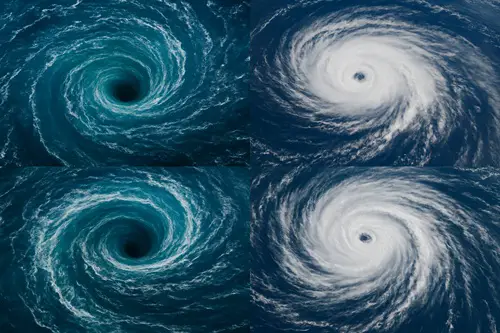
In short, within the universe itself, there has to be some sort of inherent push to greater order, some sort of probability-increasing machine, as it were. At the very least, we need something like Prigogine's intrinsic drive to produce "order out of chaos" (for example, even dead matter itself, when pushed far from equilibrium, escapes that tension by jumping to a higher level with more order, as when water chaotically splashing down the drain suddenly jumps into a perfectly formed whirlpool). This drive to create "order out of chaos," according to Prigogine's Nobel Prize-winning work, is an inherent drive of the material universe itself, which started with the Big Bang. Stuart Kauffman, of the famed Santa Fe Institute, says that complexity in the universe is "some sort of mixture of self-organization and natural selection"—with self-organization being that inherent drive to greater novelty, complexity and order...
The universe is not winding down; evolution occurs because there is a drive for the universe to wind up—that is, it's a probability-increasing machine. (Ken Wilber, Finding Radical Wholeness, 2024, p. 168-169)
Ken Wilber's recent book Finding Radical Wholeness repeats, almost verbatim, an idea he has been promoting for decades: that the universe harbors an “intrinsic drive” toward greater order, complexity, and consciousness. In doing so, he once again enlists the names of respected scientists—such as Nobel laureate Ilya Prigogine and complexity theorist Stuart Kauffman—as if they were allies in his metaphysical project. And once again, he reduces the Second Law of Thermodynamics to a straw man, implying that the universe's arrow is not toward disorder but toward “winding up.”
This is not merely a scientific error; it is an entrenched pattern of misappropriation that Frank Visser and others have been critiquing for years. What is striking is Wilber's seeming deafness to these sustained objections, and the almost total absence of critical scrutiny among his student base. It is a case study in intellectual apathy—how a community that prides itself on “integral thinking” can live comfortably with a scientifically indefensible foundation for its worldview.
The Persistence of a Misreading
Wilber's “intrinsic drive” thesis is an elegant idea—too elegant. It proposes that evolution is not merely the cumulative result of contingent, natural processes but is propelled by an inherent upward tendency baked into the fabric of the cosmos. This is attractive to those seeking a bridge between science and spirituality, but it runs afoul of two core scientific principles:
- The Second Law of Thermodynamics — In closed systems, entropy increases; the universe's overall trend is toward greater disorder. Local pockets of order (whirlpools, crystals, living organisms) are possible and common, but they occur because energy flows through the system, not because matter possesses a hidden yearning for complexity.
- Natural Selection and Self-Organization — Kauffman's self-organization and Prigogine's dissipative structures describe how local order can emerge naturally, but neither asserts an intrinsic teleological push. Complexity arises under certain conditions, but it is not inevitable, let alone universally directed toward higher consciousness.
Wilber's paraphrasing of these scientists shifts the emphasis from conditional emergence to universal purpose. This is not a minor rhetorical tweak—it changes the claim from “under certain conditions, order emerges” to “order will emerge because the universe is inherently inclined toward it.” The first is science; the second is metaphysics wearing a lab coat.
Summary of the Misrepresentation
- Shift from Conditional to Universal — Prigogine and Kauffman describe emergence of order under specific conditions, not an omnipresent cosmic push.
- Shift from Process to Purpose — Wilber recasts mechanistic tendencies as goal-directed forces.
- Shift from Local to Global — Physical processes are localized and temporary; Wilber universalizes them to the entire cosmos since the Big Bang.
- Shift in Thermodynamic Framing — The Second Law is subtly inverted to fit a spiritual narrative.
The Cosmic Drive Meets the Facts of Rarity and Contingency
If a universal drive toward complexity were truly baked into the fabric of the cosmos, one would expect life—and especially intelligent life—to be abundant and to arise quickly wherever conditions allow. But the actual story told by astronomy, planetary science, and evolutionary biology is far less obliging to such a thesis.
Within our own solar system, Earth is the only known home to life, despite several other worlds—Mars, Europa, Enceladus—that may have had (or still have) some of the ingredients necessary for biology. The sheer absence of any clear signs of life elsewhere, despite decades of increasingly sensitive observation, suggests that life is not an inevitable cosmic default but a rare product of special circumstances.
Even on Earth, the timeline offers no support for a rushing, universal drive. The planet formed about 4.5 billion years ago; the earliest evidence of life appears perhaps 3.5-3.8 billion years ago. That's fast in geological terms, but what followed was almost three billion years of microbial dominance before multicellular life emerged. Intelligent life—if we define that generously to include humans—appeared only in the last few million years, a blink of the geological eye.
These long stretches of evolutionary stasis and the late arrival of complex and cognitive forms point not to a smooth, inevitable ascent but to a process shaped by bottlenecks, accidents, and environmental contingencies. Mass extinctions, asteroid impacts, climate shifts, and genetic innovations have each redirected the trajectory of life in unpredictable ways. Remove or alter any one of these, and the outcome might have been radically different—or nonexistent.
This is why biologists and astrobiologists often emphasize contingency: the fact that complex life depends on a highly specific chain of events that may be vanishingly rare in the universe. If there is a cosmic drive, it is astonishingly patient, selective, and inefficient—so much so that it begins to look indistinguishable from no drive at all. The scientific picture instead suggests that life and complexity are emergent phenomena when, and only when, very particular conditions happen to align.
Beyond the “Intrinsic Drive”: Why Real Science is More Interesting
Ironically, removing Wilber's question-begging hypothesis of a universal drive toward complexity doesn't flatten the story of the universe—it makes it more interesting. Without the safety net of cosmic inevitability, we are left with a drama of emergence that is truly contingent, open-ended, and full of surprises.
In the actual scientific picture, complexity does not arise everywhere or always—it emerges in rare pockets where the right physical and chemical conditions happen to converge. The whirlpool, the crystal, the cell, the multicellular organism—each is the result of local processes exploiting energy flows, not the inevitable unfolding of a preordained plan. This makes them more remarkable, not less: every structure and life form we see is the outcome of improbable events piled upon improbable events, sifted by the blind but relentless filter of natural selection.
When we abandon the “intrinsic drive” story, we can appreciate just how delicately balanced the conditions for complexity really are. We gain a deeper sense of the creativity of nature—not as the execution of a cosmic blueprint, but as an endless, experimental interplay of order and disorder. The contingencies of this process mean that the actual universe is far stranger and richer than any metaphysical generalization can capture.
Seen this way, the Second Law of Thermodynamics is not a downer—it is the canvas upon which every act of local ordering is painted. Energy flow and entropy provide the constraints that make possible the improbable beauty of emergent order. The scientific account does not diminish wonder; it intensifies it. If anything “winds up” in this universe, it does so because countless local systems manage, against the grain of entropy, to carve out moments of structure before dissolving back into the thermodynamic flow.
In this sense, Wilber's downplaying of real science in favor of grand, unifying “drives” actually dilutes the drama. The reality is more precarious, more contingent, and—ironically—more spiritually humbling.
Why the Objections Don't Land
Frank Visser and other critics have spent years pointing out these misinterpretations. The arguments are clear, well-documented, and—within the scientific community—uncontroversial. So why does Wilber not engage them?
Several factors are at play:
- Immunity to Refutation — The “intrinsic drive” is framed so vaguely that it can absorb almost any counterexample. If a system breaks down into disorder, that's a local exception. If order emerges, that's the drive at work. It's unfalsifiable.
- Prestige Shielding — Wilber's longstanding reputation in the integral community grants him the benefit of the doubt. His followers often assume that he must have a sophisticated reason for his claims, even if it is not spelled out.
- Conceptual Fusion — In Wilber's thought, science, spirituality, and philosophy are integrated into a seamless whole. To admit a basic scientific error would imply cracks in the edifice, threatening the larger system.
- Asymmetric Effort — It is easier to repeat the “intrinsic drive” narrative than to unpack the technical details of thermodynamics and complex systems theory. Critics must do the heavy lifting; apologists only have to gesture toward mystery.
The Culture of Student Complacency
Wilber's readers and students are not passive victims of misunderstanding—they are co-creators of the apathy. The integral movement's emphasis on “higher ways of knowing” tends to frame scientific objections as “merely orange-level critiques,” implying that those who persist in them are stuck at a lower developmental altitude.
This developmental framing creates a self-reinforcing bubble:
- Skeptical voices are seen as immature or reductionist.
- Uncritical agreement is framed as openness to higher truth.
- Scientific dissent is reinterpreted as a lack of spiritual depth.
The result is an intellectual monoculture in which Wilber can repeat a contested claim for decades without being pressed to defend it in detail.
How to Resolve the Matter—Once and for All
The “intrinsic drive” dispute is not an eternal mystery; it is resolvable with intellectual honesty and methodological clarity. Here's how:
Demand Primary Source Accuracy
Prigogine and Kauffman's works are public. Any claim that they support an intrinsic, universal drive can be checked against their own writings. A line-by-line textual comparison would reveal the gap between their actual claims and Wilber's interpretation.
Separate Science from Metaphysics
It is entirely legitimate for Wilber to propose a metaphysical principle of Eros or Spirit as a creative force. But if this is metaphysics, it should be labeled as such—not presented as if it is an empirical finding endorsed by working scientists.
Public Dialogue with Experts
If Wilber believes his interpretation is defensible, he should be willing to engage in public dialogue with complexity scientists, thermodynamicists, and evolutionary biologists. Such dialogue would either vindicate his reading or force a revision.
Encourage Student Autonomy
Integral practitioners should be trained not only in Wilber's synthesis but in how to critically assess its components. A genuine “integral” education would model how to integrate dissenting data, not filter it out.
Acknowledge the Error
The most direct resolution is the simplest: admit the overreach. State that “intrinsic drive” is a metaphysical conviction, not a scientific consensus. This would free the claim from the burden of empirical proof and allow it to stand as a spiritual hypothesis.
| Scientist | What They Actually Say | How Wilber Paraphrases Them | Key Difference |
|---|---|---|---|
| Ilya Prigogine | Prigogine's work on dissipative structures shows that ordered patterns (e.g., convection cells, whirlpools) can emerge spontaneously in systems driven far from equilibrium by energy flows. These are local, conditional phenomena explained by nonequilibrium thermodynamics; they do not imply a universal teleology or an intrinsic cosmic drive. | Wilber presents Prigogine's findings as evidence of an inherent, universe-wide drive to create “order out of chaos,” suggesting this drive has operated since the Big Bang and underwrites increasing complexity. | Prigogine: conditional, local emergence due to energy flux. Wilber: universal, purposive drive. The move is from mechanism to metaphysical teleology. |
| Stuart Kauffman | Kauffman emphasizes that complexity can arise from a mix of self-organization and natural selection. Self-organization is a tendency of certain dynamical systems under specific constraints, not a guarantee of inevitable progress toward higher novelty or consciousness. | Wilber quotes Kauffman to support the claim that self-organization constitutes an “inherent drive to greater novelty, complexity and order,” implying a broad, directionally upward force in the cosmos. | Kauffman: conditional tendency within system dynamics. Wilber: recasts tendency as a generalized cosmic drive with teleological implications. |
| Second Law of Thermodynamics | The Second Law states that in a closed system total entropy tends to increase; local decreases (greater order) are possible but require expenditure or flow of energy. The global thermodynamic trend is toward greater disorder. | Wilber frames the universe as “not winding down” but as a “probability-increasing machine” that evolves toward higher order, effectively inverting the usual thermodynamic framing to fit a purposive narrative. | Science: net entropy increase with local exceptions. Wilber: universal “winding up” narrative that treats local order as evidence for cosmic purpose rather than energy-driven emergence. |
Conclusion
The tragedy here is not that Ken Wilber has a speculative metaphysical vision—that is the prerogative of any philosopher—but that he continues to dress it in borrowed scientific authority, despite years of well-founded objections. The deeper issue is the culture of intellectual apathy among his students, who too often prefer reverent assent to rigorous engagement.
If Wilber and his community truly aspire to an "integral" embrace of knowledge, they must learn to live with the friction of disagreement. That friction, properly handled, is not a threat to spiritual vision—it is the very sign that we are integrating truth at all levels, from the poetic to the empirical. Without it, "integral" risks becoming just another word for "comfortable."
Read More
If you prefer old-fashioned, human-written essays, check out these earlier essays:
- Frank Visser, Is Stuart Kauffman Really Ken Wilber's Ally?, October 2018
- Frank Visser, Looking Closer at Ilya Prigogine, And at how Ken Wilber Co-Opts his Work for his Own Agenda, August 2019
- Frank Visser, "Equilibrium is Death", Energy, Entropy, Evolution and the Paradox of Life's Complexity, February 2016
- Frank Visser, Ken Wilber's Problematic Relationship to Science, August 2020