Is So-Called U.S. Hegemony a Reality?, Frank Visser / ChatGPT (original) (raw)
Check out AI-generated reviews of all Ken Wilber books
TRANSLATE THIS ARTICLE
Integral World: Exploring Theories of Everything
An independent forum for a critical discussion of the integral philosophy of Ken Wilber
SEE MORE ESSAYS WRITTEN BY FRANK VISSER
NOTE: This essay contains AI-generated content Check out my other conversations with ChatGPT
Frank Visser / ChatGPT
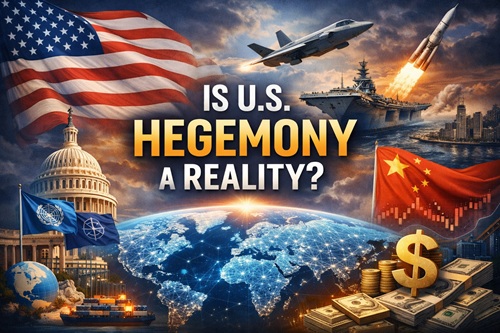
Introduction: The Hegemony Question
Few concepts in international relations are invoked as frequently—and as loosely—as U.S. hegemony. For critics, it names an all-encompassing system of domination: military, economic, cultural, and ideological. For defenders, it describes a stabilizing order that has underwritten global growth and relative peace since 1945. For others still, “U.S. hegemony” is already a relic, displaced by multipolarity, regional powers, and systemic decline.
But what, precisely, does hegemony mean—and does the United States actually possess it? To answer this requires moving beyond slogans and examining hegemony as a multidimensional phenomenon: material power, institutional control, ideological leadership, and structural constraint. Only then can we assess whether U.S. hegemony is real, partial, waning, or largely mythical.
Defining Hegemony: Power Beyond Dominance
In classical realist terms, hegemony refers to a state's preponderance of material capabilities, especially military and economic power. In this sense, a hegemon can defeat any rival and impose outcomes by force if necessary.
However, since Antonio Gramsci, hegemony has also carried a deeper meaning: leadership through consent rather than coercion. A hegemon does not merely rule; it shapes norms, institutions, and common sense itself. Others follow not only because they must, but because the hegemon's order appears legitimate, beneficial, or inevitable.
Applied to international politics, true hegemony thus requires:
- Material preponderance (economic and military).
- Institutional leadership (rule-setting power).
- Ideological legitimacy (normative influence).
- Structural embeddedness (others depend on the system the hegemon sustains).
The question, then, is not whether the United States is powerful—it clearly is—but whether it fulfills these broader conditions.
Military Power: Unmatched, Yet Constrained
By any conventional metric, U.S. military power is hegemonic in scale. The United States maintains:
- Global force projection capabilities unmatched by any other state.
- Hundreds of overseas bases.
- Technological superiority across multiple domains (air, naval, space, cyber).
- A defense budget exceeding that of its next several competitors combined.
Yet military supremacy has not translated into consistent political success. Vietnam, Iraq, Afghanistan, and Libya illustrate a central paradox: the United States can destroy regimes but struggles to control political outcomes. Asymmetric warfare, nationalist resistance, and state-building failures have revealed the limits of coercive power.
This does not negate U.S. military dominance, but it does undermine the idea of omnipotence. Hegemony, if it exists here, is operational rather than absolute—powerful enough to intervene almost anywhere, but not to dictate outcomes at will.
Economic Power: Central but No Longer Singular
Economically, the United States remains a pillar of the global system:
- The dollar is the world's primary reserve currency.
- U.S. financial markets anchor global capital flows.
- Key institutions—the IMF, World Bank, and WTO—bear the imprint of U.S. design.
- Dollar hegemony, in particular, grants extraordinary advantages: lower borrowing costs, sanctions power, and macroeconomic flexibility unavailable to others.
However, economic hegemony has become increasingly contested. China's rise, regional trade blocs, alternative development banks, and efforts at de-dollarization signal growing dissatisfaction with U.S.-centered finance. While none has yet replaced the dollar system, the trend points toward erosion rather than consolidation.
Thus, U.S. economic hegemony remains real—but increasingly conditional and dependent on the continued confidence of others.
Institutional Order: Leadership Through Architecture
Perhaps the strongest case for U.S. hegemony lies in institutions. The post-1945 international order—Bretton Woods, NATO, the UN system—was built under U.S. leadership and reflects American preferences: open markets, formal sovereignty, rule-based interaction, and liberal norms.
Crucially, these institutions constrain U.S. power as well. This has often been misinterpreted as weakness, but it is in fact a hallmark of hegemonic leadership: binding oneself to rules in order to make power more acceptable and predictable to others.
Yet institutional legitimacy depends on perceived fairness. As enforcement becomes selective, norms instrumentalized, and rules bent to serve strategic interests, consent erodes. When institutions appear less universal and more geopolitical, hegemony shifts from leadership toward dominance—an unstable position.
Ideological Influence: From Universalism to Contestation
At its height, U.S. hegemony was also ideological. Liberal democracy, market capitalism, and individual rights were widely seen not merely as American values, but as universal aspirations. The “end of history” thesis captured this moment of ideological confidence.
That moment has passed.
Today, U.S. ideology faces challenges from multiple directions:
- Authoritarian capitalism presents itself as efficient and stable.
- Post-colonial critiques frame liberal universalism as disguised power.
- Domestic polarization undermines the credibility of democratic exemplarity.
The United States still exerts enormous cultural influence, but ideological leadership has fractured. Without shared belief in the legitimacy of the system, hegemony becomes brittle.
Structural Dependence or Strategic Autonomy?
A final test of hegemony is whether other states are structurally dependent on the system the hegemon maintains. Here, the picture is mixed.
Allies remain deeply embedded in U.S.-led security and financial structures, often by choice. Yet many also hedge—seeking autonomy, diversification, and regional alternatives. Even close partners increasingly act as selective followers, not unconditional subordinates.
Rivals, meanwhile, resist U.S. power precisely by exploiting interdependence: supply chains, technology, energy, and information flows become sites of contestation rather than control.
This suggests that U.S. hegemony no longer functions as a seamless structure, but as a negotiated and contested order.
Conclusion: A Conditional, Not Absolute, Hegemony
Is U.S. hegemony a reality? Yes—but not in the totalizing sense often implied by critics or nostalgists alike.
The United States remains the most powerful state in the international system, with unparalleled military reach, central economic position, and deep institutional influence. No rival has yet assembled a coherent alternative order.
At the same time, U.S. hegemony is partial, conditional, and increasingly constrained. It depends on consent as much as coercion, confidence as much as capability. Where legitimacy erodes, power must compensate—and power alone is insufficient to sustain a hegemonic order indefinitely.
Rather than a monolithic empire or a vanished relic, U.S. hegemony today is best understood as a contested leadership: still real, still consequential, but no longer unquestioned or secure.
The future of that hegemony will depend less on raw strength than on whether the United States can renew the legitimacy of the order it leads—or whether the world will continue to drift toward fragmented, uneasy pluralism.