From Holons to Perspectives: Assessing the Philosophical Validity and Legacy of Ken Wilber's Core Concepts, Frank Visser / ChatGPT (original) (raw)
Check out AI-generated reviews of all Ken Wilber books
TRANSLATE THIS ARTICLE
Integral World: Exploring Theories of Everything
An independent forum for a critical discussion of the integral philosophy of Ken Wilber
SEE MORE ESSAYS WRITTEN BY FRANK VISSER
NOTE: This essay contains AI-generated content Check out my other conversations with ChatGPT
Assessing the Philosophical Validity and Legacy of Ken Wilber's Core Concepts
Frank Visser / ChatGPT
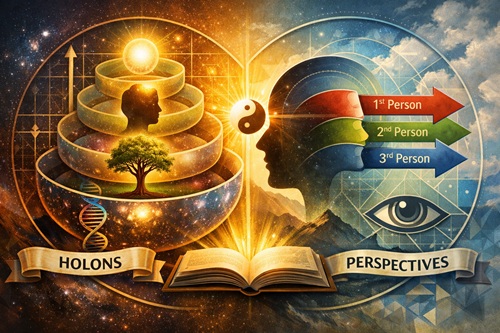
In Sex, Ecology, Spirituality (1995), Ken Wilber introduced the concept of holons as the metaphysical backbone of his Integral Theory. A holon, borrowing the term from Arthur Koestler, is defined as something that is simultaneously a whole in itself and a part of a larger whole. Wilber elevated this idea into a universal principle, claiming that reality at every level—matter, life, mind, culture, and spirit—is structured as nested holarchies of holons. Two decades later, Wilber increasingly deemphasized holons and instead proposed perspectives as ontologically fundamental, encapsulated in his oft-repeated claim that “reality is perspectives all the way down.” Both moves were presented as profound philosophical advances. The question is whether either survives serious scrutiny, and whether either has had meaningful influence outside the Integral subculture.
Holons: From Descriptive Heuristic to Metaphysical Overreach
At a modest level, the holon concept is uncontroversial. Many systems—biological organisms, social institutions, linguistic units—can indeed be described as parts within larger systems while retaining internal coherence. In systems theory, cybernetics, and biology, such part-whole relations are commonplace. As a descriptive heuristic, holons are harmless and occasionally useful.
Wilber's decisive move, however, was to universalize this observation into a metaphysical principle governing all of reality. Every entity, process, and level of existence is said to be a holon embedded in a Great Chain (later, Great Nest) of Being. This is where philosophical problems begin. Wilber offers no independent argument for why part-whole relations must be ontologically fundamental rather than context-dependent descriptions. Nor does he explain why alternative ontologies—process metaphysics, relational realism, eliminativist materialism, or pluralistic naturalism—should be subordinated to holonic metaphysics.
More seriously, the holon framework quietly smuggles in teleology. Holarchies are not merely nested; they are ranked, with higher levels (mind, soul, spirit) implicitly or explicitly valorized over lower ones (matter, life). Despite Wilber's protestations that this is not a value hierarchy, his language of “transcend and include,” “depth,” and “higher development” consistently reintroduces normative metaphysics under the guise of neutral systems theory. Critics have long noted that this structure closely mirrors pre-modern emanationist metaphysics, updated with scientific vocabulary but not constrained by scientific method.
Within philosophy proper, Wilber's holons gained no traction. They were neither debated nor adopted in analytic metaphysics, philosophy of science, or continental ontology. The concept remained confined to Integral discourse, where it functioned less as a testable theory than as a unifying rhetorical device.
The Turn to Perspectives: Ontology or Epistemology Confused?
In his later work, such as Integral Spirituality (2006), Wilber increasingly reframed his system around perspectives rather than holons. The AQAL model (quadrants, levels, lines, states, types) was reinterpreted through the lens of first-, second-, and third-person perspectives, and eventually generalized into the claim that perspectives are ontologically primitive. Reality, Wilber suggested, does not consist of things but of perspectives on things—or more radically, perspectives all the way down.
At first glance, this appears to align Wilber with phenomenology, constructivism, or even aspects of Kantian philosophy. On closer inspection, however, the move conflates epistemology with ontology. That we can only know reality from perspectives does not entail that reality is nothing but perspectives. Wilber frequently slides between these claims without argument, treating a truism about situated knowledge as a metaphysical revelation.
Moreover, Wilber's notion of perspective is radically underspecified. Is a perspective a cognitive act, a structural position, an informational relation, or a metaphysical entity? Does a rock have a perspective? If so, in what sense? Panpsychist implications are often hinted at but never rigorously defended. The result is a concept that is rhetorically expansive but philosophically thin—capable of absorbing any objection precisely because it lacks clear constraints.
Here again, the academic impact is telling. Philosophers of mind, phenomenologists, and cognitive scientists were already deeply engaged with perspectivalism long before Wilber's reframing, and they did so with far greater conceptual precision. Wilber's version did not clarify existing debates or introduce novel distinctions. As with holons, the idea circulated almost exclusively within Integral circles, where it functioned as a way to rebrand the system rather than to advance philosophical understanding.
Impact Beyond the Integral Bubble
The most revealing test of validity is external uptake. Genuine philosophical innovations provoke critique, refinement, adoption, or rejection by peers outside the originator's intellectual community. Wilber's core metaphysical constructs—holons and later perspectives-as-ontology—have failed this test. They are not cited in mainstream philosophy journals, not employed in scientific modeling, and not taught as serious metaphysical options in academic curricula.
Where Wilber has had impact is at a cultural and pedagogical level. Integral Theory has appealed to audiences seeking synthesis, spiritual meaning, and a sense of cosmic orientation in a fragmented intellectual landscape. Within that context, holons and perspectives serve an important psychological and narrative function: they promise unity without requiring hard choices between incompatible worldviews. But this integrative appeal should not be mistaken for philosophical rigor.
Indeed, one might argue that Wilber's later shift from holons to perspectives tacitly acknowledges the weakness of his earlier metaphysics. Rather than defending holons against sustained criticism, the system simply migrated to a new foundational metaphor—one equally resistant to falsification and equally insulated from external evaluation.
Conclusion
Neither holons nor perspectives, as deployed by Ken Wilber, constitute robust metaphysical philosophies. Holons began as a useful descriptive idea but collapsed under the weight of unwarranted metaphysical generalization and covert teleology. The later turn to perspectives compounded the problem by blurring the line between how we know reality and what reality is, resulting in a concept too vague to constrain explanation or generate insight.
The absence of impact beyond the Integral bubble is not accidental; it reflects the fact that these notions function more as integrative symbols than as philosophical arguments. They offer coherence to believers but little illumination to critics or scholars operating under standards of conceptual clarity and empirical accountability. In that sense, Wilber's metaphysical innovations are best understood not as contributions to philosophy, but as artifacts of a self-contained worldview—internally resonant, externally inert.