What Is Time?, Physics, Consciousness, Entropy, and the Temptation of the Eternal Now, Frank Visser / ChatGPT (original) (raw)
Check out AI-generated reviews of all Ken Wilber books
TRANSLATE THIS ARTICLE
Integral World: Exploring Theories of Everything
An independent forum for a critical discussion of the integral philosophy of Ken Wilber
SEE MORE ESSAYS WRITTEN BY FRANK VISSER
NOTE: This essay contains AI-generated content Check out my other conversations with ChatGPT
Physics, Consciousness, Entropy, and the Temptation of the Eternal Now
Frank Visser / ChatGPT
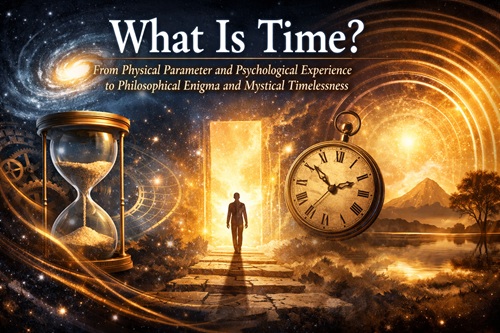
Few concepts are as omnipresent and yet as elusive as time. It structures every human experience—memory, anticipation, causation, change—while resisting any simple definition. We measure it with extraordinary precision, model it mathematically, and experience it subjectively, but these approaches do not converge on a single, unified understanding. Time sits at the crossroads of physics, philosophy, biology, and psychology, revealing different faces depending on the angle from which it is approached.
Time as Measured: The Physical Perspective
In classical physics, time was treated as absolute. For Isaac Newton, it flowed uniformly and independently of the events within it, providing a fixed backdrop against which motion and change could be described. This conception aligned well with everyday intuition and supported the mechanistic worldview of early modern science.
That picture was decisively altered by Einstein. In the theories of special and general relativity, time is no longer universal. It is relative to the observer's state of motion and to the presence of mass and energy. Clocks tick more slowly when they move at high velocities or sit in strong gravitational fields. Time becomes inseparable from space, forming a four-dimensional spacetime in which past, present, and future are geometrically related rather than metaphysically distinct.
Yet even in modern physics, time remains problematic. The fundamental equations of classical mechanics, electromagnetism, and quantum mechanics are largely time-symmetric: they work just as well forwards as backwards. Nothing in the equations themselves seems to prefer yesterday to tomorrow. And yet the world we observe is irreversibly temporal. Eggs break but do not unbreak; people age but do not grow younger. This tension leads directly to the puzzle of time's arrow.
The Arrow of Time
The most influential account of temporal direction comes from thermodynamics. The second law states that entropy—a measure of disorder or the number of possible microscopic arrangements—tends to increase in closed systems. This statistical tendency provides a physical grounding for irreversibility and underwrites the distinction between past and future.
However, this explanation is incomplete. The increase of entropy presupposes a universe that began in an extraordinarily low-entropy state. Why the early universe was so ordered is still an open question in cosmology. Thus, even the most successful physical account of time's arrow ultimately points beyond itself, toward boundary conditions rather than fundamental laws.
Time as Experienced: The Psychological Perspective
Physics may describe time in terms of equations and clocks, but lived time is something else entirely. Human experience divides time into past, present, and future, with the present carrying a unique sense of “nowness.” Memory anchors us to what has been; intention and expectation orient us toward what is to come.
Psychological time is elastic. Moments of danger or novelty seem to stretch; routines collapse into blur. This subjectivity does not mean that time is an illusion, but it does show that temporal experience is mediated by cognition, attention, and emotion. The brain does not passively register time; it actively constructs temporal order and duration.
Importantly, the “present” so vivid in experience has no clear counterpart in fundamental physics. Relativity denies a universal now, suggesting that the felt immediacy of the present is a feature of consciousness rather than of the cosmos itself.
The Mystic Notion of Time: Nunc Fluens and Nunc Stans
Alongside scientific and philosophical accounts, mystical and theological traditions have articulated a radically different understanding of time. Here, the contrast is often framed in Latin terms: _nunc fluens_—the "flowing now"—and _nunc stans_—the "standing now."
Nunc fluens corresponds to ordinary, lived time. It is the temporal stream in which moments succeed one another, the domain of change, becoming, and decay. This is the time of history, causation, memory, and anticipation. Human life, biological processes, and physical events unfold within this flowing now. In this sense, nunc fluens aligns closely with psychological time and with the arrow of time identified by thermodynamics.
Nunc stans, by contrast, refers to a timeless present: an eternal "now" that does not pass. In medieval Christian mysticism—drawing on Augustine, Boethius, and later Thomas Aquinas—nunc stans was associated with the divine perspective. God does not exist in time but apprehends all moments simultaneously in a single, unchanging act of awareness. Past, present, and future are not successive but co-present.
Mystics across traditions have claimed experiential access to something like nunc stans. In moments described as enlightenment, union, or pure presence, temporal succession seems to fall away. The self is no longer oriented toward past and future but rests in an intensified present that feels complete and timeless. Importantly, this is not experienced as an infinite duration, but as the absence of duration altogether.
Philosophically, the mystic notion of time raises difficult questions. Is nunc stans a metaphysical reality—a timeless mode of being—or is it a distinctive alteration of consciousness that suspends ordinary temporal processing? From a naturalistic standpoint, such experiences can be understood as neurocognitive states in which narrative time is temporarily silenced. From a theological standpoint, they are taken as glimpses of ultimate reality.
What is striking is how sharply nunc stans diverges from the scientific picture. Physics finds no privileged eternal present; relativity explicitly undermines it. The mystic "timeless now" therefore cannot be straightforwardly mapped onto spacetime without importing metaphysical assumptions. Attempts to do so often smuggle theology into science under the guise of profundity.
Yet the distinction remains conceptually valuable. It clarifies that debates about time are often confounded by a failure to separate experiential claims from ontological ones. Nunc fluens describes the world of processes and events; nunc stans describes a mode of apprehension that interprets or transcends that world. Conflating the two leads either to mystical inflation or to scientistic dismissal.
Seen soberly, the mystic notion of time does not solve the problem of time, but reframes it. It reminds us that time is not only something the universe does, but something consciousness negotiates—and occasionally, in exceptional states, appears to step outside of.
Philosophical Conceptions of Time
Philosophy has long wrestled with these tensions. Augustine famously observed that he knew what time was until he tried to explain it. Later debates crystallized into competing metaphysical views.
Presentism holds that only the present is real; the past has ceased to exist and the future does not yet exist. Eternalism, by contrast, treats past, present, and future as equally real, differing only in their temporal location. A related “block universe” picture aligns naturally with relativity, portraying time as another dimension in a fixed spacetime structure.
Each view carries costs. Presentism fits everyday intuition but struggles with modern physics. Eternalism fits the equations but risks flattening temporal becoming into a static geometry, making change seem illusory. No consensus has emerged, and the debate reveals how deeply time challenges our metaphysical assumptions.
Time and Life
Beyond physics and philosophy, time is inseparable from life. Biological organisms are inherently temporal systems: they grow, metabolize, reproduce, and decay. Evolution itself is a historical process, intelligible only through temporal sequence. Memory, learning, and anticipation are adaptive responses to a world in which the past informs the future but not vice versa.
From this perspective, time is not merely a dimension but a condition of meaning. Narrative, responsibility, and purpose all presuppose temporal order. A world without time might be mathematically describable, but it would be existentially empty.
Conclusion
So what is time? It is not one thing. It is a parameter in physical theories, a direction defined by entropy, a structure of conscious experience, and a precondition for life and meaning. Attempts to reduce it to a single essence have consistently failed, not because time is mystical, but because it operates across multiple explanatory levels.
Time may ultimately be best understood not as a substance that flows, nor as a mere illusion, but as a relational structure—linking events, experiences, and processes into an ordered whole. Its elusiveness is not a defect of our theories alone, but a reminder that some of the most familiar features of reality are also the most profound.