Cosmos vs. Kosmos, Carl Sagan and Ken Wilber on the Meaning of the Universe, Frank Visser / ChatGPT (original) (raw)
Check out AI-generated reviews of all Ken Wilber books
TRANSLATE THIS ARTICLE
Integral World: Exploring Theories of Everything
An independent forum for a critical discussion of the integral philosophy of Ken Wilber
SEE MORE ESSAYS WRITTEN BY FRANK VISSER
NOTE: This essay contains AI-generated content Check out my other conversations with ChatGPT
Carl Sagan and Ken Wilber on the Meaning of the Universe
Frank Visser / ChatGPT
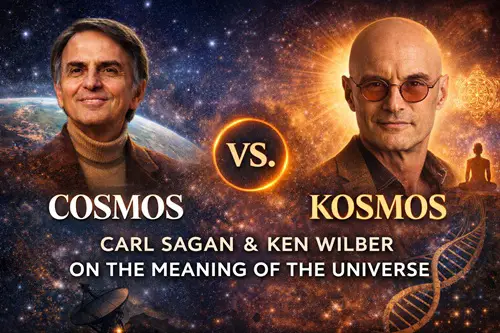
Introduction: Two Spelling Choices, Two Worldviews
At first glance, the contrast between Carl Sagan's Cosmos and Ken Wilber's Kosmos may appear superficial—merely a difference in spelling. In reality, the distinction signals two fundamentally different orientations toward science, meaning, and metaphysics. Sagan's Cosmos names the totality of what exists as revealed, however incompletely, by empirical inquiry. Wilber's Kosmos, by contrast, is a philosophically inflated universe: one that includes not only matter and life, but also Spirit, subtle realms, archetypal structures, and intrinsic teleology.
This essay argues that the difference between Cosmos and Kosmos is not merely terminological, but epistemic. It concerns what kinds of claims we are entitled to make about reality, on what grounds, and with what degree of intellectual humility.
Sagan's Cosmos: Order Without Privilege
Sagan revived the ancient Greek term kosmos—meaning order or harmony—but deliberately stripped it of metaphysical excess. In Cosmos (1980) and throughout The Varieties of Scientific Experience, the universe is lawful, intelligible in principle, and breathtaking in scale. Yet it is also indifferent to human aspirations.
Key features of Sagan's Cosmos include:
Methodological NaturalismExplanations are constrained by testability, coherence, and evidence. Appeals to transcendent agencies are unnecessary and explanatorily idle.
Anti-AnthropocentrismHumanity is not the culmination of cosmic evolution but a local, fragile phenomenon on a “pale blue dot.” Meaning is not discovered as a cosmic property but created through understanding and care.
Emergence Without TeleologyComplexity arises through natural processes without foresight or intrinsic direction. The appearance of purpose does not license metaphysical conclusions.
Awe Without Ontological InflationSagan's reverence is directed at the universe as it is, not at what it might symbolically represent beyond itself.
Crucially, Sagan never claims that science delivers ultimate meaning. He claims instead that it delivers honest meaning, bounded by what we can responsibly know.
Wilber's Kosmos: Depth, Direction, and Spirit
Wilber's choice of the archaic spelling Kosmos is intentional. It signals a universe suffused with interiority at every level—what he famously calls “turtles all the way down,” but now with consciousness and value embedded at each layer.
Defining characteristics of the Wilberian Kosmos include:
Panpsychist or Pan-Experiential AssumptionsSome form of interiority is attributed to all holons, from quarks to galaxies.
**Teleological Evolution (Eros)**Evolution is not merely a process but a drive toward greater depth, complexity, and consciousness.
Ontological PluralismGross, subtle, causal, and nondual realms are all treated as equally real domains of existence, not merely interpretive frameworks.
Spiritual Validation of MetaphysicsMeditative experience is frequently invoked as evidence for ontological claims about reality's structure.
Wilber's Kosmos aims to be maximally inclusive, but this inclusivity comes at a price: evidential asymmetry. Claims about Spirit and subtle realms are insulated from falsification while borrowing the rhetorical authority of science.
Epistemic Modesty vs. Metaphysical Ambition
The core contrast between Sagan and Wilber lies in their epistemic temperaments.
Sagan's approach is governed by what might be called tragic realism: the recognition that the universe may not satisfy our existential longings. This leads to restraint. The absence of cosmic guarantees becomes a moral challenge rather than a metaphysical embarrassment.
Wilber's approach, by contrast, exemplifies metaphysical ambition: the conviction that reality must ultimately be meaningful in a spiritually satisfying sense—and that any account falling short of this is incomplete or “flatland.”
From a Saganesque perspective, this is precisely where caution is required. The desire for depth does not justify ontological inflation. Meaningfulness is not a criterion of truth.
Science in the Two Cosmologies
Sagan treats science as a discipline of self-correction. Its authority lies in its willingness to revise or abandon cherished ideas.
Wilber treats science as a partial language that must be “transcended and included” by spiritual insight. Yet this inclusion often functions asymmetrically: scientific results are accepted when compatible with Integral metaphysics and reinterpreted or relativized when they are not.
This difference explains why Wilber's system has had little impact outside the Integral subculture, while Sagan remains a touchstone for scientists, educators, and secular humanists. Sagan speaks from within science; Wilber speaks about science from a metaphysical vantage point.
Integral World as the Site of the Dispute
Integral World exists precisely because the Wilberian Kosmos has resisted internal correction. The site's long-standing critiques target not spirituality per se, but the systematic overreach involved in turning spiritual intuitions into a cosmic theory.
From this perspective, Sagan's Cosmos functions as a control case: a demonstration that one can embrace wonder, ethics, and existential depth without postulating Spirit-in-action, Eros, or higher realms. His work exposes the false dilemma often implied in Integral discourse: that without metaphysics, only nihilism remains.
Conclusion: Two Kinds of Meaning
Sagan and Wilber offer competing answers to the same question: What kind of universe do we inhabit?
Sagan's answer is sober but bracing. The universe is vast, ancient, and indifferent—but intelligible. Meaning is local, fragile, and precious because it is not guaranteed.
Wilber's answer is consoling but speculative. The universe is fundamentally spiritual, purposive, and developmentally ordered. Meaning is built into the fabric of reality.
For Integral World, the choice between Cosmos and Kosmos is not a matter of taste, but of intellectual responsibility. The former demands restraint, humility, and courage in the face of uncertainty. The latter promises depth, but at the cost of evidential discipline.
In the end, Sagan's Cosmos may be less flattering to human aspirations—but it has the decisive virtue of not pretending to know more than it does.