The Demon-Haunted World: Lessons for an Integral Audience, Carl Sagan and the Necessity of Skeptical Literacy, Frank Visser / ChatGPT (original) (raw)
Check out AI-generated reviews of all Ken Wilber books
TRANSLATE THIS ARTICLE
Integral World: Exploring Theories of Everything
An independent forum for a critical discussion of the integral philosophy of Ken Wilber
SEE MORE ESSAYS WRITTEN BY FRANK VISSER
NOTE: This essay contains AI-generated content Check out my other conversations with ChatGPT
Carl Sagan and the Necessity of Skeptical Literacy
Frank Visser / ChatGPT
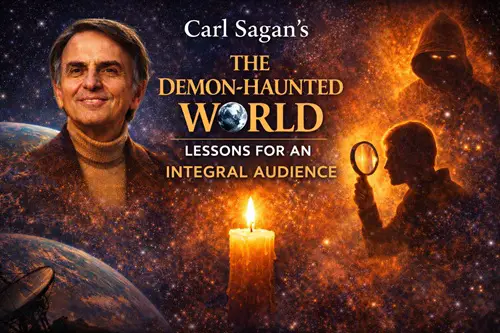
Introduction: Science as a Sacred Responsibility
Carl Sagan's The Demon-Haunted World: Science as a Candle in the Dark (1995) is often remembered as a defense of scientific rationality against pseudoscience, superstition, and credulity. For the Integral audience, which is frequently immersed in systems of thought that blend metaphysics, spirituality, and developmental claims, the book offers more than a cautionary tale—it provides a framework for discernment, critical literacy, and intellectual humility.
Sagan wrote for a public seduced by mystery yet vulnerable to error. Integral thinkers, by contrast, are often seduced by systematization and the promise of “deep insight,” which can produce a parallel vulnerability: a readiness to accept untestable metaphysical claims under the banner of integration. Sagan's lessons, therefore, remain directly relevant.
The Core Premise: Balancing Wonder with Skepticism
At the heart of The Demon-Haunted World is a simple but profound epistemic principle: humans are natural pattern-seekers, and this capacity can generate both insight and illusion. Sagan repeatedly emphasizes two complementary skills:
Critical Thinking as a Cultural ToolSagan calls for teaching not just facts, but methods: how to evaluate evidence, test hypotheses, and recognize cognitive biases.
Maintaining a Sense of WonderSkepticism does not necessitate cynicism. One can—and should—remain awed by the cosmos while rejecting claims that lack evidence.
For an integral audience accustomed to navigating complex models of development, consciousness, and Spirit, this dual principle is crucial. It reminds practitioners that embracing interiority, mysticism, or spiritual insight does not excuse them from intellectual rigor.
Relevance to Integral Theory
Integral Theory, particularly in its Wilberian form, exhibits patterns that Sagan's critique anticipates:
Overreach and TeleologyWilberian frameworks often infer developmental necessity, evolutionary purpose, or cosmic teleology from patterns in consciousness and culture. Sagan's warnings about the human tendency to see agency and design where none exists are directly applicable.
Epistemic InflationClaims about subtle, causal, or nondual realms frequently operate outside the domain of falsifiable evidence. Sagan's insistence on distinguishing “what we know” from “what we imagine” provides a necessary corrective.
Confirmation Bias and GroupthinkIntegral communities sometimes valorize alignment with the system as a marker of insight. Sagan's discussion of social reinforcement, charisma, and anecdotal evidence is a timely reminder that cognitive filters operate even among highly intelligent individuals.
In short, The Demon-Haunted World offers Integral thinkers a methodological lens: how to integrate without deceiving oneself.
The Science Literacy Imperative
Sagan's book repeatedly stresses the dangers of ignorance masquerading as profundity. For the Integral audience, there is an added layer: the need to translate complex models of consciousness and culture into forms that are both intelligible and critically accountable.
Three lessons stand out:
Skepticism as Ethical PracticeRejecting ungrounded claims is not intellectual arrogance; it is ethical responsibility. Misrepresentation of evidence can mislead students, practitioners, and seekers.
Integration Requires DiscernmentTrue integration does not mean including every spiritual or metaphysical claim. It requires discernment: deciding what can be responsibly incorporated based on evidence, coherence, and transparency.
Teaching the Tools, Not Just the MapSagan's “baloney detection kit”—a set of principles for evaluating arguments—remains invaluable. Integral educators can use similar approaches to teach critical literacy alongside developmental or spiritual content.
Wonder Without Illusion
Sagan's genius lies in demonstrating that awe need not require supernatural claims. He repeatedly returns to the majesty of the cosmos, the fragility of life, and the significance of human agency—without invoking hidden realms, subtle bodies, or cosmic teleology. For the Integral audience, this is an invitation to cultivate the same kind of deep appreciation for complexity, consciousness, and morality, while remaining grounded in epistemic humility.
In other words, The Demon-Haunted World models a form of integral practice that is both intellectually rigorous and spiritually respectful: wonder guided by method, insight constrained by evidence.
Conclusion: A Candle in the Integral Dark
For an Integral readership, The Demon-Haunted World serves as both a mirror and a guidepost. It reflects the vulnerabilities of systems that aim for grand synthesis without sufficient critical checks. At the same time, it illuminates a path forward: one in which awe, moral seriousness, and integrative ambition coexist with skepticism, evidence, and intellectual humility.
Carl Sagan's message is clear: the universe is vast, life is fragile, and knowledge is precious. For the Integral thinker, acknowledging these realities is not a limitation—it is the foundation upon which genuine integration, ethical engagement, and sustained insight can be built.