The Hard Problem of Consciousness: Mystery, Problem, or Pseudo-Problem?, Frank Visser / ChatGPT (original) (raw)
Check out AI-generated reviews of all Ken Wilber books
TRANSLATE THIS ARTICLE
Integral World: Exploring Theories of Everything
An independent forum for a critical discussion of the integral philosophy of Ken Wilber
SEE MORE ESSAYS WRITTEN BY FRANK VISSER
NOTE: This essay contains AI-generated content Check out my other conversations with ChatGPT
Mystery, Problem, or Pseudo-Problem?
Frank Visser / ChatGPT
1. Introduction: What Is the “Hard Problem”?
The term “the hard problem of consciousness” was coined by David Chalmers in the mid-1990s to designate what he took to be a fundamental explanatory gap in the sciences of the mind. While neuroscience and cognitive science can, in principle, explain functions—perception, memory, attention, verbal report—they seem unable to explain why and how these processes are accompanied by subjective experience, by what it feels like to see red, taste wine, or feel pain.
Chalmers contrasted this with the so-called easy problems: explaining behavior, information processing, and neural mechanisms. These are “easy” not because they are trivial, but because they appear tractable within the standard third-person, physicalist framework of science. The hard problem, by contrast, concerns phenomenal consciousness—qualia, first-person experience, subjectivity.
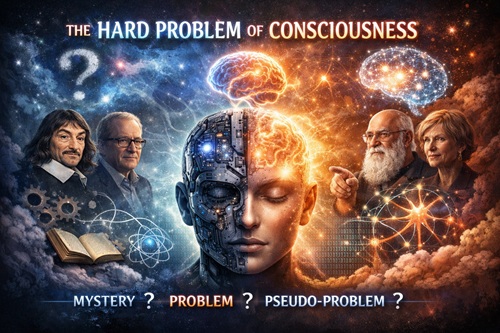
But since its introduction, philosophers have increasingly questioned whether the hard problem is:
1. a deep metaphysical mystery,
2. a legitimate but unresolved scientific-philosophical problem, or
3. a pseudo-problem generated by misleading intuitions, language, or outdated metaphysics.
2. The Classical Background: Mind-Body Dualism Revisited
The hard problem inherits much of its force from Cartesian dualism. Descartes distinguished res cogitans (thinking substance) from res extensa (extended substance), making consciousness ontologically distinct from the physical world. Although few contemporary philosophers endorse substance dualism, the intuition that experience resists physical explanation remains deeply Cartesian.
This intuition reappears in:
• Leibniz's Mill: no amount of mechanical inspection reveals perception.
• Nagel's “What Is It Like to Be a Bat?”: objective science leaves out subjective character.
• Jackson's Knowledge Argument (“Mary the color scientist”): complete physical knowledge seems insufficient to capture experience.
These arguments frame consciousness as something over and above physical structure and function—precisely the terrain of the hard problem.
3. The Hard Problem as a Genuine Philosophical Problem
David Chalmers: Naturalistic Dualism
Chalmers argues that consciousness is ontologically fundamental, like mass or charge. Physical facts do not logically entail phenomenal facts; hence physicalism is false or incomplete. His famous zombie argument—the conceivability of beings physically identical to us but lacking consciousness—aims to show that consciousness is not reducible to physical processes.
Chalmers does not invoke the supernatural. Instead, he proposes psychophysical laws linking physical states to experiences, a form of property dualism. For him, the hard problem is real, permanent, and forces a revision of our metaphysics.
Thomas Nagel
Nagel does not propose a solution but insists on the irreducibility of subjectivity. Any purely objective account will necessarily omit what consciousness is like from the inside. He regards this as a deep limitation of current scientific frameworks, not a confusion.
4. The Hard Problem as a Scientific Challenge (Not a Metaphysical Abyss)
Some philosophers accept that consciousness poses a difficult explanatory challenge but reject the conclusion that it requires new ontological categories.
John Searle: Biological Naturalism
Searle argues that consciousness is a biological phenomenon, like digestion. It is ontologically subjective but causally produced by objective brain processes. The mistake, he claims, is assuming that subjectivity implies non-physicality.
For Searle, the problem is not metaphysical but conceptual: we lack the right vocabulary to integrate first-person ontology with third-person science.
Evan Thompson
Drawing on phenomenology and embodied cognition, Thompson reframes consciousness as an enactive process, emerging from organism-environment interaction. The “hardness” of the problem arises from a disembodied, computationalist conception of mind. Once mind is situated in lived biology, the gap narrows—though it does not vanish.
5. The Hard Problem as a Pseudo-Problem
A growing camp argues that the hard problem is illusory, a philosophical mirage created by faulty intuitions about explanation, identity, and language.
Daniel Dennett: The Illusion of Qualia
Dennett is the most prominent critic. He argues that the hard problem rests on a mythical notion of qualia—private, ineffable mental items. Once we abandon this notion and focus on what consciousness does, rather than what it “intrinsically is,” the hard problem dissolves.
Dennett's heterophenomenology treats first-person reports as data to be explained, not as windows into an irreducible inner realm. From this view, asking why brain processes are “accompanied by experience” is like asking why digestion is accompanied by digestion—it is a category mistake.
Patricia and Paul Churchland
Eliminative materialists argue that our everyday mental concepts—belief, desire, experience—are part of a folk psychology that will eventually be replaced by neuroscientific descriptions. The hard problem arises because we are trying to force future science into outdated conceptual schemes.
Wittgensteinian and Deflationary Approaches
From a Wittgensteinian perspective (e.g., Peter Hacker), the hard problem results from misusing language. We reify “consciousness” as a thing and then puzzle over how it fits into the physical world. The confusion lies not in nature but in grammar.
6. Panpsychism and the Return of Metaphysics
Ironically, dissatisfaction with both reductionism and dualism has fueled renewed interest in panpsychism, endorsed (in different forms) by Chalmers, Galen Strawson, and Philip Goff. Here consciousness is taken as a basic feature of matter itself.
Critics argue that panpsychism does not solve the hard problem but relocates it—most notably in the “combination problem”: how do micro-experiences combine into unified human consciousness?
7. Diagnosing the Disagreement
Why is there such persistent disagreement?
Different standards of explanationSome expect logical entailment from physics to experience; others accept causal sufficiency.
First-person vs third-person asymmetrySubjectivity is unique in being both the explanandum and the means of access.
Residual Cartesian intuitionsEven self-described physicalists often smuggle in dualist assumptions.
Conceptual inertiaOur inherited mental vocabulary may be poorly suited to neuroscientific integration.
8. Conclusion: Mystery, Problem, or Pseudo-Problem?
The hard problem of consciousness is not a single thing, but a diagnostic label applied to different concerns:
• It is a mystery if one assumes that explanation requires reduction to physics plus an intrinsic qualitative residue.
• It is a legitimate problem if one treats consciousness as a complex biological phenomenon still awaiting theoretical integration.
• It is a pseudo-problem if one rejects the reification of qualia and the demand for a special metaphysical explanation.
What ultimately divides philosophers is not data, but metaphysical temperament: how much explanatory work we expect science to do, and how willing we are to revise our intuitions about mind, matter, and meaning.
In that sense, the hard problem may tell us less about consciousness itself—and more about the philosophical lenses through which we insist on viewing it.