The 10 Best Surf Spots in the World for 2023 | 57hours (original) (raw)
Best of article
Whether you’re looking for big waves, barrels or beginner breaks, here are ten surf destinations that every surfer needs to experience at least once.
Surfing is addictive—once you start you can’t stop. Like many, I caught the surf bug as a kid, and the more time I spent in the water, the more I dreamt of traveling to famous surf destinations across the globe.
Once I graduated college, I began researching the best surf spots in the world and slowly began checking locations off my bucket list. Although my list is still a long one, my eyes have been opened to what’s out there, and I’ve learned to appreciate each destination for what it has to offer. I’ve rounded up a list of ten of the best locations for surfing tours in the world, and what you can expect to find at each. See you on the water!
Map of the Best Surf Spots in the World
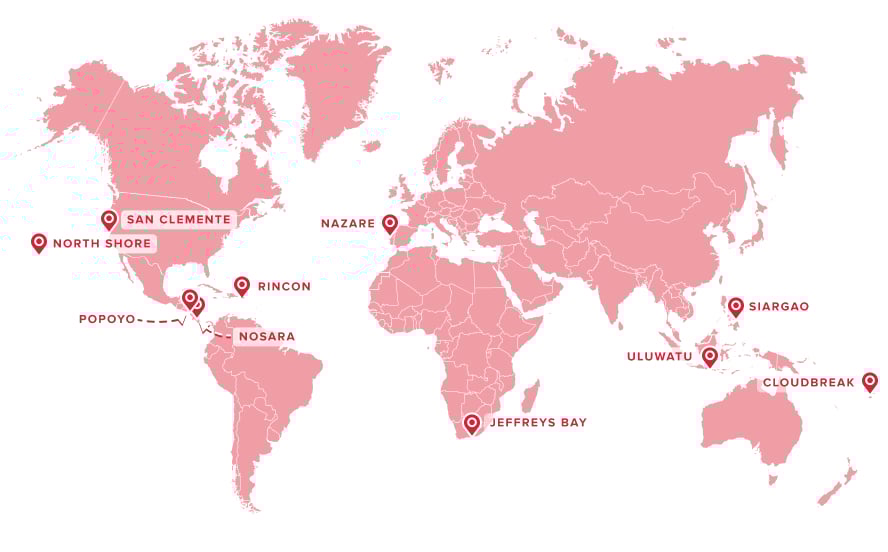
Whether you’re planning your own Endless Summer or looking for your next vacation spot, you’re sure to find la pura vida on this list.
Nicaragua
1. Popoyo
MOST CONSISTENT SURF
Consistent surf year round
Waves for every skill level
Town revolves around the surf
Affordable
Difficult to get to
Mid-day heat is intense
Limited public transportation
Over 300 days of offshore winds
Popoyo is a dreamscape for surfers. A rocky, dirt road deposits you into the heart of a small, remote village where the lifestyle is all about the surf. While many breaks revolve around swells, storms, and tides, Popoyo is consistent year-round, ticking all the marks for an awesome surf spot.
The spot receives over 300 days of offshore winds annually and, as a result, is often regarded as one of the best surf destinations in the country. Like most of Central America, Popoyo experiences a dry season and a wet season, so plan your trip accordingly.

From beginner to expert, Popoyo has breaks for every level of surfer
The main break
The main break in Popoyo is an A-frame that breaks over a rock shelf, offering up good options for regular and goofy footers — with the occasional tube. The Outer Reef Popoyo is a five-minute paddle from the main break and is a hollow left-slab suitable for expert surfers.
While many of the breaks in Popoyo can be intimidating, Beginner Bay, on the south end of the beach, offers rolling waves well-suited for beginners and intermediate surfers. It’s no surf camp in the Rockaways, but it will get you ready for more serious swells. For more beginner surfing advice, check out this Witch’s Rock Surf Camp review.
In addition to the main spots, Popoyo has a number of other noteworthy spots lining the beach: Stoneys, La Piedrita, Playgrounds, Playa Colorado, and Plays Santa. Although I’ve never been to Popoyo, a good friend of mine regularly makes the trip and comes home with stories of perfect waves — making it the top spot on my list of awesome surfing destinations I haven’t tried yet.
Popoyo is a perfect left with lots of power and can hold any size.
Harrison Abry, surfing coach at Surf Simply, surf school located in Nosara, Costa Rica


Popoyo - Good to Know
Skill level:
Beginner to expert
Wave type:
Point breaks, beach breaks, and reef breaks
Best swell direction:
SW swell; NE wind
Best season:
Dry season (November – April)
Getting around:
Public transportation is limited — you’ll need a car (4-wheel drive) or motorbike
Additional activities:
Explore tidal pools, visit natural hot springs in Las Salinas, navigate the Chacocente Natural Reserve, horseback ride down the beach, or test your hand at spearfishing
Costa Rica
2. Nosara
BEST BEACH BREAK
Warm water
Consistent surf
Friendly locals
Crowded
Getting there is a trek
Beach breaks for all skill levels
Nosara is a village located on the North Pacific Coast of the Nicoya Peninsula in Guanacaste and is famous for yoga and year-round surf. Technically, Nosara is a few miles inland, so when tourists visit, they typically head north for surfing lessons in Tamarindo Bay, or they stay in Playa Guiones, Playa Pelada, or Playa Garza, with Playa Guiones being the most popular.
In 2015, a good friend of mine moved to the area to work as a surf instructor. After hearing about the epic surf and seeing his photos, I had to visit. Nosara definitely lives up to the hype. After that first visit, I was back a year later to get my fill of warm water waves.

One of the best things about Nosara is that you can surf year-round
Playa Guiones and Playa Garza
Playa Guiones is a 7km stretch of beach with several different beach breaks spread along the coastline. Waves break in both directions and work on all tides, making it a fun spot any time of day. The main break offers waves suitable for beginners and experienced surfers, and the area has many surf schools if you’re looking to learn the sport or improve upon your skills.
Playa Guiones can get pretty busy, but just a few miles away is my personal favorite spot: Playa Garza. Playa Garza is a reef break with a mellow inside section and a stepper section on the outside. Regardless of the break you choose, Nosara delivers.
Warm water, good waves, and friendly people…what more could you ask for?
Rebecca Parsons
Nosara - Good to Know
Skill level:
Beginner to advanced
Wave type:
Beach breaks; reef breaks
Best season:
Dry season (November – April)
Best swell direction:
W/NW swell; N/NE winds
Getting around:
Walk, bike, or rent a quad or motorbike
Additional activities:
Standup paddle calm rivers, explore tide pools, or go for a hike in the jungle
Bali
3. Uluwatu
MOST SCENIC
Consistent surf
Multiple breaks
Beautiful beaches & scenery
Crowded
Competitive lineup
Not suited for beginners
Experience necessary
Uluwatu is one of those destinations that perennially top bucket lists. Located on the southwestern tip of the Bukit Peninsula, Uluwatu is known for its world-famous surf as well as the Uluwatu Temple: an 11th-century Hindu temple.
Due to its famous name and prime conditions, Uluwatu is one of the busiest surf spots in all of Bali and is best suited for experienced surfers. Consistent year-round, Uluwatu offers hollow, performance waves during low tide and slower, mellower waves during high tide.

Uluwatu is a spot for experienced surfers that can handle big waves
The five peaks
Although generally referred to as Uluwatu, it’s actually a wide reef that is home to five different peaks: Temples, The Bombie, The Peak, Outside Corner, and Racetracks.
Temples is the farthest south and requires the longest paddle — the spot offers more size on smaller days. The Bombie is the most exposed spot and offers some of the biggest swells and waves in all of Indo. The Peak is located directly in front of the stairs and is the most consistent, offering multiple takeoff points and fast, short sections.
Outside Corner offers big, open faces for only the most experienced surfers, making it a great spectacle for beachgoers. Lastly, Racetracks breaks over a shallow reef and has long, fun sections and occasional barrels. Although Bali does have some beginner-friendly spots, Uluwatu is suited for experienced surfers.
From the paddle out through the cliffs to the backdrop and its perfect peeling lefts, it’s unlike any other wave I’ve ever surfed.
Harrison Abry, surfing coach at Surf Simply, surf school located in Nosara, Costa Rica


Uluwatu - Good to Know
Skill level:
Advanced to expert
Best season:
Dry season (May – September)
Best swell direction:
South swell
Where to stay:
Jaya Homestay for affordable accommodation and Uluwatu Surf Villas for luxury accommodation
Getting around:
Motorbikes are best, but public transport is available as well
Additional activities:
Visit Uluwatue Temple, yoga, explore stunning beaches, or enjoy a sunset at Single Fin
Fiji
4. Cloudbreak
BEST SPOT TO WATCH PRO SURFERS
World class
Spectator friendly (from boats)
Warm, tropical water
Expert only
Breaks over a shallow reef
Surfing the famous Cloudbreak
Located just three miles south of Namotu Island in Fiji, Cloudbreak is famous for consistently being one of the most challenging waves in the world. The spot breaks over a sharp, shallow reef and offers fast, barreling lefts.
The Pacific is known for having the biggest waves in the world, but Cloudbreak takes it to another level. As the wave progresses, it tends to speed up, presenting shallower, more critical sections. The wave is as equally amazing as it is dangerous and, as such, it attracts pros from across the globe. If you aren’t up for surfing Cloudbreak, getting an up-close view from a boat is an incredible way to experience the wave.

A group of surfers at the famous Cloudbreak, Fiji
Other waves nearby
Cloudbreak is beautiful from afar but surreal when viewed up close. The spot breaks best during long-period swells rolling in from the south/southwest. When the swell comes from the south, the spot offers peeling point breaks; when the swell comes from the west, you can find heavier tubes.
Cloudbreak is home to varying conditions, and waves can range in size from 2–20 feet. When the waves are small, they tend to be faster and shallower — exercise caution on the inside as the reef is extremely shallow. While Cloudbreak is the most iconic spot in the area, there are a number of other incredible waves near Namotu Island: Desperations, Tavarua Rights, Restaurants, Swimming Pools, Namotu Lefts, and Wilkes Passage.
Having surfed and traveled to over fifty countries around the world, this wave holds a special place in my heart... because of the energy and culture of this area
Zane Schweitzer, professional waterman, 15x world champ


Cloudbreak - Good to Know
Best season:
Dry season (April – October)
Best swell direction:
S/SW swell; S/SE wind
Getting around:
Local surf breaks are all accessible via boat
Additional activities:
Standup paddle, fish, foil, kitesurf, dive, do yoga, or get a massage
South Africa
5. Jeffreys Bay
BEST POINT BREAK
Perfect rights
Works on all tides
Multiple sections
Lots of dining and accommodation options
Crowded
Locals can be territorial
Sharks!
The water is cold
One of the world’s best right point breaks
Often referred to as J-Bay, Jeffreys Bay is regarded as the surfing mecca of South Africa and home to one of the best right point breaks on the planet. Located on the western edge of South Africa’s Eastern Cape Province, also home to some of the best kitesurfing in the world, Jeffreys Bay is situated inside a crescent-shaped bay that shelters many of its incredible point breaks. Sharks wander off and the water is so cold you’ll feel like you’re surfing in Santa Cruz, but besides that, it’s pretty close to a perfect surf spot.
The region was first popularized in The Endless Summer, when Bruce Brian stumbled upon Cape Saint Francis — the spot that is now lovingly referred to as Bruce’s Beauties. Although Brian deemed the spot perfect at the time, J-Bay, located just to the east, is more deserving of surfing glory.

J-Bay is home to one of the best right point breaks in the world.
The ten sections of Jeffreys Bay
Offshore winds shape the classic point break, which offers long rides, fast walls, and barreling sections. J-Bay is sometimes thought of as one particular spot, but it’s actually home to ten different sections: Kitchen Windows, Magnatubes, Boneyards, Supertubes, Impossibles, Salad Bowls, Coins, Tubes, The Point, and Albatross.
Supertubes is regarded as the crown jewel of the region, offering long, fast waves — this is where contests are typically held. The Point and Albatross offer slower, more manageable waves, well-suited for intermediate surfers and longboarders. The spot works during all tides, but tends to be best on a mid-incoming tide. While J-Bay sees waves year-round, it’s best during the winter months when storms come in close to shore.
South Africa's southeastern coast boasts one of the best right point breaks on the planet.
Jay Reale, seasoned Southern California surfer
Jeffreys Bay - Good to Know
Skill level:
Intermediate to expert
Best season:
Winter (May – September)
Best swell direction:
SW/SSW swell; SW/W wind
Getting around:
Cabs and airport shuttles are readily available
Additional activities:
Hiking, sandboarding, enjoy a beach dune safari, or go horseback riding
Puerto Rico
6. Rincon
BEST SURF IN THE CARIBBEAN
Warm year round
Multiple breaks
Friendly locals
Crowded during high season
Rip currents and exposed rocks
Rincon’s phenomenal breaks
Often referred to as the surf capital of the Caribbean, west Puerto Rico is home to a variety of incredible beaches. While the surfing in Aguadilla and Isabela hosts strong, deep-rooted communities, the most iconic spot has to be Rincon.
Rincon has been on the map as a premier surf spot since 1968 when the Surfing Championships were held there. Located on the northwest side of the island, southwest of Aguadilla, and north of Mayaguez, Rincon is one of the most consistent spots in the Caribbean.
While the locals are typically friendly and a variety of surf craft can be found in the water on any given day, be sure and respect the rules of the lineup and scan the beach for hazards before entering the water. Rincon is home to a handful of stellar breaks: Little Malibu, Tres Palmas, Maria’s, Indicators, Domes, Sandy Beach, and Antonio’s.

Rincon has some of the most consistent waves in the Caribbean
Spots for different styles and skill levels
Little Malibu can be a fun spot for longboarding — a fast right-hander breaks over a shallow reef. Tres Palmas is a right-hand reef break and is the most famous big wave spot in the Caribbean. Maria’s is a fun spot for all skill levels that offers long rights and works best on a northwest swell. Indicators is best suited for experienced surfers as it can get big and dangerous with hollow rights and a challenging paddle out.
Domes is a right-hand point break with a flat rock bottom that offers fun waves for a variety of skill levels. As the name suggests, Sandy Beach has a sandy bottom with long lefts breaking along the reef. Antonio’s works best in the morning when the winds are low and offers both rights and lefts. Like most spots, if you do a little searching, you’ll find a number of fun, less crowded spots along the coast.
Tropical temps combined with Puerto Rico's unique culture make for a fantastic surf trip.
Jay Reale, seasoned southern California surfer


Rincon - Good to Know
Skill level:
Intermediate to advanced
Best season:
Dry season (December-April)
Best swell direction:
NW sell; SE wind
Getting around:
Walk, rent a car, or taxi
Additional activities:
Dive, snorkel, stand up paddle, parasail, or do yoga
Portugal
7. Nazare
HEAVIEST WAVE
World’s biggest wave
World record potential
Dangerous for both surfers and beach spectators
Cold
Inconsistent
Next level big wave surfing for experts
Nazare, Portugal, is home to one of the most iconic and biggest waves in the world. The fishing village is located in the Oeste region and Leiria District, in a historical Estremadura in Portugal. The town is one of the most popular seaside resorts on the Silver Coast.
Although it’s been popular among surfers and body boarders for decades, it wasn’t until 2011 that the spot gained popular recognition. In 2011, Garrett McNamara rode a giant wave at Nazare, earning the Guiness Book of World Records title for “largest wave ever ridden.” In 2013 he broke his own record there, and in 2017, Rodrigo Koxa took the title by riding an 80-foot wave at the same spot.
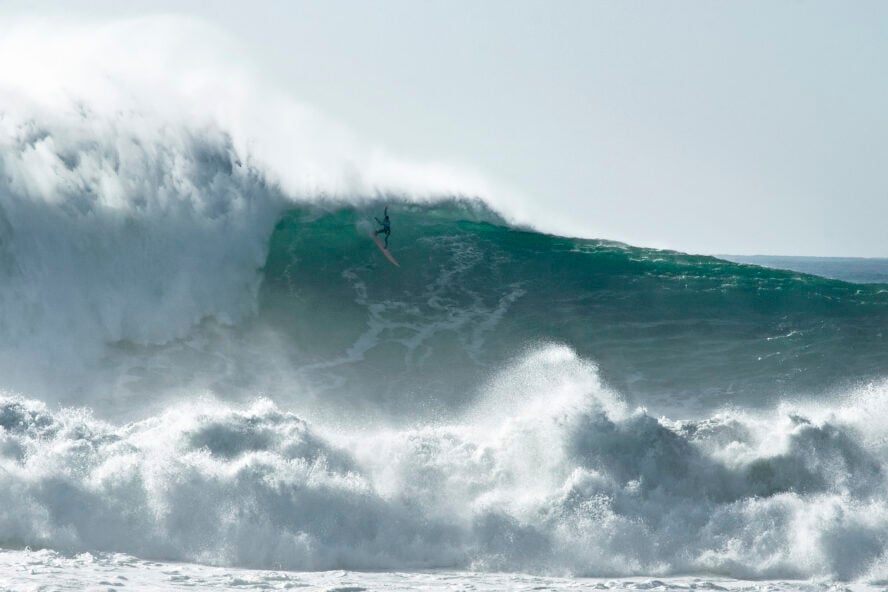
Nazare is home to some of the heaviest waves you’ll find anywhere in the world
Praia do Norte
When people think of Nazare, they think of Praia do Norte. Praia do Norte offers the biggest waves in the region, and the sets that come through are big, heavy, and powerful. While the spot is only suited for the most experienced of big wave surfers, it can be beautiful to view from the shore — exercise caution when viewing as people die on the beach each year.
Praia de Vila
Another popular spot in the area is Praia de Vila, located next to the central promenade of Nazare. At Praia de Villa, surfers will find a powerful beach break with inconsistent rights and lefts. Finally, on the south end of Nazare, next to the harbor, is Praia do Su l— the spot works well during big swells and offers fast, barreling waves. Nazare is a popular tourist destination, but as far as surfing goes, it’s only suitable for very experienced athletes.
I saw the biggest, scariest, and most impressively beautiful cold mountain waves of my life over there.
Aline Adisaka, professional Brazilian standup paddler & surfer
Nazare - Good to Know
Best season:
Winter (October – March)
Best swell direction:
NW swell; SE/E wind
Getting around:
Public transportation is readily available: taxi, trains, and buses
Additional activities:
Day trip to Batalha, kayak along the Sitio headland, and enjoy the local seafood
Philippines
8. Siargao
BEST REEF BREAK
Affordable
Beautiful
Few crowds (if you know where to look)
Warm water
The surfing capital of the Philippines
Siargao is a teardrop shaped island located 800 kilometers southeast of Manila, the capital city. Like many of the islands in the area, Siargao is breathtakingly beautiful, but what sets it apart from the rest is its incredible surf. Siargao is home to 27km of exposed coastline and has the feel of an older Bali. Although Siargao is made up of over thirty surf breaks, the island often experiences long, flat periods, so you’ll want to watch the swell and try to time your trip accordingly.

Siargao is made up of over thirty surf breaks — but often with long flat periods
Cloud 9
The most well-known spot on the island is Cloud 9 — consistently recognized as one of the top ten breaks in the world due to its big, steep waves that break in both directions. A stone’s throw from Cloud 9 is Tuason’s Point, a point break that offers a left-hand barrel that can get pretty heavy.
Siargao’s other breaks
A few other spots in the area are Stimpy’s, Caridad, Cemetery, Pilar, Jacking Horse, and Daku Island. The spots that break close to shore have a tendency to get crowded, but if you hop on a boat to an outer reef, you’ll have a better chance of scoring some empty waves. While the island has potential for waves year-round, your best bet is to visit General Luna during the southwest monsoon and Pilar during the northeast monsoon.
Siargao - Good to Know
Skill level:
Intermediate to advanced
Best season:
Dry season (March – November)
Best swell direction:
E swells; SW/NE winds
Getting around:
Habal-habal (motorcycle taxi) or boat
Additional activities:
Island hopping, visit Magpupungko Rock Pools, swim in Sugba lagoon, or check out Sohoton Cove
California
9. San Clemente
BEST SURF ON USA’S MAINLAND
Good surf for all skill levels
Multiple breaks
Safe for travelers
Crowded
Locals can be territorial
Sharks frequent the lineup
San Clemente’s famous spots
Although I’ve been to a number of incredible surf spots across the globe, my home break in San Clemente will forever be my favorite. San Clemente, a seaside town in Orange County, California, was founded in the 1920s and has been on the map as one of the best surfing spots in the USA for quite some time.
San Clemente is home to a number of world-famous surf spots: T-Street, Upper Trestles, Lower Trestles, and San Onofre. If you’ve ever been surfing in and around New York, you know the story—traffic is unavoidable both on and off the water. But, battling the throngs of people will be well worth it once you drop into a wave at Lowers.

San Clemente is home to several famous surf spots
The four main breaks of Trestles
Trestles is a world-renowned wave and what San Clemente is best known for. Trestles consists of four main breaks: Cotton’s, Uppers, Lowers, and Church. Lowers is the best and most popular spot and frequently hosts surf competitions; it offers an A-frame wave that breaks over a cobblestone bottom. The beginner-friendly breaks are outstanding, not unlike those you get when surfing in Costa Rica.
San Onofre
A few miles south is San Onofre, one of the dreamiest longboarding spots in the world. San Onofre, or San O, as the locals call it, includes The Point, Four Doors, Old Man’s, and Dog Patch. Old Man’s is probably the most famous spot and offers long, rolling waves, perfect for hanging ten. Although San Clemente sees waves year-round, my personal favorite season is fall — the water is warm, and the summertime crowds are gone.
Other hot spots in the area
If you’re new to surfing in Cali (or in general), taking surfing lessons in Santa Cruz is a great choice. They’re hosted by local legends, so you’ll have a wealth of knowledge at your disposal. I’ve already covered all you need to know about surfing in Santa Cruz, so feel free to check it out. The surfing in San Diego is also top-notch, with great late-summer-early-fall swells and a booming community. And for off-the-board activities, California is one of the best places to rock climb in the world, so why not give it a go?
Although I’ve been to a number of incredible surf spots, my home break in San Clemente still takes the cake as my favorite wave.
Rebecca Parsons
San Clemente - Good to Know
Skill level:
Beginner to advanced
Wave type:
Beach breaks; point breaks
Best swell direction:
S/SW; NE/E
Getting around:
Public transportation is lacking; you’ll need a car
Additional activities:
Visit the Surfing Heritage & Culture Center, hiking, standup paddling
Oahu
10. North Shore
WORLD’S BEST SURF
Epic surf
Multiple breaks
World renowned
Competition hotspot
Seasonal
Expensive
Dangerous
The Seven Mile Miracle
Often referred to as the “Seven Mile Miracle,” the North Shore of Oahu is home to some of the best surf in the world. While it’s typically calm and flat during the summer months, the North Shore lights up during the winter, and prime waves can be found up and down the coast.
If you’ve ever been surfing in Maui or Oahu, you’ll know what I’m talking about—Hawaii epitomizes surf culture. On any given winter day, a number of professional surfers can be found on the North Shore, making for an impressive show for those who prefer to stay on the beach. Although there are a few beginner-friendly spots, the North Shore is most famous for the massive waves that can be found at Banzai Pipeline, Sunset Beach, or Waimea Bay.

Surfing at Sunset Beach on the North Shore of Oahu in Hawaii
Big, powerful waves that call for big skills
Pipeline is one of the most famous and most dangerous surf breaks in the world — it offers perfect, barreling waves that break over a shallow reef. Located just past Pipeline is Sunset Beach, which is known for its big, powerful waves and beautiful beach. Waimea Bay, the most famous big-wave spot on all of the North Shore, regularly receives 10–30 foot swells during the winter.
Waimea Bay hosts a number of big wave chargers and is home to the famous “Eddie Would Go” contest, in honor of legendary surfer Eddie Aikau. While many of the famous spots on the North Shore are too challenging for me personally to surf, I’ll never tire of watching the impressive waves and talent that have made the stretch of coast famous. Like the surfing in Kauai, you’ll feel be watching or riding waves with legends-to-be.
While you’re there, make sure to check out the breathtaking Oahu hikes.
The stretch between Haleiwa to the west and Kahuku to the east boasts some of the most iconic surf spots in the sport, and is host to the world's best surfers every winter.
Jay Reale, seasoned Southern California surfer
North Shore - Good to Know
Skill level:
Beginner-Expert
Best season:
Winter (October – April)
Best swell direction:
W/N/NWs well; trade winds
Getting around:
Rent a car or take the bus
Additional activities:
Snorkel, hike, standup paddle
Surf’s up! Time to seek your own swells
Well, that’s it. I’ve covered some of my favorite surf spots around the globe. That’s not to say that you can’t find primo waves in other places: France’s Hossegor, Micronesia’s P-Pass, and the Maldivian Sultans are just a few items on my ever-growing bucket list of surfing adventures. Once the bug bites you and you feel your first high, the surf never stops.
About the author
 Rebecca Parsons Southern California-based surfer and travel writer
Rebecca is a seasoned writer and outdoor enthusiast. Born and raised in Orange County, she has spent countless hours exploring the California coastline. She loves surfing, standup paddling, and anything that involves water. When she’s not in the ocean, you can find her exploring the local trails or sleeping under the stars alongside her adventure pup, Koa.