Sonar API | AIMLAPI (original) (raw)


Sonar
Sonar rapidly retrieves and synthesizes information from diverse sources, delivering clear, cited answers that set a benchmark for real-time research and analytics.
Perplexity Sonar Description
Perplexity AI’s Sonar is an advanced multimodal AI assistant optimized for real-time, context-aware web search, synthesis, and conversational analytics. Designed for both professional and consumer workflows, Sonar combines fast, authoritative information retrieval with robust reasoning over retrieved documents.
Technical Specification
Performance Benchmarks
- Model Architecture: Hybrid system combining proprietary and open-source LLMs (LlaMa 3.1 70B base, custom Perplexity fine-tuning), with integrated real-time web search and multi-document synthesis.
- Context Window: Dynamic, automatically adjusts to the retrieved content and query complexity.
- Tool Integration: Native live web search, academic databases, and citation engine for source-backed answers.
Performance Metrics
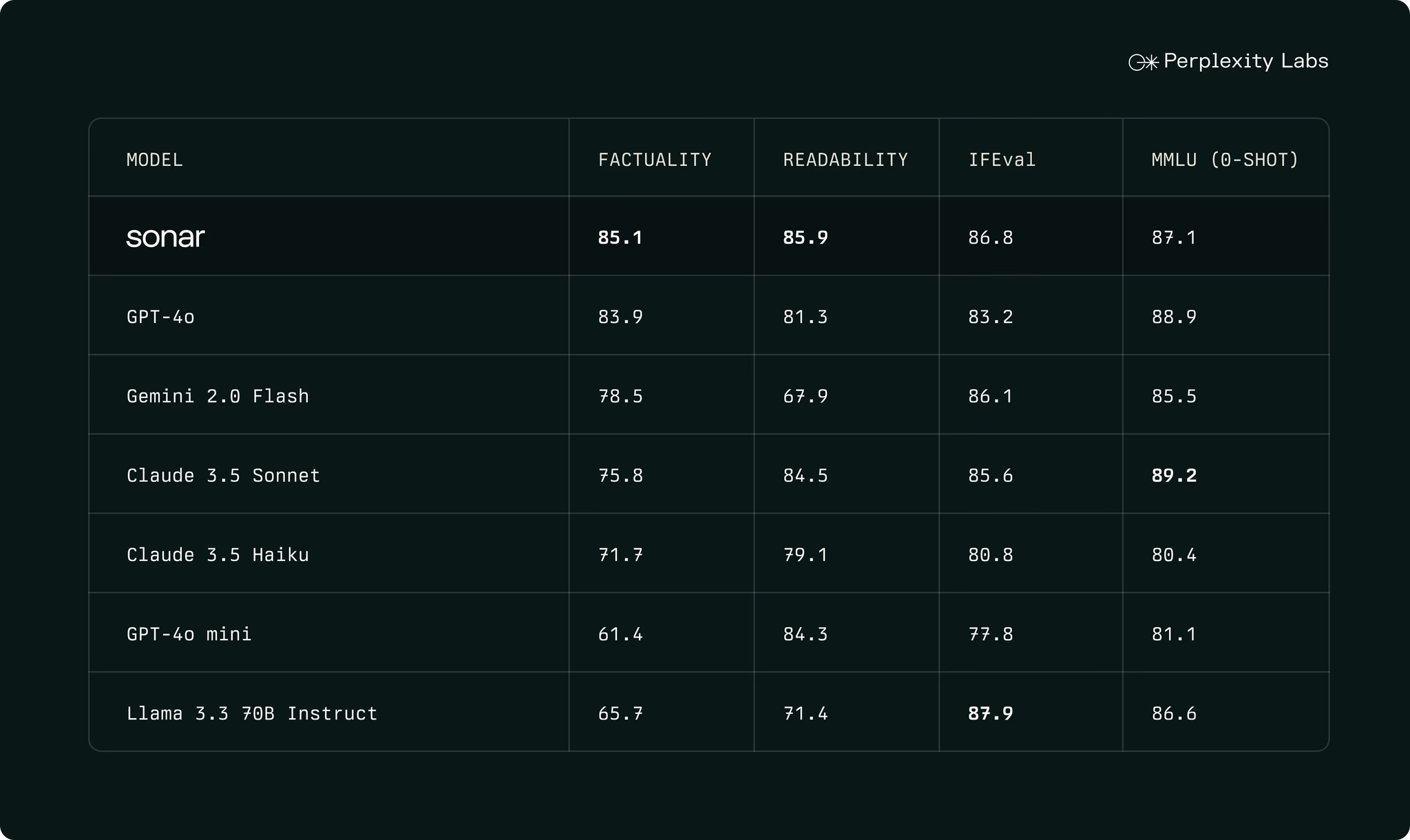
Sonar demonstrates consistency in real-time information retrieval and source-backed answer quality. Its upward trend in query volume and user engagement signals strong market fit for knowledge-intensive workflows. The trade-off for rapid, cited answers is slightly higher latency compared to pure LLM chatbots, but with greater accuracy and transparency.
API Pricing
- Input: $1.3 per million tokens
- Output: $1.3 per million tokens
Key Capabilities
Perplexity Sonar API delivers authoritative outputs for information-dense workflows.
- Advanced Search & Synthesis: Excels in cross-referencing multiple web sources, distilling complex information, and presenting it with clarity and transparency.
- Conversational Analytics: Supports multi-turn, context-aware dialogues for research, business intelligence, and decision support.
- Tool Utilization: Integrates proprietary live web search, enabling real-time fact-checking and source citation.
Code Sample
Comparison with Other Models
Vs. Claude 4 Opus: Sonar specializes in live, cited answers from the web, while Claude 4 Opus leads in autonomous coding, reasoning, and agentic workflows. Sonar is optimized for users who need answers grounded in the latest, most authoritative sources rather than long-context reasoning or code generation.
Vs. Gemini 2.5: Sonar emphasizes real-time search and synthesis; Gemini models offer broad multimodal capabilities and long-context reasoning but may not always surface citations or real-time data as explicitly.
Vs. OpenAI GPT-4: Perplexity Sonar is purpose-built for retrieval-augmented generation (RAG) and source transparency; GPT-4 is a generalist model, best for broad reasoning and creative tasks without built-in web sourcing.
Limitations
Perplexity/Sonar specializes in real-time research, multi-source synthesis, and cited analytics, setting it apart for up-to-date, accurate, and verifiable answers. However, its limitations are equally distinctive:
- No Traditional Coding or Reasoning Benchmarks: Unlike models such as Claude Opus 4 or Kimi K2, Perplexity Sonar does not publish standard coding or reasoning metrics (e.g., SWE-bench, LiveCodeBench) because its architecture is optimized for real-time, sourced knowledge retrieval rather than autonomous coding or long-horizon reasoning
- Best for Research and Analytics, Not Code: It excels in tasks requiring live web search, deep citation, and business intelligence, but is less suitable for pure code generation, agentic autonomy, or scenarios where generative program synthesis is critical.
- Static Knowledge and Reasoning: For tasks beyond the scope of its search-embedded, live-updated knowledge, Perplexity Sonar operates like any RAG (Retrieval-Augmented Generation) system: without real-time, cited web access, it cannot claim dramatic accuracy or recency advantages over other frontier models.
API Integration
Accessible via AI/ML API. Documentation: available here
Perplexity Sonar Description
Perplexity AI’s Sonar is an advanced multimodal AI assistant optimized for real-time, context-aware web search, synthesis, and conversational analytics. Designed for both professional and consumer workflows, Sonar combines fast, authoritative information retrieval with robust reasoning over retrieved documents.
Technical Specification
Performance Benchmarks
- Model Architecture: Hybrid system combining proprietary and open-source LLMs (LlaMa 3.1 70B base, custom Perplexity fine-tuning), with integrated real-time web search and multi-document synthesis.
- Context Window: Dynamic, automatically adjusts to the retrieved content and query complexity.
- Tool Integration: Native live web search, academic databases, and citation engine for source-backed answers.
Performance Metrics
Sonar demonstrates consistency in real-time information retrieval and source-backed answer quality. Its upward trend in query volume and user engagement signals strong market fit for knowledge-intensive workflows. The trade-off for rapid, cited answers is slightly higher latency compared to pure LLM chatbots, but with greater accuracy and transparency.
API Pricing
- Input: $1.3 per million tokens
- Output: $1.3 per million tokens
Key Capabilities
Perplexity Sonar API delivers authoritative outputs for information-dense workflows.
- Advanced Search & Synthesis: Excels in cross-referencing multiple web sources, distilling complex information, and presenting it with clarity and transparency.
- Conversational Analytics: Supports multi-turn, context-aware dialogues for research, business intelligence, and decision support.
- Tool Utilization: Integrates proprietary live web search, enabling real-time fact-checking and source citation.
Code Sample
Comparison with Other Models
Vs. Claude 4 Opus: Sonar specializes in live, cited answers from the web, while Claude 4 Opus leads in autonomous coding, reasoning, and agentic workflows. Sonar is optimized for users who need answers grounded in the latest, most authoritative sources rather than long-context reasoning or code generation.
Vs. Gemini 2.5: Sonar emphasizes real-time search and synthesis; Gemini models offer broad multimodal capabilities and long-context reasoning but may not always surface citations or real-time data as explicitly.
Vs. OpenAI GPT-4: Perplexity Sonar is purpose-built for retrieval-augmented generation (RAG) and source transparency; GPT-4 is a generalist model, best for broad reasoning and creative tasks without built-in web sourcing.
Limitations
Perplexity/Sonar specializes in real-time research, multi-source synthesis, and cited analytics, setting it apart for up-to-date, accurate, and verifiable answers. However, its limitations are equally distinctive:
- No Traditional Coding or Reasoning Benchmarks: Unlike models such as Claude Opus 4 or Kimi K2, Perplexity Sonar does not publish standard coding or reasoning metrics (e.g., SWE-bench, LiveCodeBench) because its architecture is optimized for real-time, sourced knowledge retrieval rather than autonomous coding or long-horizon reasoning
- Best for Research and Analytics, Not Code: It excels in tasks requiring live web search, deep citation, and business intelligence, but is less suitable for pure code generation, agentic autonomy, or scenarios where generative program synthesis is critical.
- Static Knowledge and Reasoning: For tasks beyond the scope of its search-embedded, live-updated knowledge, Perplexity Sonar operates like any RAG (Retrieval-Augmented Generation) system: without real-time, cited web access, it cannot claim dramatic accuracy or recency advantages over other frontier models.
API Integration
Accessible via AI/ML API. Documentation: available here