Building a No-Code AI Lead Generation Workflow (original) (raw)
AI sales agents promise automated prospecting and outreach, but most are bundled as full sales engagement platforms costing significantly once onboarding, data enrichment, integrations, and premium support are added. After reviewing leading AI SDR and lead generation tools and building hands-on workflows, I found that many teams need something simpler, more flexible, and more cost-effective.
See top AI lead generation tools, AI role in lead generation, and real-world n8n workflows, including a step-by-step tutorial on capturing leads via a Telegram bot, scraping relevant data, and automatically sending the results to Google Sheets:
Many AI SDR tools (e.g. Regie.ai, Jason AI, AiSDR) include basic prospect finding (via LinkedIn search, small databases, intent data).
However, their core strength is in engagement (personalized messaging, qualifying, nurturing).
1. Lead data providers
These tools offer contact information, company data, and tools for sales and marketing teams to find and engage with prospects.
- Apollo (Apollo.io): Database of 275M+ contacts.1 More affordable than ZoomInfo, but records can be outdated, leading to higher bounce rates.
- ZoomInfo: Database of 200M+ contacts, with intent data.2
- Success AI: Database of 700M+ contacts combined with outreach tools. Coverage is narrower than Apollo/ZoomInfo.3
- Gotelescope.ai (Telescope): Dataset of ~900M contacts / 50M companies across 100+ countries. Broader in scale than Apollo/ZoomInfo..4
2. AI SDR & nurturing platforms
These automate outreach, conversations, qualification, and follow-up.
- Drift: Website chatbots for inbound qualification. Strong for real-time chat, weaker for outbound nurturing.
- Exceed.ai: Multi-channel automation (email, SMS, chat). Offers broader nurturing channels than Drift does, though it supports fewer integrations overall.
- Regie.ai: Generates outbound sequences and sales copy. Useful when paired with clean data from providers..
- Conversica: Email & SMS qualification. Mature product, but responses can sound scripted compared to newer SDRs.
- AiSDR, Jason AI, Artisan Ava, Bella, Unify: Newer AI SDRs focused on scale + automation. Faster than Conversica/Exceed.
- Aimdoc AI: Lightweight website chatbot for inbound leads. Similar to Drift but simpler.
These help identify, track, and engage with potential customers and influencers within online and offline communities.
- Gotelescope.ai (community role): Broader community monitoring than Reddit-only.
4. Custom AI workflows
Build your own lead-gen flows if off-the-shelf tools don’t fit.
- cbk.ai (ChatBotKit): SDKs + templates for custom chatbots and workflows. More flexible than Drift/Landbot, but requires developer resources.
5. Workflow automation & integration platforms
Enables you to connect different applications and automate processes across the lead generation stack. Note that, these platforms don’t provide data or run outreach directly.
Typical uses include moving contacts from a provider like Apollo into a CRM, triggering outreach campaigns, or routing leads to sales teams.
Examples include:
- Creatio: a no-code platform that enables teams to build AI agents and business apps without writing code.
- **n8n: Open-source workflow automation platform.
- Zapier: Widely adopted for no-code integrations across thousands of apps.
- Make: Visual workflow builder with complex branching logic.
- Tray.io: Enterprise-grade automation with stronger scalability and governance.
Compared with Custom AI workflows (e.g., cbk.ai, which is about building AI-driven agents), these platforms emphasize connecting existing tools together rather than creating new AI logic.
How can you use AI for lead generation?
1. Finding leads
AI can help identify potential prospects by analyzing website engagement, monitoring online activity, and recognizing behaviors indicative of strong buying intent. AI helps capture and interpret demand signals; it does not generate fundamental customer desire on its own.
AI can streamline lead generation by:
- Engaging visitors: AI chatbots capture leads by offering value (consultations, audits, resources) in exchange for details.
- Monitoring social channels: AI tools track activity on LinkedIn, Instagram, or messaging apps to flag potential prospects.
- Detecting high-intent behavior: AI identifies signals like repeat visits to pricing pages or downloads, enabling timely outreach before interest fades.
2. Qualifying leads
If you generate plenty of leads, the bigger challenge is filtering out those that aren’t worth your team’s time. AI excels here because it recognizes patterns that humans often miss and applies them consistently.
AI can enhance lead qualification by:
- Conversational pre-qualification: Chatbots engage prospects in natural dialogues, asking about budget, role, or company size, and offering tailored insights in return.
- Behavioral tracking: AI scores interest based on digital actions like repeat visits, time on site, or demo requests, and can trigger targeted follow-ups.
- Lead scoring, segmentation, and routing: AI ranks leads (hot, warm, cold), automates follow-up actions, and routes them to the right sales team or nurturing flow.
3. Contacting leads
Once prospects are identified and qualified, AI can support multi-channel outreach to keep the momentum going.
AI can improve lead engagement across multiple channels:
- Email: Automates personalized follow-ups and nurturing sequences, triggered by lead interactions.
- Text (SMS or WhatsApp): Ideal for instant reminders or confirmations—short, clear, and always with consent.
- Phone calls: Flags high-value leads for quick outreach, equipping reps with AI-generated scripts and talking points.
- Social media: Keeps conversations active on platforms where leads engage most, boosting response rates through timely interactions.
4. Optimizing & monitoring
- Tracking KPIs: conversion rate, time-to-contact, qualification accuracy, and engagement per channel. Monitor model drift and false positives.
- Learning from data: use AI to surface which touchpoints and messages correlate with conversion and to recommend next best actions.
- Real-world proofing: coordinated efforts between marketing platforms and consulting partners (for example, a Salesforce Marketing Cloud partnership with IBM Consulting) have shown measurable uplift from better segmentation and personalization; still, gains depend on data quality and execution.
Implementation of AI in lead generation best practices
Before adopting AI:
- Evaluate your current process to identify bottlenecks.
- Choose tools that integrate with existing workflows and CRM systems.
- Train employees to ensure adoption and comfort with AI systems.
- Monitor results continuously and refine models based on performance data.
AI for lead generation works best when it enhances human relationships, not when it replaces them.
Don’t miss our benchmarks and data-driven insights. The button opens Google; selecting AIMultiple confirms that you wish to see AIMultiple more often in Google search results.
 Add as preferred source
Detailed examination of n8n
Building a no-code AI lead generation workflow with n8n
Tutorial: Web scraping with n8n for automated lead generation5
What does this workflow do?
This workflow sends a request to the Telegram bot, the AI interprets it, and once it has the details like role, location, and industry.
It triggers a scraper to collect relevant leads. Then the data is saved directly into Google Sheets, and the bot replies with a confirmation of how many contacts were added.
Below, see the step-by-step implementation process:
1. Get n8n hosting
To begin, you’ll need hosting for your n8n automation platform. There are three main options:
- Host locally (free): You can install n8n on your computer at no cost. However, this option is more technical and requires manual setup.
- WebSpaceKit hosting (~$4/month): A cost-effective option that gives you unlimited workflow executions and active workflows.
- n8n Cloud (~$20/month): The official hosting by n8n, but it comes with some feature limits compared to self-hosted options.
- n8n-specific Managed Platforms (e.g., n8nhost.io, MassiveGRID): Platforms built specifically for n8n hosting, offering one-click setup, automatic updates, and managed infrastructure.
2. Setup n8n
Once your hosting plan is active, the next step is to set up n8n. The setup needs to be done once, and after that, you can build as many automations as you like.
- Start the setup: In your hosting dashboard, click on “Go to Setup.”
- Enter details: Fill in the required information, click Next, and complete the wizard.
- Access the dashboard: After setup, you’ll land on the n8n dashboard, where you can begin creating workflows.
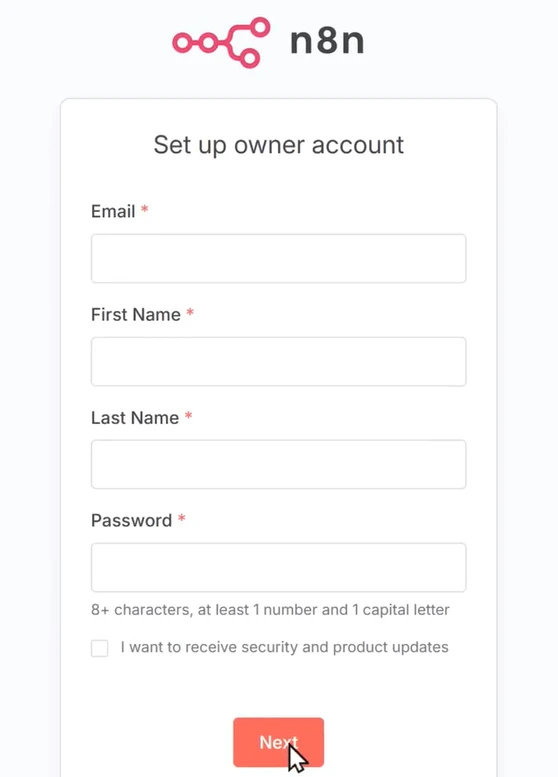
From here, you have two options:
- Build from scratch by adding nodes one by one to design your own workflow.
- Use a ready-made workflow template for faster setup.
We’ll go with the ready-made lead generation workflow template. Note that this template is a paid option provided by WebSpaceKit hosting. However, you can also find lead generation templates on the official n8n website. Keep in mind that some of these templates require a self-hosted n8n instance to run properly.
Here is the WebSpaceKit template:
After downloading the template, you can launch the n8n dashboard and click “Import” in the top-right corner to bring the template in.
3. Set up the workflow
You can either download a ready-made workflow template or build one from scratch.
Below is an overview of the workflow we will be building for:
After importing, you’ll see warnings on certain nodes that still need to be configured.
- Telegram trigger node: Starts the workflow when a user sends a message to the bot.
- Transcribe node (Optional): Converts Telegram voice messages into text using OpenAI.
- Lead agent node: The “brain” of the workflow. Interprets user queries, remembers context, and decides when to trigger scraping
4. Set up Telegram trigger node
To set it up, first, we need to connect our Telegram node to n8n. To do this, we’ll create a new credential. Open the node, click on the option, and select Create New Credentials.
Below is a screenshot of the node details:
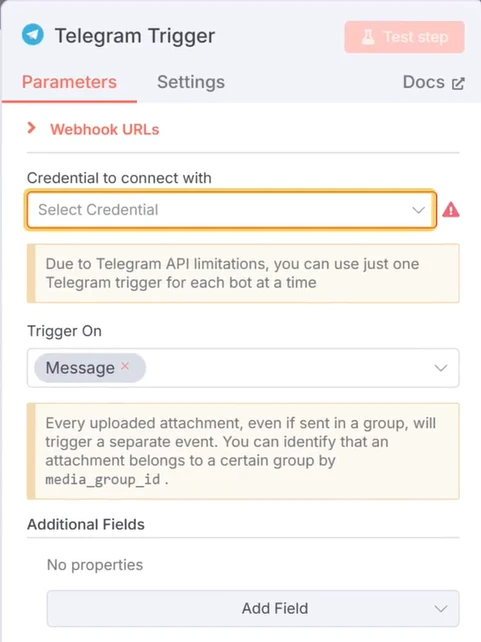
5. Set up the lead agent node
The lead agent node is the brain of the workflow. It interprets user requests, retrieves lead information, and decides when to trigger scraping:
- OpenAI chat model: This node interprets the user’s request. For example, if someone types “Find SaaS leads in New York”, the Chat Model processes the message, understands the intent, and guides the workflow. It acts as the “brains” of the system.
- Simple memory: This node allows the AI to track previous interactions. For instance, if a user first says “Find developers in Texas” and then follows up with “in the IT industry”, the memory ensures both messages are linked together rather than treated separately.
- leadScraping (Tool): Once all the required details (job role, location, industry) are gathered, this tool is triggered. It scrapes relevant lead information—such as names, emails, job titles, LinkedIn profiles, and prepares the data to be stored in Google Sheets.
6. Configure the sub workflow for scraping
This sub-workflow takes the user’s request, such as job title, location, and industry, and passes it to a scraper tool (e.g, Apollo Scraper or Bright Data).
In this example, the Apify platform is used to extract leads from a large professional database. The scraped information (name, email, LinkedIn profile, seniority, etc.) is cleaned and then stored in Google Sheets. A confirmation is sent back through Telegram, stating the number of leads added.
Here is an overview of the lead generation agent, as it is asked to find leads in the IT industry:
Here is the final example of how the leads appear in Google Sheets:
What is n8n?
While n8n is a workflow automation platform that can also be used for lead generation.
It offers access to more than 330+ prebuilt lead generation workflows. With n8n, you are free to build as many workflows as you like, and you pay when they run.
Local hosting is free but technical. The n8n Cloud starter plan costs €24 (~$27) per month, billed monthly, and includes 2,500 workflow runs.6
How does n8n help lead generation?
- Automated lead enrichment: It can handle automated lead enrichment by connecting form tools like Jotform, Typeform, or HubSpot with verification services, ensuring the data received is clean and complete.
- Flexible CRM integration: It also makes CRM integration surprisingly flexible. Whether you’re using Pipedrive, Salesforce, or HubSpot, n8n’s node-based workflows let you send leads wherever you need them.
- Automated triggers: It triggers actions automatically whenever leads change status or complete activities like purchases or form submissions.
n8n lead generation workflows
- Lead generation agent: Automatically find business leads by industry and location.7
- LeadBot autopilot: Chat-to-Lead for Salesforce: Convert website chat conversations into Salesforce leads.8
- Qualify & reach out to B2B Leads with Groq AI, Apollo, Gmail & Sheets: Capture leads, enrich with Apollo, and send outreach emails automatically.9
- Lead generation system: Google Maps to email scraper with Google Sheets Export: Scrape businesses from Google Maps and create email prospect lists.10
- Lead workflow: Yelp & Trustpilot scraping + OpenAI analysis via BrightData: Scrape reviews from Yelp/Trustpilot and analyze them with AI to find potential leads.
- Build targeted prospect lists with HubSpot: Discover companies that match your ICP, enrich lead data, and send directly to HubSpot.11
- Lead generation automation on LinkedIn: Automate LinkedIn lead collection, enrichment, and personalized outreach.12
FAQs
AI lead generation refers to the use of AI to identify potential customers.
In practice, AI lead generation follows three stages:
1. discovering potential leads,
2. qualifying them based on fit and intent,
3. engaging them at the right time with personalized messaging.
AI qualifies leads through conversational chatbots, behavioral tracking (like repeat visits or downloads), and lead scoring models that rank prospects as hot, warm, or cold.
Popular tools include AI chatbots, CRM platforms with AI scoring, workflow automation tools like n8n, and data-scraping services like Apify or Apollo.
Cite this research
Pick the format that matches where you're publishing. Pasting the link version into your CMS preserves the backlink.
Cem Dilmegani (2026) - "Building a No-Code AI Lead Generation Workflow". Published online at AIMultiple.com. Retrieved March 30, 2026, from: https://aimultiple.com/ai-lead-generation [Online Resource]
Dilmegani, C. (2026, March 30). Building a No-Code AI Lead Generation Workflow. AIMultiple. https://aimultiple.com/ai-lead-generation
@misc{dilmegani2026, author = {Dilmegani, Cem}, title = {{Building a No-Code AI Lead Generation Workflow}}, year = {2026}, month = mar, howpublished = {\url{https://aimultiple.com/ai-lead-generation}}, note = {AIMultiple. Retrieved March 30, 2026} }

Cem Dilmegani
Principal Analyst
Cem has been the principal analyst at AIMultiple since 2017. AIMultiple informs hundreds of thousands of businesses (as per similarWeb) including 55% of Fortune 500 every month.
Cem's work has been cited by leading global publications including Business Insider, Forbes, Washington Post, global firms like Deloitte, HPE and NGOs like World Economic Forum and supranational organizations like European Commission. You can see more reputable companies and resources that referenced AIMultiple.
Throughout his career, Cem served as a tech consultant, tech buyer and tech entrepreneur. He advised enterprises on their technology decisions at McKinsey & Company and Altman Solon for more than a decade. He also published a McKinsey report on digitalization.
He led technology strategy and procurement of a telco while reporting to the CEO. He has also led commercial growth of deep tech company Hypatos that reached a 7 digit annual recurring revenue and a 9 digit valuation from 0 within 2 years. Cem's work in Hypatos was covered by leading technology publications like TechCrunch and Business Insider.
Cem regularly speaks at international technology conferences. He graduated from Bogazici University as a computer engineer and holds an MBA from Columbia Business School.