Sea Snakes - Facts, Venom & Habitat Information (original) (raw)
Sea snakes are closely related to Cobras. They are aquatic rather than land dwelling snakes. True sea snakes only live in water. Sea Snakes have adapted to a life in water and have small flattened heads that minimizes water resistance when they swim. The Sea Snakes body is compressed as an adaptation for swimming and the snakes are so thoroughly aquatic that they are either clumsy or slow when brought ashore.

Sea Snake Characteristics
Sea Snakes are only moderately large, rarely exceeding 2 metres in length, often with peculiarly small heads for their body size.
Only genus ‘Laticauda’ (which includes the Black Banded Sea Krait) has the typical broad ventral scales of snakes and it is often considered the least advanced of the sea snakes. Nevertheless, similar to cetaceans, their lungs still require them to surface occasionally to breathe. Oxygen intake through the skin has been demonstrated in sea snakes. Sea snakes like warm, tropical waters, however, when the water gets too warm, they swim down to cooler temperatures.
Transmitters attached to yellow-bellied sea snakes show they can dive to about 150 feet and can stay underwater for more than three hours. Like seabirds and sea turtles, sea snakes have special glands that collect extra salt from the blood. The snakess salt glands lie beneath their tongues. Each time a sea snake flicks its tongue, it is ejecting salt back into the ocean.
Sea snakes have specialized flattened tails for swimming and have valves over their nostrils which are closed underwater. Unlike eels, sea snakes lack gills or fins, instead having scales and spending much of their time underwater, they must surface regularly to breathe.
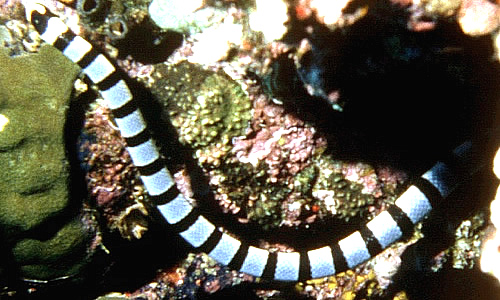
Sea Snake Habitat
Sea snakes are confined to the tropical oceans, chiefly the Indian Ocean and the western Pacific Ocean. The yellow-bellied sea snake, (Pelamis platurus), extends to the eastern Pacific. The olive sea snake, (Aipysurus laevis), tends to live in reefs.
Sea Snake Behaviour and Diet
The yellow-bellied sea snake (Pelamis platurus) is pelagic (living in open oceans or seas rather than waters adjacent to land or inland waters) and is seen on occasions floating in massive groups. Fish that come up to shelter under slicks provide food for the snakes. Occasionally these yellow-bellied sea snakes get washed up on beaches after storms and pose a hazard to children.
Sea snakes are aggressive only during the mating season in the winter, the sea snake is very curious and they become fascinated by elongated objects such as high pressure hoses.
The Sea snakes favourite food is fish. Sea snakes prey on fish (including eels) and crustaceans. A couple of species are specialised in eating fish eggs. Others are specialised in eating certain fish species.
Sea Snake Reproduction
Except for a single genus, all sea snakes are ovoviviparous (development of eggs that remain within the mothers body up until they hatch or are about to hatch.). The young are born alive in the water where they live out their entire life cycle. In some species, the young are quite large, sometimes up to half as long as their mother. The one exception is the genus ‘Laticauda’, which are oviparous (animals that lay eggs with little or no other embryonic development within the mother). Its five species all lay their eggs on land.
Sea Snake Venom
Sea snakes may not be the most venomous in the world, however, their venom is more toxic than that of Mojave rattlesnakes and king cobras. Sea snakes venom contains some of the same chemicals found in cobra venom, only more concentrated in form.
What is a Sea Snakes?
Sea snakes are closely related to Cobras. They are aquatic rather than land dwelling snakes.
What do Sea Snakess eat?
Sea Snake Behaviour and DietnnnnThe yellow-bellied sea snake (Pelamis platurus) is pelagic (living in open oceans or seas rather than waters adjacent to land or inland waters) and is seen on occasions floating in massive groups.
Where do Sea Snakess live?
Sea Snake HabitatnnnnSea snakes are confined to the tropical oceans, chiefly the Indian Ocean and the western Pacific Ocean.
Are Sea Snakess endangered?
Sources & ReferencesnnnnnIUCN Red List u2014 HydrophiinaenAnimal Diversity Web u2014 HydrophiinaenWikipedia u2014 Hydrophiinae
How big do Sea Snakess get?
Sea Snake CharacteristicsnnnnSea Snakes are only moderately large, rarely exceeding 2 metres in length, often with peculiarly small heads for their body size.
Sources & References
Cite This Page
APA
Joanne Spencer (2026, April 15). Sea Snakes. Animal Corner. Retrieved 2026, May 18, from https://animalcorner.org/animals/sea-snakes/
MLA
Joanne Spencer. "Sea Snakes." Animal Corner, 2026, April 15, https://animalcorner.org/animals/sea-snakes/.
Click to copy
Joanne Spencer is the founder and lead writer at Animal Corner, where she has been researching and writing about wildlife since 2005. With over 19 years of experience in animal behavior, ecology, and conservation, Joanne has authored hundreds of species profiles and educational guides covering mammals, birds, reptiles, amphibians, and marine life. Her work draws on field observations, peer-reviewed research, and partnerships with conservation organizations to deliver accurate, accessible animal information for students, educators, and wildlife enthusiasts worldwide.