Tortoise - Facts, Life Span, Diet & Habitat Information (original) (raw)
A Tortoise is a land-dwelling reptile of the order Testudines.
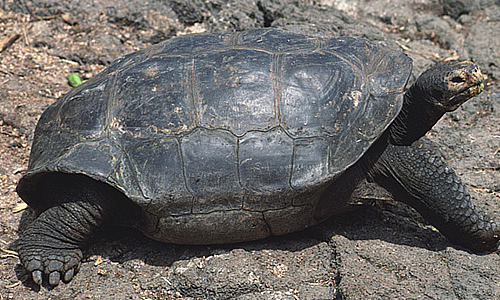
Tortoises are found worldwide with the most famous tortoise of all, the Giant Tortoise Lonesome George who lived on the Galapagos Islands near Ecuador. Tortoises, like their aquatic cousins, the Turtles, have a hard shell which protects their body.
The top shell is called the carapace (a dorsal section of an exoskeleton or shell) and the bottom is called the plastron (the nearly flat part of the shell structure). The carapace and the plastron are connected by what is called the ‘bridge’. The shell is covered with scutes which are scales that are made of keratin (the same protein that our fingernails are made of). The carapace can help indicate the age of the tortoise by the number of concentric rings, much like the cross-section of a tree.
Many animals have scales, but none are quite as impressive as those on display with a tortoise or a turtle.

Many tortoises can retract their head, their four limbs and tail into the shell for protection. Tortoises have a beak but no teeth and no external ears, just two small holes on the sides of the head. Across the different species, tortoises can vary in size from a few centimetres up to two metres in length. Male tortoises tend to have a longer, protruding neck plate than their female relatives.
Tortoises tend to be diurnal (active during the day) animals with tendencies to be crepuscular (animals that are primarily active during the twilight), depending on the ambient temperatures. Tortoises are generally reclusive and shy creatures.
Tortoise Diet
Most land based tortoises are herbivores, feeding on grazing grasses, weeds, leafy greens, flowers and certain fruits. Their main diet consists of alfalfa, clover, dandelions and leafy weeds.
Tortoise Reproduction
Female tortoises dig and lay about a dozen eggs in burrows or holes they dig.
Hatchlings take approximately 90 – 120 days to incubate from eggs the size of a ping-pong ball.
The hatchlings break out of their shells with a front beak. Most hatchlings are born with an embryonic egg sac which serves as a source of food for the first couple of days. Tortoise hatchlings are capable of eating solid food in about 3 – 7 days.
Tortoise Life span
Tortoises generally have life spans comparable with those of human beings, however, some tortoises have been known to have lived longer than 150 years. The lifespan for individual species can vary widely and there are a number of reasons for this, including many environmental factors.
You can get a feel for the rough lifespans of each of the species in the table I’ve provided at the bottom of this post.
Tortoise History
Tortoises and Turtles have existed since the era of the dinosaurs, some 300 million years ago. Tortoises and Turtles are the only surviving branch of the even more ancient clade Anapsida, which includes groups such as the procolophonoids, millerettids and pareiasaurs. Most of the anapsids became extinct in the late Permian period, with the exception of the procolophonoids and the precursors of the testudines (turtles and tortoises).
A Tortoise As A Pet
What Supplies Do You Need To Provide A Home For A Tortoise?
Of course, not all tortoises are suitable as pets, only a few of the smaller and more populous species should be considered as such. But for those that are looking for one of these companions to add to your family, there are a few things you will need:
- A suitable enclosure or terrarium that provides enough space and stimulation for your hard shelled friend
- Thermometer, heat lamp and heat mat to help regulate their environmental temperature
- A suitable reptile feeding dish and gravel or substrate to line the base of their enclosure
- A safe outdoor space where outside threats are unlikely to invade, ie – the neighbors dog.
Pros And Cons Of Owning A Tortoise As A Pet
Pros
- Quiet (unless mating)
- No Shedding of hair or mess
- Very little maintenance required other than regular enclosure cleaning and having the right equipment
- Docile and unlikely to run away
- Minimal allergy risk
Cons
- Lifespan – great for the tortoise, but requires you to think about and commit to long term care
- Can grow to be very large
- They don’t need much, but what they do need is very specialized, particularly if they are a hibernating variety.
Tortoise FAQs
Sources & References
What is the difference between a turtle and a tortoise?
There are a few differences between these two cousins. The first and most obvious is habitat. Most turtles are water dwellers after being born on land they make their way to the sea or freshwater. Tortoises on the other hand tend to be land dwellers.u003cbru003eu003cbru003eAnother major difference is diet. While most turtles are u003ca href=u0022https://animalcorner.org/blog/omnivores/u0022 target=u0022_blanku0022 data-type=u0022blogu0022 data-id=u002222817u0022 rel=u0022noreferrer noopeneru0022u003eomnivoresu003c/au003e, most tortoises prefer a herbivorous diet. u003cbru003eu003cbru003eTurtles can cover vast distances in the water, but a tortoise is very slow moving on land.
Why do tortoise live so long?
Slow metabolism has a part to play in the longevity of tortoises. However, research into the deceased Giant Turtle Lonesome George by several institutions, has revealed that there are many genetic variations down to DNA level, that effect the process of aging. They have incredible DNA repair and immune response as a result of their remarkable genetic make-up.
Tortoise Species List
| Species | Genus | Binomial Name | Size (length) | Lifespan | IUCN Status |
|---|---|---|---|---|---|
| Speckled (Cape) Tortoise | Chersobius | Chersobius signatus / Homopus signatus | Between 6-10 cm | Over 100+ years | Endangered |
| Egyptian Tortoise / (Kleinmann’s Tortoise) | Testudo | Testudo kleinmanni | Up to 13 cm | Between 70-100 years | Critically Endangered |
| Russian Tortoise | Agrionemys | Agrionemys horsfieldii | Bwetween 13-25 cm | Between 40-50 years | Vulnerable |
| Greek Tortoise | Testudo | Testudo Graeca | Between 13-28 cm | Up to 125+ years | Vulnerable |
| Hermann’s Tortoise | Testudo | Testudo hermanni | Up to 18 cm | Up to 75 years | Near Threatened |
| Pancake Tortoise | Malacochersus | Malacochersus tornieri | Up to 18 cm | Up to 25 years | Critically Endangered |
| Gopher Tortoise | Gopherus | Gopherus polyphemus | Between 20-40 cm | Average 40 years, but oldest is 101 years old as of 2023 | Vulnerable |
| Speke’s Hingeback Tortoise | Kinixys | Kinixys belliana | Up to 22 cm | Up to 20 years | Not Evaluated |
| Indian Star Tortoise | Geochelone | Geochelone elegans | Up to 25 cm | Between 30-80 years | Vulnerable |
| Elongated Tortoise | Indotestudo | Indotestudo Elongata | Up to 30 cm | Between 40-50 years | Endangered |
| Desert Tortoise | Gopherus | Gopherus agassizii | Between 25-36 cm | Between 50-80 years | Critically Endangered |
| Red Footed Tortoise | Chelonoidis | Chelonoidis carbonarius | Between 30-40 cm | Up to 50 years | Vulnerable |
| Marginated Tortoise | Testudo | Testudo Marginata | Up to 35 cm | Between 100-140 years | Least Concern |
| Burmese Star Tortoise | Geochelone | Geochelone playtona | Up to 35 cm | Between 30-80 years | Critically Endangered |
| Impressed Tortoise | Manouria | Manouria impressa | Up to 35 cm | Unknown | Vulnerable |
| Angonoka Tortoise | Astrochelys | Astrochelys yniphora | Between 38 – 43cm | Up to 180+ years | Critically Endangered |
| Yellow Footed Tortoise | Chelonoidis | Chelonoidis Denticulatus | Up to 40 cm | 50-60 years | Vulnerable |
| Radiated Tortoise | Astrochelys | Astrochelys radiata | Up to 40 cm | 100-188 years | Critically Endangered |
| Leopard Tortoise | Stigmochelys | Stigmochelys pardalis | Up to 69 cm | 50-100 years | Least Concern |
| African Spurred Tortoise | Centrochelys | Centrochelys sulcata | Up to 83 cm | 70-100 years | Endangered |
| Aldabra Tortoise | Aldabrachelys | Aldabrachelys gigantea | Up to 122 cm | Estimated to be up to 200 years! | Vulnerable |
| Galapagos Giant Tortoise | Chelonoidis | Chelonoidis nigra | Between 61-150 cm | 100-150 years | Various subspecies all listed as Vulnerable or above |
Cite This Page
APA
Joanne Spencer (2026, April 7). Tortoise. Animal Corner. Retrieved 2026, May 17, from https://animalcorner.org/animals/tortoise/
MLA
Joanne Spencer. "Tortoise." Animal Corner, 2026, April 7, https://animalcorner.org/animals/tortoise/.
Click to copy
Joanne Spencer is the founder and lead writer at Animal Corner, where she has been researching and writing about wildlife since 2005. With over 19 years of experience in animal behavior, ecology, and conservation, Joanne has authored hundreds of species profiles and educational guides covering mammals, birds, reptiles, amphibians, and marine life. Her work draws on field observations, peer-reviewed research, and partnerships with conservation organizations to deliver accurate, accessible animal information for students, educators, and wildlife enthusiasts worldwide.