Insects, Bugs & Creepy Crawlies Facts & Information (original) (raw)
Insects are all around us, they make up more than half of all living things on the planet. There are more than a million known insect species and there are probably many more waiting to be discovered. True insects are those that are classified in the Class ‘Insecta’.

They are a major group of arthropods (a type of invertebrate, animals that lack a backbone), and the most diverse group of animals on the Earth. Insects rank among the most successful animals on our planet. The study of insects is called ‘entomology’.
Insects may be found in nearly all environments on the planet, although only a small number of species are found in the oceans where crustaceans, such as crabs and shrimp, tend to predominate instead.
Insects live in almost every habitat on land. Some live in extremely cold environments like those who survive in the peaks of the Himalayas and produce a kind of anti-freezing substance that prevent their body fluids from freezing and those who reside in the Sahara Desert in extremely hot temperatures of over 50 degrees Celsius (122 degrees Fahrenheit).
There are approximately 5,000 dragonfly species, 2,000 praying mantis, 20,000 grasshoppers, 170,000 butterflies and moths, 120,000 fly, 82,000 true bugs, 360,000 beetles and 110,000 bee, wasp and ant species described to date. Estimates of the total number of current species, including those not yet known to science, range from two million to fifty million.
All insects have a hard exoskeleton (external skeleton) and a 3 part segmented body inclusive of a head, thorax and abdomen. They have 3 pairs of jointed legs, compound eyes and 2 antennae. The legs (and wings, if applicable) are attached to the thorax. Insects breathe through holes called spiracles.

Insects are also characterized by the following characteristics:
- They have six legs (the term ‘Hexapoda’ means: ‘hexa’-six and ‘poda’-feet).
- Most insects have wings and form the largest part of the subphylum ‘hexapoda’.
- Their life cycles generally consists of these stages: egg, larva and adult, known as ‘metamorphosis’.
- More advanced insects go through a further stage called the ‘pupa’ stage whereby a re-organisation of body parts takes place between the laval and adult stages.
Featured Insect Guides
Our most popular and in-depth insect guides — jump straight into a specific species, or browse by insect type below.

Bumble Bees
Fuzzy, social pollinators that can fly in cooler temperatures than honey bees — critical workhorses of wildflower and crop pollination.

Praying Mantis
Ambush predators with rotating heads and lightning-fast forelegs — the only insect that can turn and look over its shoulder.

Ladybird Anatomy
A detailed illustrated guide to the external anatomy of ladybirds — elytra, pronotum, antennae and more.

Green Caterpillars
An identification guide to the many species of green caterpillar — what they eat, what butterflies and moths they become.

Cicada Killer Wasps
Large but docile solitary wasps that paralyse cicadas and bury them alive as food for their larvae.
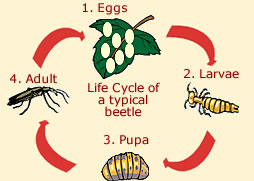
Beetle Life Cycle
The four stages of beetle metamorphosis — egg, larva, pupa, adult — illustrated and explained.

Morpho Butterfly
One of the world’s most striking butterflies — the iridescent blue wings aren’t pigmented, they’re nanoscopically structured.

Moths
The more numerous and diverse cousins of butterflies — around 160,000 species, mostly nocturnal, often drab by day but stunning up close.

Poisonous Caterpillars
An identification guide to the world’s most toxic caterpillars — hairs, stings, and contact poisons to watch for.
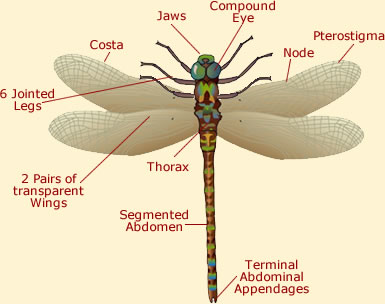
Dragonfly Anatomy
A labelled illustration of the external anatomy of a dragonfly, plus its larval form — wings, abdomen, compound eyes.

Grasshopper
Powerful-legged jumping insects found on every continent except Antarctica — some species can leap 20 times their body length.

Butterflies
Nature’s most colourful daytime insects — complete metamorphosis, long migration flights and remarkably diverse wing patterns.
Click on an insect below to find out more about them.
Other Creepy Crawlies
Some species of bug that belong to the ‘Arthropod’ family are sometimes mistaken for insects but are not actually ‘insects‘, spiders, worms, millipedes and centipedes are an example. An insect has six legs, however, most spiders have 8 legs and centipedes have at least 36 legs, worms do not have legs.
Spiders belong to a large class called ‘Arachnids’, Centipedes are in a class called ‘Chilopoda’, Millipedes belong to the class ‘Diplopoda’ and worms belong to a class of creatures called ‘annelids’.
Check out these creepy crawlies!
Learn about the different State Insects of the USA.