Hexose MonoPhosphate Shunt and its Significance (original) (raw)
The Hexose Monophosphate Shunt is also known as “**Pentose Phosphate Pathway**” (PPP). This is an alternative Glucose oxidation pathway. The hexose monophosphate pathway is used for the production of NADPH from NADP.
The NADPH is required for biosynthetic reactions such as fatty acid synthesis, cholesterol synthesis, drug reduction, and as a cofactor for some non-synthetic enzymatic reactions. Pentose Phosphate Pathway is the alternative Glucose oxidative pathway.
In addition, it is used for the production of ribose for nucleotide and nucleic acid synthesis. The Pentose Phosphate Pathway also allows the entry of some carbohydrates into the glycolytic pathway (especially ribose, but also some others), and therefore acts as a connection route between different pathways.
- Glycolysis – Glucose Catabolic Pathway
- Citric acid cycle: Central metabolic cycle and its Significance
The muscle, however, like all tissues, needs to be able to synthesize Ribose in order to make nucleotides and nucleic acids.
- What is the Pentose Phosphate Pathway?
- What are the Phases of the Pentose Phosphate Pathway?
- Step 1: Dehydrogenation of Glucose – 6- Phosphate
- Step 2: Formation of Ribulose-5-Phosphate
- Step 3: Epimerization of ribulose-5-P into Xylulose-5-P
- Step 4: Isomerization of Ribulose-5-Phosphate to Ribose-5-Phosphate
- Step 5: Epimerization of Ribulose – 5- Phosphate to Xylulose-5-Phosphate :
- Step 6: Transketolation
- Step 7: Transaldolation
- Step 8: Transketolation
- Overall Pathway of Hexose MonoPhosphate Pathway
- Why the pentose phosphate pathway is called hexose monophosphate shunt?
- The significance of HMP Shunt
What is the Pentose Phosphate Pathway?
The pentose phosphate pathway (also called “Phosphogluconate pathway” or “ Pentose Phosphate Pathway ”) occurs in the cytoplasm. It is a source of NADPH and ribose-5-Phosphate for nucleic acid biosynthesis.
It has an oxidative phase (NADPH generation) and a non-oxidative (non-oxidative sugar interconversion).
Steroidogenic tissues, red blood cells, and the liver are the major sites of the hexose monophosphate pathway.
Muscle has small amounts of some of the Pentose Phosphate Pathway enzymes, because it has little need for synthetic reactions, and therefore, little need for NADPH.
What are the Phases of the Pentose Phosphate Pathway?
The pentose phosphate pathway occurs in the cytosol and can be divided into two phases:
- Oxidative phase: it generates NADPH.
- Non-oxidative phase: synthesize pentose-phosphate and other phosphate monosaccharides.
Oxidative phase
The oxidative portion of the HMP shunt consists of 3 reactions that lead to the formation of Ribulose-5-Phosphate, Carbon dioxide, and 2 molecules of NADPH, for each molecule of Glucose-6-Phosphate oxidized.
During the oxidative phase, from glucose-6-phosphate obtained by phosphorylation of the free glucose, NADPH finally obtained is formed pentose, ribulose 5-phosphate, why this metabolic process is called “the Pentose Monophosphate Pathway”.
Step 1: Dehydrogenation of Glucose – 6- Phosphate
Glucose-6-Phosphate is converted into “_6-Phospho Gluconate_” in the presence of the enzyme, Glc-6-Phosphate dehydrogenase. In this reaction, NADP+ acts as a coenzyme. NADPH is a potent competitive inhibitor for the enzyme (Under some conditions).
- The first reaction is the oxidation of glucose 6-phosphate, carried out by the enzyme glucose-6-phosphate dehydrogenase. In this first step, the C1 group is dehydrogenated to give a group carboxyl, which, next to C5 forms a lactone, i.e. an ester intramolecular.
- It is here that two free hydrogen ions (proton) and two electrons are transferred to NADP+ which acts as an electron acceptor being reduced to form the first molecule of NADPH; the remaining proton is released in the middle.
Step 2: Formation of Ribulose-5-Phosphate
6-Phospho Gluconate is converted into Ribulose-5-Phosphate by eliminating CO2 from Carbon one of Glucose, in the presence of the enzyme 6-Phosphogluconate dehydrogenase.
- Then, it produces Lactone by hydrolysis and by the action of the lactonase, whereby the free acid is obtained 6-phosphogluconate.
- Then, the latter becomes ribulose-5-phosphate by the action of 6-phosphogluconate dehydrogenase.
- Here NADPH second molecule is obtained, in addition to the release of a molecule of CO 2 because of the oxidative decarboxylation.
- Finally, the enzyme pentose-5-phosphate isomerase, by an intermediary enediol, isomerizes the ribulose 5-phosphate and converts ribose-5-phosphate to the transformation of the group ketose in aldose.
- This latter reaction prepares a central component nucleotide synthesis for the biosynthesis of RNA, DNA and nucleotide cofactors. At the same time, it carries out the transition to the non-oxidative metabolic phase of the pentose phosphate pathway.
It ends thus obtaining two NADPH molecules which, besides their use in reductive biosynthesis, is also responsible for maintaining a reducing environment within the cell. This can be seen if there is a deficit of glucose-6-phosphate dehydrogenase, produced by a defect in a gene located on the X chromosome, which may affect more proportion to men.
The general reaction to this first phase is:
Glucose-6-phosphate + 2 NADP + + H 2 O → Ribulose-5-phosphate + 2 NADPH + 2 H + + CO 2
Non-oxidative phase
The non-oxidative reaction of the pentose phosphate pathway catalyzes the interconversion of 3, 4, 5 and 7- carbon sugars.
The non-oxidative phase of the pentose phosphate pathway is initiated when the cell needs more NADPH than ribose-5-phosphate.
This second process is a complex sequence of reactions that let you change the C3, C4, C5, C6, and C7 pentose sugars to form finally glyceraldehyde-3-phosphate and fructose 6-phosphate, which can go directly to glycolysis.
Step 3: Epimerization of ribulose-5-P into Xylulose-5-P
Ribulose-5-Phosphate is converted into Xylulose-5-Phosphate; in the presence of the enzyme “_Phosphopento epimerase_” this reaction is one of the examples to Epimerization.
This phase includes a series of reversible reactions, the direction of which depends on the availability of the substrate. Also, the isomerization of ribulose-5-phosphate to ribose-5-phosphate is also reversible.
Step 4: Isomerization of Ribulose-5-Phosphate to Ribose-5-Phosphate
Ribulose-5-Phosphate is isomerized into Ribose-5-Phosphate by the enzyme “_Phosphopentose isomerase_”. This enables us to eliminate excess ribose-5-phosphate to finish transforming it into intermediates of glycolysis.
Step 5: Epimerization of Ribulose – 5- Phosphate to Xylulose-5-Phosphate :
The final product of oxidative reactions Ribulose-5-Phosphate is epimerized into Xylulose-5-Phosphate. This reaction proceeds with the utilization of the second glucose molecule. This reaction is catalyzed by “_Phosphopentose Epimerase_”.
The reaction is carried out epimerization, regulated by the pentose-5-phosphate epimerase enzyme, which converts the ribulose-5-phosphate, a product of the oxidative phase, xylulose-5-phosphate, thereby generating the necessary substrate for controlled by the following reaction transketolase, which acts together with coenzyme Thiamine Pyrophosphate (TPP).
Step 6: Transketolation
When the Ribose-5-Phosphate reacts with Xylulose-5-Phosphate. It gives Sedoheptulose-7-Phosphate and Glyceraldehyde-3-Phosphate by the enzyme Transketolase. Here TPP (Thiamine Pyrophosphate) acts as a Co-enzyme. In this reaction first and second carbons of Xylulose-5-Phosphate. Simply this is a 2 carbon shifting mechanism.
This will convert Xylulose 5-phosphate into Ribose-5-phosphate and, by transferring unit C2 of the aldose to ketose, will produce glyceraldehyde-3-phosphate and sedoheptulose-7-phosphate.
Step 7: Transaldolation
When Sedoheptulose-7-Phosphate reacts with Glyceraldehyde-3-Phosphate; it gives 4 carbon compound – Erythrose-4-Phosphate and 6 carbon compound Fructose-6-Phosphate.
This reaction is catalyzed by the enzyme Transaldolase, In this reaction, the first 3 carbons of Sedoheptulose-7-Phosphate is shifted to the aldehyde group of the Glyceraldehyde-3-Phosphate. Simply this is a 3 carbon shifting mechanism.
Finally, the transaldolase, with the help of a rest Lysine in the active site, transfers a unit C3 sedoheptulose-7-phosphate to glyceraldehyde-3-phosphate, which will form the tetrose Erythrose-4-phosphate, in addition of one of the first end products: fructose 6-phosphate, which is directed towards glycolysis.
Step 8: Transketolation
When the Erythrose-4-Phosphate reacts with Fructose-6-Phosphate gives Xylulose-5-Phosphate and Glyceraldehyde-3-Phosphate. This reaction is catalyzed by “_Transketolase_”. This is TPP dependent enzyme.
Then, again Transketolase enzyme transferring a C2 unit, from Xylulose-5-phosphate to Erythrose-4-phosphate, thus form another molecule of Fructose 6-phosphate and Glyceraldehyde-3-phosphate, both are intermediates of glycolysis. Thus, the phase of this non-oxidative metabolic pathway is closed.
Overall Pathway of Hexose MonoPhosphate Pathway
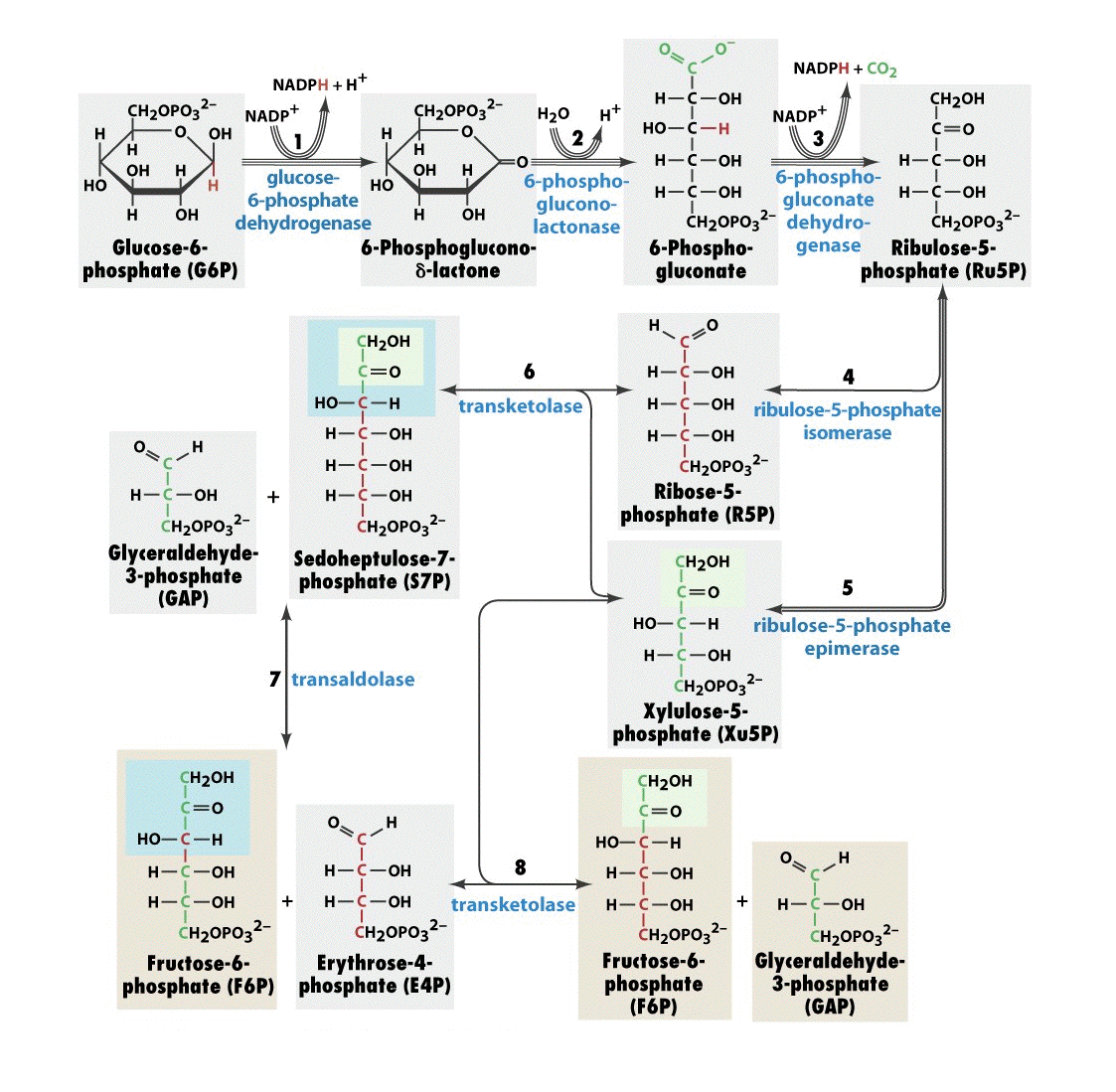
This stage of the route will connect the metabolic processes that generate NADPH with originating NADH/ATP. Furthermore, glyceraldehyde-3-phosphate and fructose 6-phosphate may be involved instead of the glycolysis, in gluconeogenesis to form a new glucose synthesis.
Why the pentose phosphate pathway is called hexose monophosphate shunt?
The pentose phosphate pathway (PPP; also called the phosphogluconate pathway and the hexose monophosphate shunt) is a process that breaks down glucose-6-phosphate into NADPH and pentoses (5-carbon sugars) for use in downstream biological processes.
During this process, two molecules of NADP+are reduced to NADPH.
The significance of HMP Shunt
1. Producing NADPH + H+
- Pentose Phosphate Pathway producing Biochemical reductant NADPH + H+. This reductant participating in the reductive anabolic pathway. Especially in Fatty acid Biosynthesis
- NADPH involves in Glutathione Reductase catalysis. This enzyme neutralizes the superoxide and hydroxyl radicals from hydroxyl peroxide molecules.
- The NADPH is one of the important coenzymes for the microsomal for the liver microsomal, Cytochrome-P450 Mono-Oxygenase system. This is the major pathway for the hydroxylation of Aromatic and Aliphatic compounds such as Steroid alcohols and many drugs.
- In the Phagocytosis mechanism, NADPH + H+ is very important in Respiratory Burst.
- Ribose-5-Phosphate is the precursor molecule for nucleotide synthesis. The concentration of Ribose-5-Phosphate is optimized by the enzyme Glucose-6-Phosphate dehydrogenase in HMP shunt.
2. Producing Ribose-5-Phosphate
- Pentose Phosphate Pathway provides Ribose-5-Phosphate for the Purine biosynthesis by the level of Ribose-5-Phosphate is regulated by Glucose-6-Phosphodehydrogenase.
3. Producing Glycolytic Intermediate
- In the Pentose Phosphate Pathway Pathway, few molecules of Glycolytic intermediates are produced these are directly involved in Glycolysis. The molecules are Glyceraldehyde-3-Phosphate and Fructose-6-Phosphate.
Discover more from Biochemistry Den
Subscribe to get the latest posts sent to your email.