National Broadband Map | BroadbandNow (original) (raw)

Measuring America's Digital Future
BroadbandNow Research exists to ensure that universal, high-quality internet access becomes a reality for all Americans. Through rigorous data analysis and ground-truth research, we expose connectivity gaps, drive policy discussions, and attempt to accelerate the deployment of robust digital infrastructure needed to power humanity's next great technological leap forward.
- The BroadbandNow National Broadband Map provides block-level views of internet availability, pricing, and provider competition across the U.S.
- Recent federal initiatives, including the $42.45 billion BEAD program, are actively funding the deployment of high-speed infrastructure to close the digital divide.
- Over 7 million American homes and businesses remain unserved, lacking access to even basic broadband speeds.
How to use the map:Pan and zoom around our interactive map to see how availability varies from region to region. You can use the toggles to filter by price, availability, and speed.
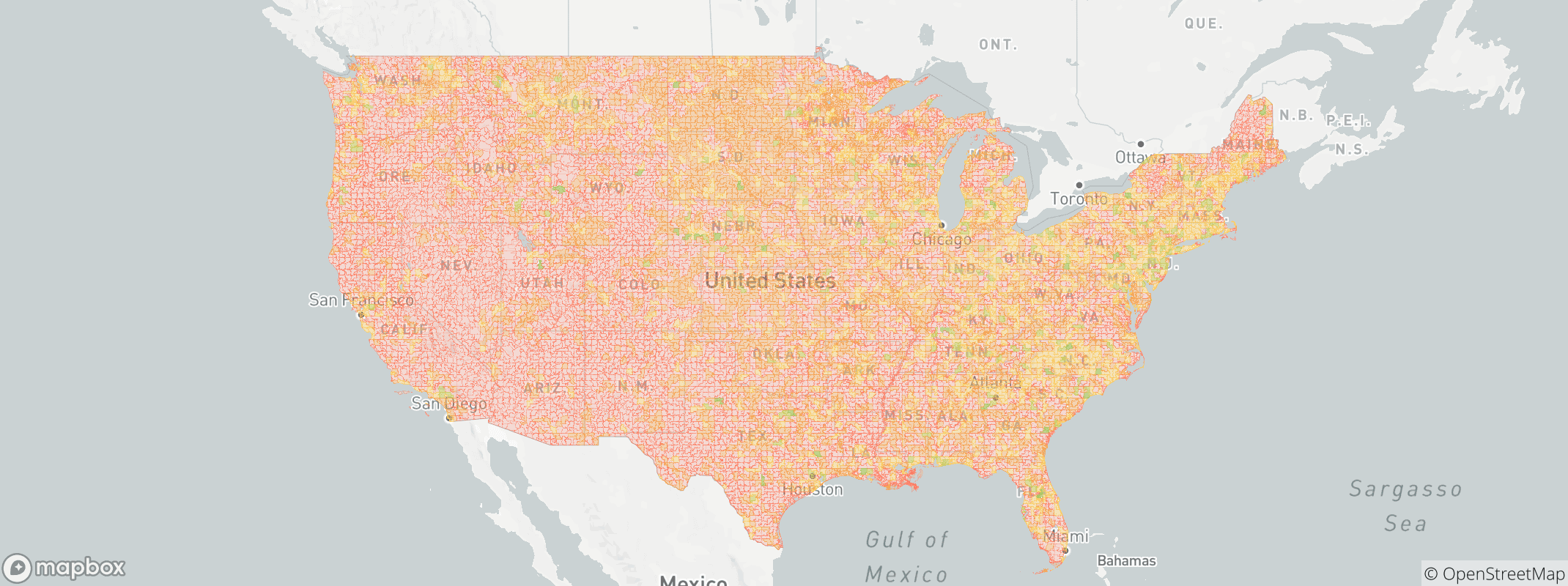
Click here to initialize interactive map
Provider Counts
Min. Speed
Max. Speed
Min. Price
DSL
Cable
Fiber
Fixed Wireless
DSL
Cable
Fiber
Fixed Wireless
Which Federal Programs Fund Last-Mile Broadband Internet?
The U.S. continues to suffer from a digital divide, a gap in access to broadband services between urban city dwellers and rural residents. For over two decades, various U.S. government agencies have attempted to address this issue through broadband funding initiatives. Much like the government was able to bring electricity and later telephony to rural parts of America, these programs effectively offer carrots to telecommunications companies to spur them to build out expensive broadband infrastructure in areas where it would otherwise be too expensive. As of early 2024, the Federal Communications Commission (FCC) reports that over 7 million homes and businesses remain entirely unserved by high-speed internet networks offering at least 100 Mbps download speeds. Millions more are critically underserved, functioning on outdated connections that struggle to support the heavy bandwidth requirements of modern smart homes, remote work hubs, and high-definition video conferencing.
In recent years, the federal government has identified universal rural broadband as a top domestic priority. Following the historic passage of the bipartisan Infrastructure Investment and Jobs Act (IIJA), the National Telecommunications and Information Administration (NTIA) formally allocated $42.45 billion through the Broadband Equity, Access, and Deployment (BEAD) Program. This generational investment coordinates directly with state governments to guarantee gigabit-capable internet infrastructure reaches every unserved citizen to close the digital divide across America.
Which USDA Programs Fund Rural Broadband Deployments?
The U.S. Department of Agriculture’s Rural Utilities Service (RUS) managed several broadband funding initiatives, including the Rural Broadband Access Loan and Loan Guarantee Program, the Community Connect Grant Program, and the ReConnect Program. Unfortunately, these programs are no longer open for applications.
RUS also manages the Telecommunications Infrastructure Loan and Loan Guarantee Program and the Distance Learning and Telemedicine (DLT) grants. The DLT grants, while applications are now closed, were not specifically for broadband deployments. Instead, it funded equipment and software for telemedicine and distance-learning applications to support everyday household needs, such as virtual doctor visits and remote coursework.
Who Is Eligible for the Telecom Infrastructure Loan Program?
- What it is: Offers long-term guaranteed loans to finance traditional telecommunications infrastructure, focusing on maintaining and expanding reliable services in rural hubs.
- Who qualifies: Qualified telephone companies or cooperatives, nonprofits, limited dividend associations, mutual associations, or public bodies.
- Minimum speeds: Networks must be engineered to actively remove outdated legacy bottlenecks and support reliable broadband service.
- Funding available/status: Subject to annual federal budgetary allocations; applications are accepted continuously.
- How awards are made: Processed on a year-round, non-competitive basis, reliant on financial and engineering viability.
This initiative prioritizes keeping rural lifelines operational while prepping communities for digital expansion. Eligible rural areas must not be contained within the boundaries of any incorporated or unincorporated city, village, or borough with a population exceeding 5,000 residents.
How Does the FCC's Universal Service Fund Finance Broadband Expansion?
The FCC’s “universal service” principle means that all Americans should have access to communications services. Consequently, the Universal Service Fund is designed to promote the availability of quality telecommunications services for all consumers, including those living in low-income, rural, insular, and high-cost areas. The goal is to keep rates just, reasonable, and affordable so that rural households can afford the bandwidth necessary for data-heavy applications, such as 4K streaming and remote work platforms, at prices on par with what consumers in urban areas pay. The fund supports eligible telecommunications companies (ETCs) in deploying broadband services in underserved or unserved areas within the U.S.
The Universal Service Fund encompasses the Connect America Fund, the Universal Service Schools and Libraries program, the Rural Healthcare program, and the Rural Digital Opportunity Fund (RDOF).
Loans and grants disbursed through the Universal Service Fund are paid for by contributions from wireline, wireless, and cable telecommunications companies, based on their revenues, which they then pass on to their subscribers. That means the fund is essentially paid for by consumers through their phone bills. The Universal Service Administrative Company administers the loans at the direction of the FCC.
What Is the Connect America Fund (CAF) and Who Qualifies?
- What it is: A foundational USF program designed to offset the high costs of expanding internet networks into hard-to-reach rural geographies.
- Who qualifies: Eligible telecommunications companies (ETCs) who commit to expanding fixed voice and broadband services to high-cost populations.
- Minimum speeds: Progressively increased from 4 Mbps to 10 Mbps for legacy phases, with moving targets adapting alongside federal benchmarks like 25/3 Mbps and later 100/20 Mbps.
- Funding available/status: Largely legacy; actively shifting focus to RDOF to cover remaining gaps with faster, higher-capacity networks.
- How awards are made: Cost modeling allocations and competitive reverse auctions.
The Connect America Fund provides funding to ETCs to help cover the costs of deploying broadband service in areas that are deemed high-cost, rural, or insular, where market conditions do not favor deployment without government intervention. CAF was initially proposed in 2010 as part of the FCC’s National Broadband Plan.
The first phase of CAF involved a total of $4.5 billion in subsidies doled out between 2012 and 2015 to ETCs who promised to build out broadband service in underserved and unserved areas. Under Phase I of CAF, ETCs were required to offer services of at least 4 Mbps. In 2014, the FCC approved Phase II of CAF, which allocated an additional 1.8billioninfundingperyear.DuringPhaseII,theFCCincreasedtheminimumspeedsto10Mbps.However,itwasn’tuntil2018thattheFCCconductedareverseauctiontoallocatefundstoeligibleareasintheU.S.Duringtheauction,103bidderswereawardedatotalof[1.8 billion in funding per year. During Phase II, the FCC increased the minimum speeds to 10 Mbps. However, it wasn’t until 2018 that the FCC conducted a reverse auction to allocate funds to eligible areas in the U.S. During the auction, 103 bidders were awarded a total of [1.8billioninfundingperyear.DuringPhaseII,theFCCincreasedtheminimumspeedsto10Mbps.However,itwasn’tuntil2018thattheFCCconductedareverseauctiontoallocatefundstoeligibleareasintheU.S.Duringtheauction,103bidderswereawardedatotalof1.49 billion in funds over 10 years to provide broadband service to more than 700,000 locations in 45 states. As of 2025, the FCC has shifted focus from legacy CAF expansions toward more robust technological standards, using the Rural Digital Opportunity Fund (RDOF) to drive deployments capable of meeting heavier modern household demands.
How Does the Universal Service Schools and Libraries Program (E-Rate) Work?
- What it is: A federal support program providing discounted internet and telecommunications services to educational facilities.
- Who qualifies: Primary/secondary schools (without endowments exceeding $50 million) and independent, nonprofit print or digital libraries.
- Minimum speeds: No strict mandate; based on capacity needed to meet FCC targets (e.g., 1 Mbps per student).
- Funding available/status: An annual cap of $4.46 billion for Funding Year 2024.
- How awards are made: Service providers offer discounted rates to qualifying institutions and are reimbursed by the Universal Service Administrative Company (USAC).
Also known as E-Rate, this program offers discounts on telecommunication and broadband services to schools and libraries. E-Rate was launched in 1996 and has helped the U.S. achieve near-universal broadband access in schools.
The FCC updated the E-Rate program in 2014 to include Wi-Fi networks, and in 2024 began taking steps to extend support for off-premises Wi-Fi hotspots for students lacking home internet. Eligible schools must not have endowments larger than $50 million, and eligible libraries must be nonprofit and have budgets that are completely separate from the school.
Discounts range from 20 percent to 90 percent and are available to eligible entities based on the level of poverty in the community they serve, with different rates for urban and rural areas. E-Rate program funding is demand-based, with an annual Commission-established cap of $4.76 billion for Funding Year 2024.
What Support Does the Rural Healthcare Program Provide?
- What it is: A USF subsidy ensuring rural healthcare partners can afford the high-capacity broadband needed for digital records and telehealth.
- Who qualifies: Eligible public or nonprofit health care providers (HCPs) in rural areas.
- Minimum speeds: Varies; targets enterprise-grade connectivity sufficient for remote medicine.
- Funding available/status: Active; capped at $724 million for Funding Year 2025.
- How awards are made: HCPs receive discounted communication services; participating ISPs are then reimbursed.
This program provides funding to eligible health care providers (HCPs) for telecommunications and broadband services to support telemedicine applications. In the program, HCPs apply for discounts, and the USAC coordinates with telecom providers and internet service providers (ISPs) to deliver broadband service. The USAC then reimburses the ISPs. The program was historically capped at 400millionannually,buttheFCCnowadjuststhecapforinflationeachyear,raisingitto400 million annually, but the FCC now adjusts the cap for inflation each year, raising it to 400millionannually,buttheFCCnowadjuststhecapforinflationeachyear,raisingitto724 million as of Funding Year 2025. It currently comprises four programs: the Healthcare Connect Fund, the Telecommunications Program, the Internet Access Program, and the Rural Health Care Pilot Program.
What Is the Rural Digital Opportunity Fund (RDOF)?
- What it is: A multi-billion-dollar USF initiative bridging the digital divide by funding broadband networks in completely unserved rural areas.
- Who qualifies: Telecommunications providers who bid aggressively in FCC reverse auctions.
- Minimum speeds: Bidders must deliver at least 25/3 Mbps, though higher weight is assigned to gigabit-level, low-latency commitments.
- Funding available/status: Phase I was initially awarded $9.2 billion. Phase II targets have since been conceptually absorbed by modern NTIA programs.
- How awards are made: Through two rounds of a multi-tiered reverse auction process.
The FCC previously announced the creation of a third broadband initiative within the Universal Service Fund, launched in 2020: the Rural Digital Opportunity Fund. The FCC hopes the fund will connect up to 5.2 million rural homes and businesses to gigabit-speed broadband services. It will repurpose funds to allocate $20.4 billion in subsidies to telecommunications companies over a 10-year period through an auction process.
Which NTIA Programs Manage Broadband Infrastructure Funding?
The National Telecommunications and Information Administration (NTIA), an agency of the U.S. Department of Commerce, manages several historic and active broadband grant programs. The NTIA oversees $4.3 billion worth of these legacy broadband infrastructure projects across the country. These projects support efforts to enhance broadband access among residents and promote statewide broadband planning and data collection. However, the NTIA no longer has funding available and is not accepting applications for these particular early programs.
Today, the NTIA serves as the primary distributor of modern broadband infrastructure funds from the 2021 Bipartisan Infrastructure Law, fundamentally altering the landscape of federal internet deployment mapped at the household level.
What Is the Broadband Equity, Access, and Deployment (BEAD) Program?
- What it is: A transformative $42.45 billion program to expand high-speed internet by funding physical network construction in unserved and underserved regions.
- Who qualifies: All 50 states, Washington, D.C., and U.S. territories use these funds to distribute subgrants to ISPs, utility cooperatives, and local governments.
- Minimum speeds: Funded projects must deliver dependable connections of at least 100/20 Mbps.
- Funding available/status: Active and heavily funded. Allocation totals across all states and territories reached $42.45 billion in 2023.
- How awards are made: States established competitive grant selection frameworks tailored to their respective unserved metrics.
The BEAD program represents the largest single federal investment in broadband deployment in U.S. history. By leveraging precise availability data from the National Broadband Map, states use BEAD funding to ensure households entirely unserved by high-speed networks get top priority for new gigabit-capable infrastructure projects.
Tip for Consumers: While you can’t apply for BEAD funding directly, you can actively verify your home’s connectivity speeds on the National Broadband Map. Funding distributions to your state directly depend on accurate household statistics. If an ISP incorrectly claims it serves your home, you can challenge it online and legally dispute its availability.
What Other Federal Agency Programs Fund Broadband?
Beyond the primary telecommunications authorities, several other federal departments manage programs that can be utilized to improve local internet infrastructure:
- Economic Development Administration (EDA): The U.S. Department of Commerce’s EDA Facilities and Public Works program provides funding for the construction of critical infrastructure in high-cost areas. The funds typically go towards water and sewer infrastructure, though some communications projects have received funding through the program.
- Department of Housing and Urban Development (HUD): The U.S. Department of Housing and Urban Development’s Community Development Block Grant Programs provide funding to promote access to broadband, including through the acquisition, installation, or improvement of broadband networks. States and cities that allocate CDBG funding decide whether to prioritize broadband access projects.
- Appalachian Regional Commission (ARC): The Appalachian Regional Commission is a regional economic development agency that represents a partnership of federal, state, and local governments. Its grant program aims to expand broadband access in the Appalachian region by helping to create community broadband networks that can be used by all sectors of the community. Its projects have included building out fiber optic rings, deploying broadband in industrial parks and business incubators, and piloting emerging broadband technologies. Most ARC project grants originate at the state level and are supported through state and federal funds.
How Will Federal Funding Impact The Future Of American Broadband?
Despite a variety of federal funding programs aimed at closing the digital divide, millions of U.S. residents in rural areas are still being left behind in the digital economy. For households managing simultaneous Zoom calls, smart home devices, and daily 4K streaming, a lack of reliable infrastructure creates a significant barrier. Some of these programs, particularly within the Universal Service Fund, have been criticized for giving wireline broadband providers too much leeway in how and where they build out federally subsidized broadband networks.
BroadbandNow has conducted extensive research on the digital divide: see our 2025 estimate of the number of Americans without access to broadband internet.
The latest generation of wireless technology, 5G, has successfully started to plug some of those holes. Wireless carriers rapidly expanded Fixed Wireless Access (FWA), making it a highly viable alternative to traditional wireline services. According to the FCC’s 2024 Communications Marketplace Report, FWA subscriptions surpassed 11 million by mid-2024, driven largely by 5G deployment, which helped connect underserved residential areas and gave consumers more choices for reliable home internet.
Are you a journalist or researcher writing about this topic?
We'll connect you with a broadband market expert on our team who can provide insights and data to support your work.
Who is BroadbandNow and BroadbandNow Research?
What powers this map today (data sources and frequency)?
As of 2026, our mapping tool is informed by the FCC’s Broadband Data Collection (BDC) records, which completely replaced the outdated Form 477 reporting model in recent years. Because federal data can still lag behind actual household realities, we have also leveraged our own extensive database of information provided directly by internet providers or retrieved from publicly available sources. This information includes more granular availability and pricing information. We use this data to power public-facing webpages that show every internet provider in Houston, TX, and all internet plans and prices in Los Angeles, CA. This ongoing provider verification process allows consumers to find any internet provider by ZIP code.
There are many well-documented challenges underpinning the ongoing effort to accurately map broadband availability. This page also includes information on how new broadband developments are funded at the national level; we’ve provided a comprehensive breakdown of the major funding sources for reference.
We would love your support in improving this map and ensuring it accurately reflects the quality of your home’s connection. Please send us your suggestions using the contact form at the bottom of this page. Providers who would like to provide us with more granular information can also contact our team directly. Hundreds of internet service providers update their data with us each year.
What is the FCC's current broadband benchmark?
The FCC currently defines ‘broadband internet’ as any connection offering at least 100 Mbps (megabits per second) download speeds and 20 Mbps upload speeds. It’s important to note that this metric has changed in the past, recently quadrupling its aging 25/3 standard, and it will likely change again as the standards and technology that make up the internet continue to grow and evolve.
Why can a block show coverage I can't order?
Historical data were often universally grouped at the census block level. In some rural environments or new developments, a provider might actively service a few households on one end of a block but lack the physical fiber lines to reach your specific address. Additionally, challenging local terrain, private driveway lengths, or physical property barriers can stop installations from reaching your front door, even if the primary neighborhood map flags your broader block as a served area.
How accurate is pricing, and what's included?
Our listed prices typically reflect a provider’s entry-level consumer tiers or current wide-scale promotional terms. Because ISPs launch targeted seasonal promos or utilize complex data cap structures, final monthly costs can vary. As of 2026, many previously hidden fees are now disclosed through the FCC’s mandatory Broadband Consumer Labels. However, it is a best practice to assume our baseline map prices exclude local market taxes, optional Wi-Fi router rentals, and one-time installation charges unless otherwise noted.
References and Primary Sources
To ensure neutrality and accuracy, all deployment metrics, speed definitions, and program funding details cited across this resource are pulled directly from primary government agencies and regulatory frameworks as of 2026.
- Appalachian Regional Commission (ARC) Broadband Projects:
https://www.arc.gov/broadband-projects/ - BroadbandNow 2025 Estimate of Americans Without Broadband: https://broadbandnow.com/research/fcc-broadband-overreporting-by-state
- Economic Development Administration (EDA) Public Works Program:
https://www.eda.gov/sites/default/files/pdf/about/Public-Works-Program-1-Pager.pdf - Federal Communications Commission (FCC) 2024 Communications Marketplace Report:
https://docs.fcc.gov/public/attachments/FCC-24-136A1_Rcd.pdf - Federal Communications Commission (FCC) Broadband Consumer Labels:
https://www.fcc.gov/broadbandlabels - Federal Communications Commission (FCC) Broadband Data Collection: https://www.fcc.gov/BroadbandData
- Federal Communications Commission (FCC) E-Rate Schools & Libraries USF Program:
https://www.fcc.gov/general/e-rate-schools-libraries-usf-program - Federal Communications Commission (FCC) Report FCC-24-27A1:
https://docs.fcc.gov/public/attachments/FCC-24-27A1.pdf - Federal Communications Commission (FCC) Rural Digital Opportunity Fund (RDOF):
https://www.fcc.gov/auction/904 - HUD Community Development Block Grant Programs (Broadband FAQs):
https://www.hudexchange.info/resource/4891/cdbg-broadband-infrastructure-faqs/ - National Telecommunications and Information Administration (NTIA) BEAD Program:
https://www.ntia.gov/funding-programs/high-speed-internet-programs/broadband-equity-access-and-deployment-bead-program - National Telecommunications and Information Administration (NTIA) BroadbandUSA:
https://broadbandusa.ntia.gov/ - Universal Service Administrative Company (USAC) Homepage: https://www.usac.org/
- USAC Rural Health Care Program:
https://www.usac.org/rural-health-care/ - USDA Rural Utilities Service (RUS) Telecom Programs: https://www.rd.usda.gov/programs-services/telecommunications-programs