How We Implemented The 4-Day Work Week, Step By Step | Buildremote (original) (raw)

Lance (the guy in glasses) and I (beard) run Nectafy together. In January 2020, we switched our fully remote company to a four-day work week.
We started discussing it in the fall of 2019 and it took three months to finally decide to implement it. It wasn’t actually that hard to implement. It’s just a big leap of faith, so we dragged our feet a bit.
Now two years later, we have some perspective (and advice) on how to implement a four-day work week for your company. Above, you’ll find an informal video discussion about the transition and impact. Below, you’ll find my step-by-step tips to implement the four-day work week.
First, how do I define a four-day work week?
My definition (and Nectafy’s policy):
- Four days of work (Monday – Thursday for us) and three days of no work
- 32 hours per week (standard eight per day)
- Same pay as before
I mention that because it could mean a number of different things like a 4-10 compressed schedule or a seasonal four-day work week (Fridays off in the summer). In fact, I’ve written about 29 compressed work schedules before, so there’s plenty to choose from.
See Also: 232 Remote Companies With 4-Day Work Weeks
Specific Steps To Implement The Four-Day Work Week
I’m going to share my most practical tips for implementing a four-day work week at your company. There are a number of things you’ll want to do to tweak your company culture, but that’s personalized to your company. I can’t help much there.
These are the exact steps and tips I’d recommend to set up a four-day work week.
1. Don’t trial it it. You can’t.
Companies like Toshiba and Shake Shake, tech startups, and countries like Spain and Iceland have famously “trialed” the four-day work week.
When it came to our company, I knew we couldn’t trial it. My guess is it’ll be the same at your company. Here’s why:
- Announcing a trial would inherently skew the results. Say you tell your employees that you’ll do a six-month trial of working less for the same pay. If it goes well, you’ll implement it permanently. Won’t everyone become more productive to ensure that result?
- You can’t really say it didn’t work out. Could you go back to your team and say the trial failed? In other words, you aren’t smart or efficient enough to figure this out. What would be the impact to your culture?
Since you won’t get any real data or optionality from a trial, here’s what to do instead.
2. Set a permanent policy on the way toward the four-day week.
If you’re around 40 hours per week now and don’t want to blow up your company by cutting out 20% of your work time, permanently implement a policy that isn’t quite a leap. Here are some options:
- Seasonal four-day work week (Summer Fridays): “We no longer work on Fridays in the summer.”

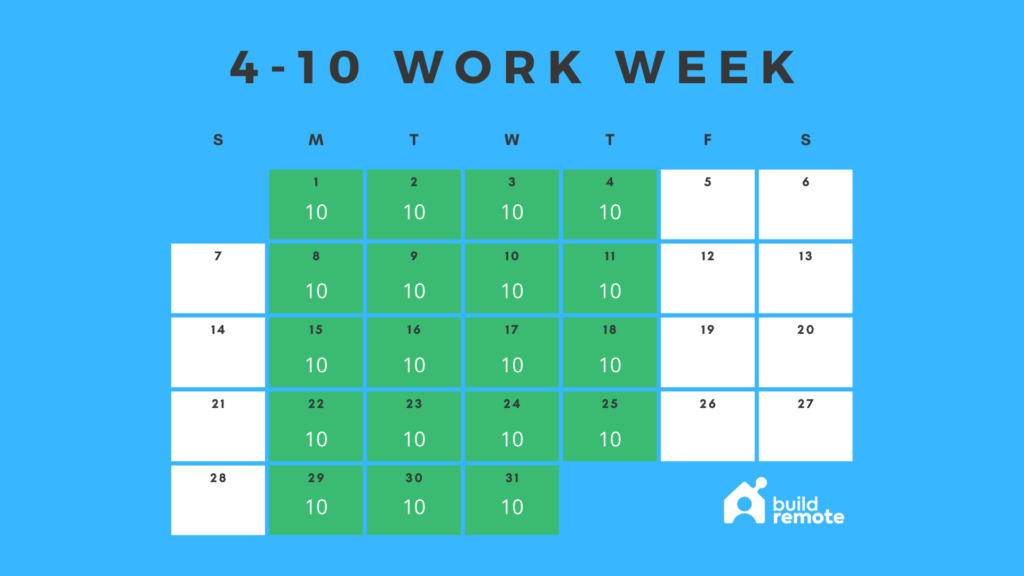
- Compressed work week (4-10 schedule): “We now work Monday – Thursday, 10 hours per day.”
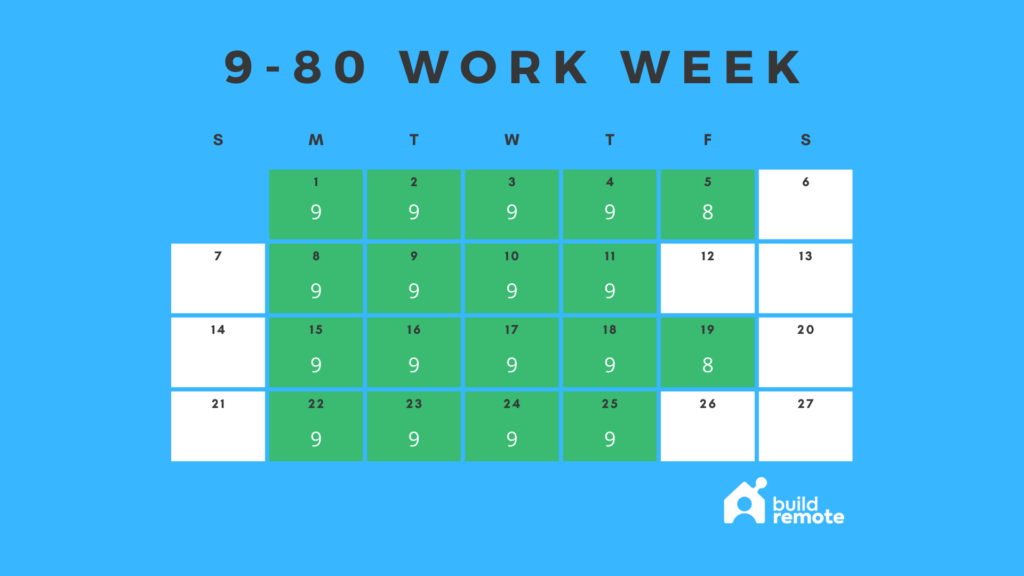
- 9-80 work schedule: “We take every other Friday off. We work four nine-hour days followed by an eight-hour Friday. The next week is four nine-hour days followed by a Friday off.”
- **36-hour work week (Half-day Fridays): “Every Friday afternoon is off.”
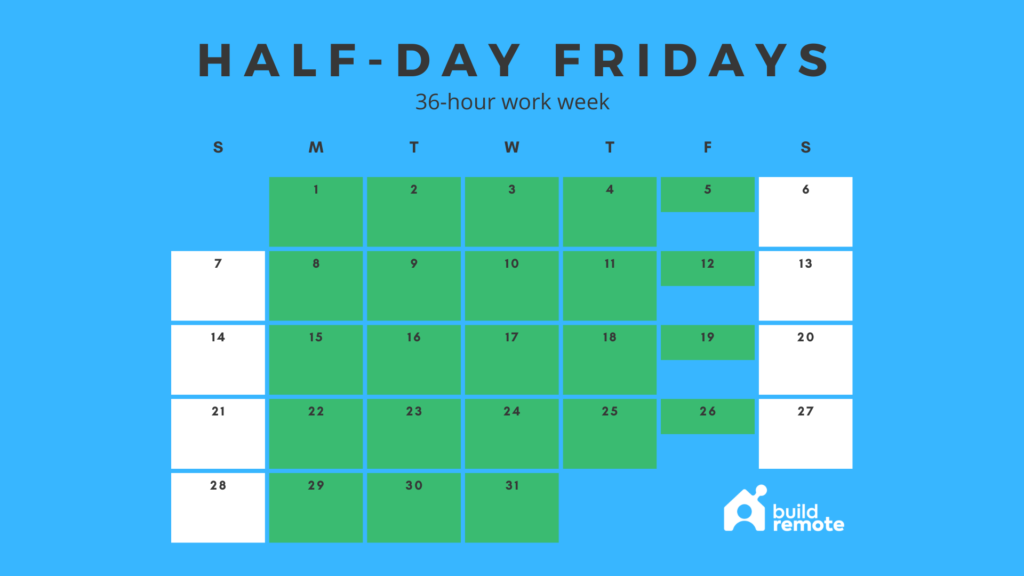
**This is my personal favorite because it’s what we did for years before switching to the four-day, 32-hour week.
- It removes 10% of your work time, then you only have another 10% to go.
- It removes the least efficient work time (Friday afternoons).
- Every employee will appreciate this, whereas switching to 4-10s could actually be worse for some.
Announce that you’ll do this new schedule permanently, not as a trial. If it goes well, put in the four-day work week six months or a year later.
3. Switch from an org chart to an accountability chart.
The accountability chart comes from the book, “Traction: Get a Grip on Your Business.” It drastically changed the way we run our business and paved the way for our four-day work week operations.
- The org chart shows titles and who reports to whom
- The accountability chart includes the key business functions that each role is responsible for
I think of it like a puzzle. Each piece is a specific function that is required for your company to thrive, with a person assigned to each.
If you’re missing a puzzle piece, something critical isn’t getting done.
If multiple people are assigned to the same responsibility, it likely won’t get any attention.
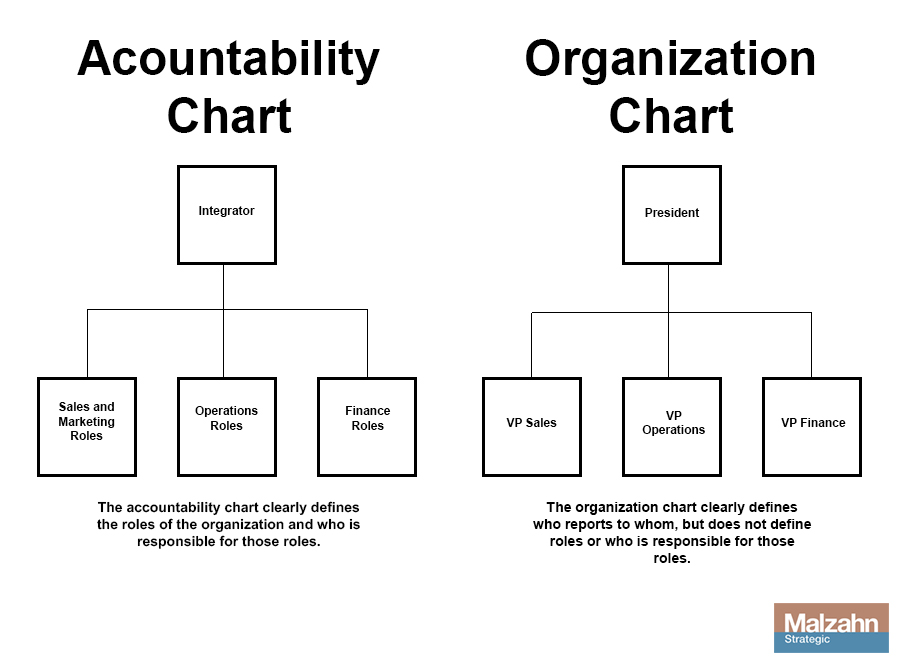
Source: Malzahn Strategic
The accountability chart will help you move to managing output instead of hours. When that switch is made, you can easily cut out time at your desk.
4. Document your processes.
So much inefficiency comes from lack of documentation. Since you’re planning to cut out work time, you need better processes and you need them written down, accessible, and editable.
At Nectafy, we’ve built up to a 101-page process manual in Google Docs. For years, every time a recurring task is done at the company, we strive to document the process step-by-step.
This is another step toward running on output rather than time.
Here’s where good documentation helps:
- You’re less reliant on certain team members
- You no longer require people to be working at specific times (asynchronous work)
- You can cover for each other to take time off
- You remove the inefficiency of people coming up with new ways to do the same thing every time
Tools like Almanac could supercharge your documentation. Friday could set you up well to move away from time and toward output. Zapier could help you automate tasks to free up more time. We have a number of helpful tools here.
5. Cut your meetings in half.
You may have certain people push back at the idea of a four-day work week. They’ll feel like they are too busy to work fewer hours. It’s your job to show them where you can find some extra time.
- Cut one-hour meetings into 30 minutes
- Cut 30-minute meetings to 15 minutes
- Make weekly meetings bi-weekly
Then, question the purpose of each meeting. If it no longer becomes useful, encourage people to cut it. There are a number of great ways to improve your meetings in preparation for a shorter work week.
Most likely, that just opened up multiple hours per week and month for everyone.
6. Reverse communication expectations.
If your current culture rewards people for responding quickly on Slack or over email, you’ll need to reverse that.
The expectation to reply instantly relies on everyone working multiple, inefficient blocks of time together. A four-day work week condenses that time drastically and moves you closer to asynchronous work, where people can work whenever they choose to get the job done.
- If people respond to email on vacation, discourage it. Encourage them to enjoy their time off of work.
- Encourage people to log off Slack completely for the day to get some deep work done.
- Encourage people to respond to email in blocks and not more than once or twice per day.
Most emails and Slack messages are a distraction to the true work, which slows everyone down. You should encourage your team to stop responding so quickly and being so available. That availability calls for 40 hour work weeks (or more), but you’re heading toward 32 (or less).
7. Decide on a policy for part-time employees.
The four-day work week is, by default, a benefit for salaried employees. But you may have some part-time people.
When we were implementing the four-day work week, we saw two options for how to handle part-time employees:
- Essentially, all of your full-time people are getting paid more per hour by switching to a four-day work week. You could encourage your part-time people to work fewer hours, too, and increase their pay per hour. For example, if someone worked 20 hours per week, you could have them target 16 per week but pay them what amounts to the same working 20.
- Or, you could just say it’s a benefit for full-time people. In that case, you’ll need to encourage part-time people to not work on Fridays anymore. The three-day weekend is for everyone’s benefit to get a break from the work.
We went with option two.
Final Thoughts On The Four-Day Work Week
In 1955, Cyril Northcote Parkinson wrote in an essay for The Economist that “work expands so as to fill the time available for its completion.” This concept is now known as Parkinson’s Law.
If you have 40 hours to get some things done, it’ll take 40 hours.
If you have 32 hours, it’ll take 32 hours.
In other words, I bet you aren’t quite so reliant on your current work week structure as you might think.
- You won’t blow up your company switching to a four-day work week. But if you’re concerned, choose a less drastic schedule change first.
- Your employees will likely all be much healthier, happier, and just as productive.
- You’ll retain your best and most productive employees at a higher rate, as a result.
You can do this.