Config Sync overview (original) (raw)
This page provides an overview of Config Sync, the GitOps service included with Google Kubernetes Engine.
Adopting GitOps as a universal best practice helps organizations manage Kubernetes configuration at scale. By using a central source of truth like a Git repository, you can improve stability, consistency, and security.
Config Sync helps you implement GitOps by automating the synchronization of your configuration and policies across any number of clusters. Automatic syncing lets you manage fleets of clusters centrally, prevent configuration drift, and empower both platform and application teams.
This page is for Operators who want to implement GitOps tools to centralize configuration management for their teams. To learn more about common roles and example tasks that we reference in Google Cloud content, seeCommon GKE user roles and tasks.
Pricing
For information about pricing, see GKE pricing.
Why choose Config Sync for GitOps on GKE?
Although all GitOps tools provide benefits like improved stability and consistency, Config Sync provides a set of unique advantages:
- Integration with GKE and other Google Cloud products: Config Sync is compatible with the Google Cloud console, Terraform, or Google Cloud CLI. Config Sync extends the functionality of GKE and works well with services like Policy Controller, Workload Identity Federation for GKE, and Cloud Monitoring. The built-in integration helps you set up GitOps and eases the maintenance burden required for open-source alternatives.
- Built-in observability: Config Sync includes a dashboard in the Google Cloud console that requires no extra setup. You can view the sync status of all your clusters and configs from a central location, or use the Google Cloud CLI to check for reconciliation issues.
- Scalable multi-cluster and multi-team management: Config Sync is designed for both centralized platform administration and delegated application management. Its architecture is tested to be horizontally and vertically scalable, letting you manage clusters at scale and empower your application teams to safely manage their own environments.
How Config Sync works
Config Sync continuously monitors a central source of truth and automatically reconciles the state of your clusters to match it. You can use a Git repository, OCI image, or Helm chart as your source of truth.
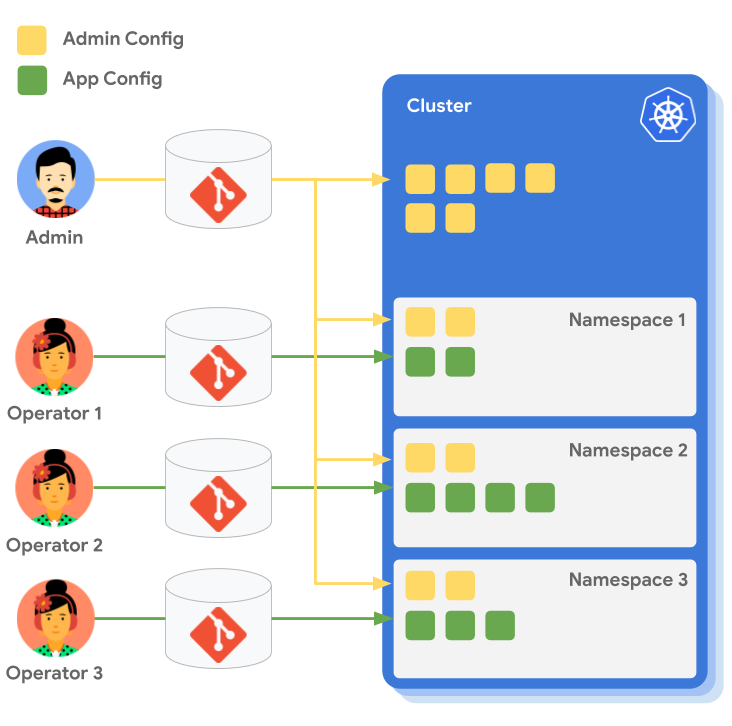
The following diagram shows an overview of how a platform administrator can manage central policies while three application operators manage their own namespace configurations. The namespaces all have the same admin configuration, but each namespace has a different application configuration.
Configuring clusters
Config Sync lets you create a common set of configuration and policies, such as Policy Controller constraints, and consistently apply them across registered and connected clusters from a single source of truth.
Instead of repeatedly running the kubectl apply command manually, you can orchestrate configuration changes across fleets of clusters.
Configuring namespaces
You can use Config Sync to provision and manage Kubernetes namespaces with namespace-scoped policies, such as RBAC roles. These policies can help you implement and manage multi-tenancy within your clusters, letting application teams to manage their own configurations safely.