JPMorgan Sees CLARITY Act At Risk As Election Clock Ticks (original) (raw)
JPMorgan analysts have warned that the chances of passage for the CLARITY Act in 2026 may be coming to a close. They spotlighted that U.S. lawmakers face a packed Congressional calendar ahead of the 2026 midterm elections. Also, the continue debate over stablecoin yield is weighing on the odds.
JPMorgan Analysts Share Opinion On CLARITY Act Approval Odds
Political timing may be a big hurdle for the CLARITY Act, according to the analysts led by Nikolaos Panigirtzoglou.
“With the U.S. midterms approaching, the legislative window for passage of the Market Structure Bill has narrowed, which could postpone progress on crypto market-structure reform this year,” the analysts wrote in a report.
The CLARITY Act is considered one of the most important legislative proposals for the crypto industry. It aims to create a comprehensive federal digital asset regulation regime. Moreover, it will assign crypto regulatory duties to the Securities and Exchange Commission (SEC) and the Commodity Futures Trading Commission (CFTC).
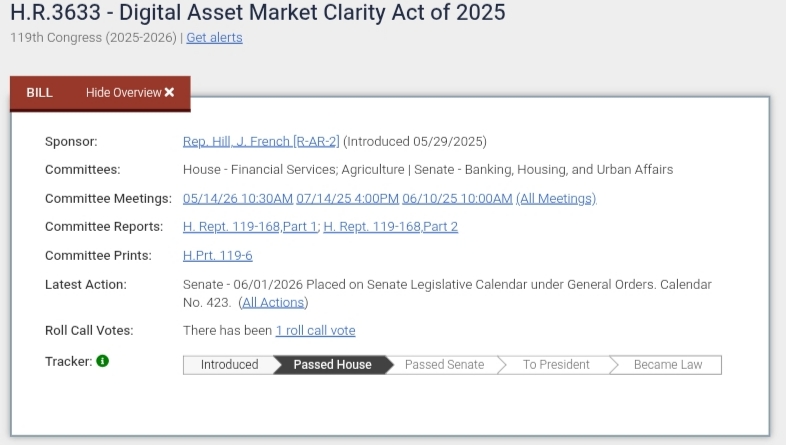
Details on the CLARITY Act progress in the Senate. Source: Congress.gov
The bill passed the Senate Banking Committee in May and was recently put on the Senate calendar. However, it has yet to overcome a few problems. It must pass the Senate floor, complete reconciliation with House legislation, and get the U.S. President Donald Trump’s signature.
The outlook for CLARITY Act enacting this year has become moderate, JPMorgan said, as election-year politics meet growing opposition from traditional financial institutions.
Thus, the timing of any deal could influence the final draft of the law, JPMorgan said. The deal made prior to the mid-term elections may vary significantly from one made after the mid-term elections. It Democrats win over, the priorities and political leverage of Congress may change. It could even put the CLARITY Act on hold, experts warned.
The Stablecoin Yield Debate Continues
The debate has been brought to the forefront due to a public feud regarding the bill among banks and crypto entities.
New York Citi Bank Chairman and CFO David L. Cohen and JPMorgan CEO Jamie Dimon recently expressed opposition to the legislation. They even voiced wider worries among certain sections of the banking industry owing to the stablecoin clause in the bill.
Here, the key problem that remains to be sorted out is the handling of stablecoin yield. The policymakers seem to be pushing for such limits on the passive interest that can be paid on stablecoin balances.
However, they have not barred the rewards the tokens can bring as a part of payments or transactions, loyalty programs or trading incentives. Also, the current wording of the bill doesn’t actually ban interest-bearing stablecoin deposits as some policymakers have suggested. Hence, banks and several Democrats are opposing the CLARITY Act.
Nonetheless, Senator Cynthia Lummis hopes to get bill to a full Senate before the August recess.