10 Best Arthouse War Movies, Ranked (original) (raw)

Poster for Soviet war movie Come and See (1985)
Image via Sovexportfilm

Published Jun 10, 2024, 5:30 PM EDT
Jeremy has more than 2500 published articles on Collider to his name, and has been writing for the site since February 2022. He's an omnivore when it comes to his movie-watching diet, so will gladly watch and write about almost anything, from old Godzilla films to gangster flicks to samurai movies to classic musicals to the French New Wave to the MCU... well, maybe not the Disney+ shows.
His favorite directors include Martin Scorsese, Sergio Leone, Akira Kurosawa, Quentin Tarantino, Werner Herzog, John Woo, Bob Fosse, Fritz Lang, Guillermo del Toro, and Yoji Yamada. He's also very proud of the fact that he's seen every single Nicolas Cage movie released before 2022, even though doing so often felt like a tremendous waste of time. He's plagued by the question of whether or not The Room is genuinely terrible or some kind of accidental masterpiece, and has been for more than 12 years (and a similar number of viewings).
When he's not writing lists - and the occasional feature article - for Collider, he also likes to upload film reviews to his Letterboxd profile (username: Jeremy Urquhart) and Instagram account.
He has achieved his 2025 goal of reading all 13,467 novels written by Stephen King, and plans to spend the next year or two getting through the author's 82,756 short stories and 105,433 novellas.
Sign in to your Collider account
A good deal of the time, if a film looks at a real-life war, it will feel like an anti-war movie, and be at least somewhat critical of war as a concept. It might be looked at as a necessary evil by some filmmakers telling some stories, while other directors will condemn every conceivable aspect of war (it can depend on the war being covered). Such war films will, therefore, be challenging viewing experiences, and this feeling sometimes gets heightened when the film can also classify itself as a piece of arthouse cinema.
Arthouse films generally aim to challenge conventions, offer viewers something new or unexpected, or be incredibly personal films from directors not interested in crafting mass-appeal works necessarily. Taking all these things into account, it’s not surprising to find that there are numerous arthouse films that are also war movies, with the following being some of the best arthouse war films ever made.
10 'Cold War' (2018)
Director: Paweł Pawlikowski

Joanna Kulig and Tomasz Kot as Zula and Wiktor embracing in Cold War.
Image via Curzon Artificial Eye
Cold War is quite forgiving with its runtime, at least as far as arthouse cinema goes, given it runs for less than 90 minutes. It does prove challenging with its pacing and style, though, feeling unconventional, sometimes puzzling, but ultimately evocative and engrossing as a film about two people trying to get by in Poland in the years following the end of World War II, both falling for each other.
That makes Cold War a rather striking romantic movie on top of being about the end of one war and the early years of another – the titular Cold War. It also incorporates a good deal of music into the plot, too, evoking a certain mood and showcasing the ups and downs of a romance in a less-than-direct, distinctive way. It’s light on narrative beats, but the overall feeling of Cold War leaves an impression.
Release Date
June 8, 2018
Runtime
88 minutes
Director
Pawel Pawlikowski
9 'Salò, or the 120 Days of Sodom' (1975)
Director: Pier Paolo Pasolini

Boys standing around looking serious in Salò
Image via United Artists
While it’s not a war movie in the traditional sense, Salò, or the 120 Days of Sodom doesn’t have to be to count as an arthouse war film, as even more than many other arthouse works, it aims to shock, provoke, and challenge. It takes place during the Second World War, but focuses on a group of fascist libertines who kidnap numerous teenagers before proceeding to, as the title hints at, torture them in various ways for 120 days.
This also makes Salò, or the 120 Days of Sodom a horror film, naturally, and one of the most infamous and widely banned of all time. For as grim and confronting as it is, the ever-political, outspoken, and controversial director Pier Paolo Pasolini was trying to make a point with the film, critiquing fascism and not shying away from brutality and depravity. It’s not meant to be easy viewing, though opinions vary on whether it goes too far or not; it’s not the sort of film that’s easily agreed upon.
Release Date
November 23, 1975
Runtime
116 Minutes
Director
Pier Paolo Pasolini
8 'The Tragedy of Macbeth' (2021)
Director: Joel Coen

Denzel Washington in The Tragedy of Macbeth
Image via Apple TV+
Starring the always-great Denzel Washington in a memorably villainous turn, The Tragedy of Macbeth marked the first instance of Joel Coen making a film without his brother, Ethan. The story here is the same one that’s been told time and again throughout numerous adaptations of Shakespeare’s Macbeth, but the solitary Coen brother does more than enough to make his take on the classic play stand out.
There’s a certain dreamlike – and eventually nightmarish – feel to The Tragedy of Macbeth, with “eerie” being an overall good way to describe how the film looks. The set design, a sense of minimalism, and the stark black-and-white visuals all combine to make things feel bold and unique, and war being a factor in the story about one man’s desperate and deadly quest to be king, this all adds up to make The Tragedy of Macbeth feel like an arthouse war film of sorts.
Runtime
105 minutes
Director
Joel Coen
7 'Richard III' (1995)
Directed by Richard Loncraine
Many years before The Tragedy of Macbeth, another great war movie based on a Shakespeare play came out, and made some bold creative decisions; enough to make it classifiable as an arthouse film. That movie was Richard III, which might well have Ian McKellen’s greatest lead performance, as he plays the titular character: a dangerous and cunning man who plans to murder his way onto the British throne.
Beyond McKellen crushing it and a large supporting cast also doing great work, one thing that jumps out about Richard III is the way it decides to update the play’s setting to England in the 1930s. The civil war being fought throughout the film is fictitious (call it alternate history), but the technology and some fascist imagery do, perhaps naturally, echo World War II, which did begin at the end of the 1930s in real life. Anyway, Shakespearean dialogue with an updated setting and a World War II-esque flavor might sound like a recipe for chaos, but Richard III is surprisingly great, and one of the more underrated Shakespeare film adaptations out there.
6 'Kagemusha' (1980)
Director: Akira Kurosawa
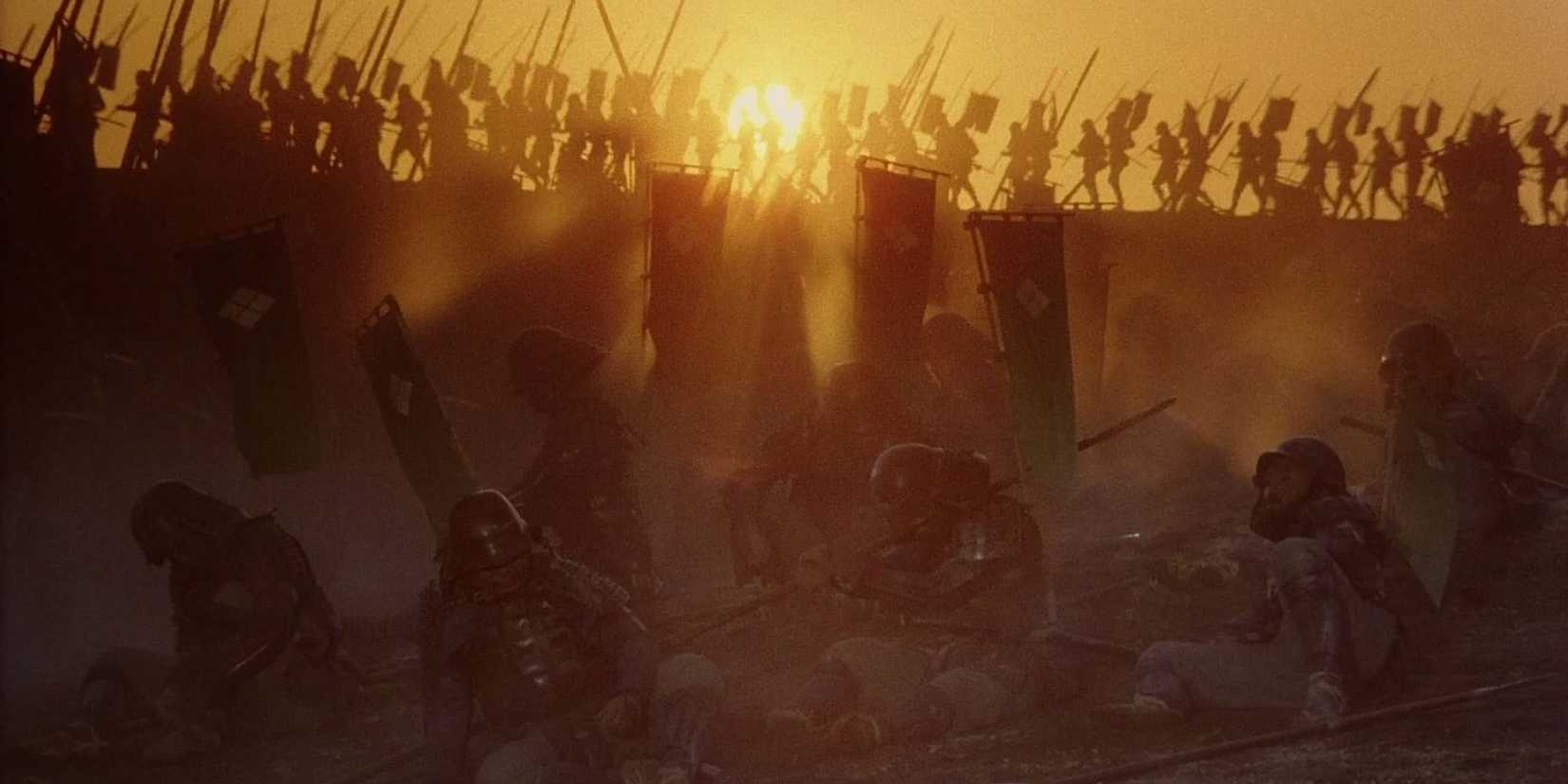
Akira Kurosawa Kagemusha 1980 Battle Finale
Image via Toho
Kagemusha has a truly epic scale, and could well count itself as Akira Kurosawa’s biggest film were it not for the existence of Seven Samurai and Ran. Both those films are probably a touch better, too, but Kagemusha nonetheless deserves more love than it tends to get, having an interesting story that centers on a doppelgänger of a warlord who’s forced to take on said warlord’s identity after he unexpectedly dies.
It might work best as a psychological drama with a historical setting, but Kagemusha also takes place during a time of warfare, which necessitates the illusion that the aforementioned warlord is still alive, lest his forces fall into chaos. When battle scenes are shown, they do impress, while much of the film is also beautiful and expectedly artistic and visually bold, especially some brief but hard-to-forget dream sequences.
Release Date
April 26, 1980
Runtime
180 minutes
Director
Akira Kurosawa
5 'Army of Shadows' (1969)
Director: Jean-Pierre Melville

Jean-Pierre Cassel in Army of Shadows
Image via Valoria Films
Just because something’s “arthouse” doesn’t mean it’s going to be a slog, nor have anything by way of thriller elements. Indeed, even though Army of Shadows is something of a slow-burn film that emphasizes suspense over explosions, it does still feel like it blends thriller and war genres, all the while having an arthouse style, owing to the distinctive voice of its director, Jean-Pierre Melville.
Melville specialized in making films about gangsters/criminals and heist movies, but made an all-time great World War II movie with Army of Shadows, which is about a Resistance fighter battling Nazi forces while also trying to get revenge on a person who betrayed him earlier during the war. It’s a film all about paranoia and not knowing who to trust, capturing the chaos and psychological struggles of warfare in a genuinely impactful way.
Release Date
September 10, 1969
Runtime
145 minutes
Director
Jean-Pierre Melville
4 'Ivan’s Childhood' (1962)
Director: Andrei Tarkovsky
If you wanted to count Ivan’s Childhood as a coming-of-age movie, then it would have to rank among the bleakest out there. The title character is a 12-year-old boy forced to grow up during a particularly difficult time in history, and also made to put his life in danger, given he's used as a spy during World War II, as his size means he can sneak across enemy lines with greater ease.
Ivan’s Childhood was the first Andrei Tarkovsky film to be genuinely feature-length, though a couple of his earlier films had been close, hovering around the 45-minute mark. It’s less difficult than later Tarkovsky movies owing to it being fairly straightforward and not too long, but certain creative decisions and director trademarks nevertheless make Ivan’s Childhood feel artistic and distinctive, certainly feeling like an Andrei Tarkovsky film. It’s thematically complex, but narratively quite straightforward by the filmmaker’s standards.
3 'The Zone of Interest' (2023)
Director: Jonathan Glazer

Children Playing in The Hoss Pool in The Zone of Interest (2023)
Image via A24
The exploration of evil found in The Zone of Interest is hard to execute, and then when such an approach is successful, the results are naturally difficult to watch. The Zone of Interest is about a family living their lives in ignorance of the horrors going on around them, with their house being right next to Auschwitz. The head of this household is Rudolf Höss, the commandant of Auschwitz, and a man whose actions there were found to constitute war crimes following the end of World War II.
What goes on inside the concentration camp isn’t seen, but it is heard, and The Zone of Interest also chooses not to show anything by way of warfare or combat scenes. It takes a blunt and eerie approach to showcasing how certain people can ignore violence and great evil, and the film overall leaves a significant impact thanks to its startling and uncomfortable style. It’s one of the decade’s best films so far, but also might be one of the more challenging movies in recent years.
Release Date
December 15, 2023
Runtime
105 minutes
Director
Jonathan Glazer
2 'The Battle of Algiers' (1966)
Director: Gillo Pontecorvo
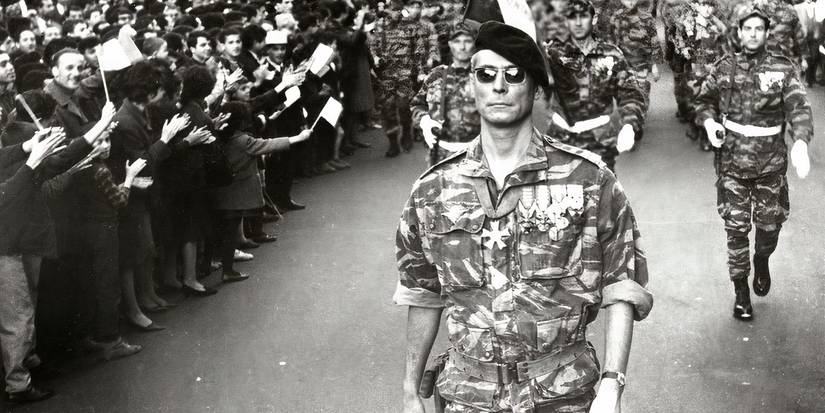
Military officer in sunglasses and a beret leads a group of soldiers behind him through a crowd in The Battle of Algiers - 1966
Image via Allied Artists
The Battle of Algiers isn’t just one of the best war movies of its time, but it also ranks high among the greatest films released during the 1960s. It also feels extra significant for shedding light on a somewhat lesser-known conflict, the Algerian War, which took place a little while after the end of World War II, being fought between 1954 and 1962.
Acclaimed for feeling strikingly realistic, The Battle of Algiers still packs a punch as a retelling of how rebel forces in Algeria fought against French colonial forces wanting to maintain power over the country, having done so since 1830. The Battle of Algiers is uncompromising as a political film, and still feels effective thanks to almost feeling like a documentary at times, proving to be an effective historical document alongside being a powerful anti-colonialism statement.
The Battle of Algiers, directed by Gillo Pontecorvo, is a historical war film depicting the struggles of Algerian revolutionaries against French colonial rule in the 1950s. Focusing on urban guerrilla warfare, the film presents a gripping portrayal of both sides' tactics and the broader socio-political implications. With a documentary-style approach, it emphasizes the intense atmosphere and moral complexities involved in the liberation movement.
1 'Come and See' (1985)
Director: Elem Klimov

Military men set up a scarecrow in Come and See
Image via Sovexportfilm
A landmark film that might well be one of the first people think of when they hear the term “arthouse cinema,” Come and See is also understandably regarded as one of the most harrowing war movies of all time. For nearly 2.5 hours, it shows horrific acts of warfare and violence through the eyes of a young boy, with his experiences changing him both psychologically and physically.
It's an unconventional and unnerving film, starting eerily quiet and gradually increasing things when it comes to intensity, unfolding into nightmarish chaos for much of its final hour. Come and See is a difficult watch by design, and filled with things both visually and aurally that are intended to disorientate, disturb, and perhaps even traumatize viewers. Anti-war films don’t get much more anti-war than this one.
Release Date
October 17, 1985
Runtime
142 Minutes
Director
Elem Klimov