10 Best Movies of 1959, Ranked (original) (raw)

Published Oct 29, 2023, 3:00 PM EDT
Jeremy has more than 2500 published articles on Collider to his name, and has been writing for the site since February 2022. He's an omnivore when it comes to his movie-watching diet, so will gladly watch and write about almost anything, from old Godzilla films to gangster flicks to samurai movies to classic musicals to the French New Wave to the MCU... well, maybe not the Disney+ shows.
His favorite directors include Martin Scorsese, Sergio Leone, Akira Kurosawa, Quentin Tarantino, Werner Herzog, John Woo, Bob Fosse, Fritz Lang, Guillermo del Toro, and Yoji Yamada. He's also very proud of the fact that he's seen every single Nicolas Cage movie released before 2022, even though doing so often felt like a tremendous waste of time. He's plagued by the question of whether or not The Room is genuinely terrible or some kind of accidental masterpiece, and has been for more than 12 years (and a similar number of viewings).
When he's not writing lists - and the occasional feature article - for Collider, he also likes to upload film reviews to his Letterboxd profile (username: Jeremy Urquhart) and Instagram account.
He has achieved his 2025 goal of reading all 13,467 novels written by Stephen King, and plans to spend the next year or two getting through the author's 82,756 short stories and 105,433 novellas.
When it comes to selecting which year of the 1950s was the best for cinema, 1954 is a difficult one to argue against. For the Japanese films alone, it had the likes of Seven Samurai, Godzilla, and Sansho the Bailiff, with classics from elsewhere in the world including Rear Window, La Strada, and of course On the Waterfront. But every year has its great movies, and 1959 - to haphazardly paraphrase that aforementioned Marlon Brando movie - could well be a contender.
It was a year that sent the 1950s off with a bang, while also pushing certain genres and styles of filmmaking forward in ways that were further built on in the coming years. What follows are some of the very best titles that were released during 1959, with all representing the year at its best and being ranked below, starting with the great and ending with the greatest.
10 'Imitation of Life'

Lana Turner and Juanita Moore in Imitation of Life
Image via Universal Pictures
Douglas Sirk was responsible for making numerous movies that could be classified as melodramas, though had the kind of skilled approach to this style of film that resulted in better movies than one might think of when they hear the term. Because sure, sometimes “melodramatic” is used as a derogatory word when describing movies that might feel far-fetched, implausible, or even kind of silly and hard to take seriously. But when a melodrama works, it can make for great and compelling storytelling of a different kind than usual.
Such is the case for Imitation of Life, which is one of Sirk’s best movies overall, and an essential blend of romance and sweeping drama from this period in film history. It looks at the trials and tribulations of being a mother while also unpacking themes surrounding race and prejudice in a remarkably open way for a film of its time. It’s also a good deal better than the first film adaptation of the novel of the same name, with that film being released in 1934.
9 'Ben-Hur'
 Image via MGM
Speaking of 1959 movies that could count as remakes or re-adaptations, Ben-Hur (1959) is a bigger and better update of 1925's Ben-Hur: A Tale of the Christ, which itself told the same story as was told in a 1907 short film called Ben Hur. In all cases, the story revolves around a man named Judah Ben-Hur who's living during the time of Jesus Christ, following his quest for revenge against the Roman Empire after his family is enslaved and his life is thrown into chaos.
As far as large-scale epics with plenty of adventure and/or action go, Ben-Hur is one of the biggest and also one of the best, and ended up winning Best Picture at the Oscars. It's worth watching for the massive chariot race in the climax alone (it's understandably the film's most popular scene), and for seeing just how big Hollywood productions could get at this time (the film industry did have to compete with all the newfound entertainment on television, after all).
8 'Hiroshima Mon Amour'

Emmanuelle Riva and Eiji Okada in 'Hiroshima, Mon Amour' (1959)
Image via Cocinor and Daiei
Though it takes place in the aftermath of World War II, Hiroshima Mon Amour still feels as though it might well be one of the most powerful and striking war movies of all time. It's an exceptionally difficult film to watch in parts, as its director, Alain Resnais, did tend to push boundaries and challenge the viewers of his films. That being said, if he was to have a film that was to be called approachable (at least by French New Wave standards), then Hiroshima Mon Amour would be it.
It takes place in Hiroshima shortly after the city - alongside Nagasaki - was bombed by U.S. forces with devastating nuclear weapons, with the film covering the devastation wrought in a solemn and grim opening sequence before focusing on the bond that forms between a Japanese man and a French woman. Hiroshima Mon Amour's a slow but absorbing film, and there's something about it that remains haunting, with images and moments sticking in one's mind long after the film itself finishes.
7 'Rio Bravo'

Though John Wayne is most commonly associated with director John Ford, he also collaborated plenty of times with Howard Hawks during his long and highly celebrated acting career. Of the films both men were involved in making, their 1959 Western, Rio Bravo, is arguably their best (though shouldn't be mixed up with other John Wayne movies, like 1950's Rio Grande or 1970's Rio Lobo, the latter of which was also directed by Hawks).
Rio Bravo takes place in a small Western town and sees an unlikely group of characters brought together to hold off the henchmen of the film's villain until help in the form of a marshal arrives. It's a movie with endearing characters, a good balance of action, humor, and drama, and one that's overall entertaining and fairly breezy to watch, even with a relatively lengthy runtime that comes in at just nine minutes short of two-and-a-half hours.
6 'Apur Sansar'
 Image via Sony Pictures Classics
The effect of Apur Sansar can only be fully appreciated when it's watched after 1955's Pather Panchali and 1956's Aparajito, given those are the first two films in Satyajit Ray's Apu Trilogy. The trilogy's films collectively tell a powerful story about a struggling family in rural Bengal, with the titular character at first being more of an observer of the things going on in other family members' lives before coming into his own as the protagonist in films #2 and #3.
With a focus on Apu reaching early adulthood and all the responsibilities that come with it, Apur Sansar might well be the most emotionally charged and hard-hitting film of the three, though again, all are worth watching and experiencing in full. You know when a movie is counted among Akira Kurosawa's favorites it's more than likely a great one, which is a piece of trivia that can be said about at least the first movie in this trilogy, Pather Panchali.
5 Anatomy of a Murder'
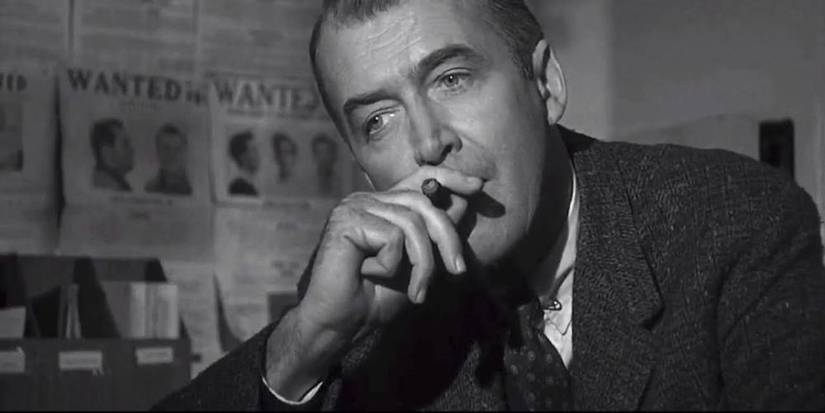
Jimmy Stewart smoking a cigar and staring in Anatomy of a Murder
Image via Columbia Pictures
Anatomy of Murder is a great enough courtroom drama to be placed among the ranks of its decade's very best movies, or at least can be counted as one that holds up significantly better than most films of its age. It's a long film, at 161 minutes, but it's paced well and manages to remain engaging and exciting throughout, focusing on a high-profile and especially dramatic murder case that pulls an aging lawyer - played by James Stewart - out of his (semi) retirement.
Stewart had a career filled with iconic performances, but even so, his lead role in Anatomy of a Murder still manages to stand out, with the level of intensity he brings to the role helping to make the film electric. It could also be the best film directed by Otto Preminger, a celebrated filmmaker from this time in Hollywood history who still perhaps doesn't quite get the level of credit he deserves.
4 'The 400 Blows'

The 400 Blows Antoine Jean-Pierre Léaud
Image via Cocinor
A searing coming-of-age movie that's also one of cinema's most effectively moving dramas, The 400 Blows stands as one of the most famous - and overall greatest - French films of all time. Not to downplay the other films made by its director (François Truffaut was prolific and consistently interesting, after all), but it's also easy to call The 400 Blows his most acclaimed and legendary work.
Though it focuses on one boy struggling with adolescence during one particular period in history, there is something universal and relatable about its themes and story; an impressive honesty with how it tackles youthful disillusionment and uncertainty. It can be a harsh and quite sad movie (its sequels do get a little lighter in tone), but it undeniably leaves an impression and is easily up there with the highlights of not just 1959, but the '50s as a whole.
3 'Some Like It Hot'

Sugar Kane, played by Marilyn Monroe, singing and performing in 'Some Like It Hot'
Image via United Artists
It's hard to deny that Edgar Wright's a funny guy who's made some very funny movies, so if he lists Some Like It Hot as one of his all-time favorite comedies, then that's got to be worth something. It's a classic farcical crime movie about two men on the run from the mob after witnessing a murder, with their desperation to escape pursuers leading them to disguise themselves as women and sneak into an all-girl band that's about to go on tour.
Once everything's been set up, Some Like It Hot feels like a non-stop barrage of great jokes, and features arguable career-best performances from its three lead stars: Marilyn Monroe, Tony Curtis, and Jack Lemmon. Filmmaker Billy Wilder was truly unstoppable around this time, as he kicked off the 1950s with the iconic Sunset Boulevard and ended it with this film... not to mention just one year after Some Like It Hot, he made the Best Picture-winning The Apartment (1960), another indisputable classic.
2 'North by Northwest'

Roger Thornhill running away from a plane in North by Northwest
Image via Metro-Goldwyn-Mayer
Throughout his decades-long career, Alfred Hitchcock mastered plenty of genres and styles, but will forever be most remembered for his contributions to the thriller genre. After all, he was justifiably labeled the master of suspense, and made so many great thrillers that it would take another list or three to go through them all... yet few can claim to be quite as fun, action-packed, and overall entertaining as 1959's North by Northwest.
The idea of a man being accused of something he didn't do, forcing him to go on the run while proving his innocence was a familiar narrative for Hitchcock to explore. With North by Northwest, it felt like he took that premise and did everything he possibly could with it, exhausting all the potential and in the process crafting something amazingly entertaining. It could well have one of the best casts in Hitchcock's filmography, too, as Cary Grant and Eva Marie Saint are great as the leads, and there are memorable villainous turns by the likes of James Mason and Martin Landau.
1 'The Human Condition I: No Greater Love'
 Image via Shochiku
Like the aforementioned Apu Trilogy, The Human Condition trilogy is one where all three films need to be watched for full appreciation of the epic story being told. Parts 1 and 2 - No Greater Love and Road to Eternity - were both released in 1959, while part 3 - A Soldier's Prayer - ended up being released in 1961. All three tell a 9+ hour story about the intense physical and emotional journey a conscientious objector during World War II goes through, with No Greater Love perhaps being the best of the three (if one was forced to choose).
The story is hugely ambitious and emotionally devastating, and marks one of the best collaborations between filmmaker Masaki Kobayashi and actor Tatsuya Nakadai (the two also did the acclaimed - and dark - 1962 samurai movie, Harakiri). It's one part of what could well be one of the greatest war films of all time, so for part 1 alone - and even if its true conclusion didn't get screened until 1961 - The Human Condition deserves to be crowned the greatest film of 1959.