10 Best Movies of 1967 — Rise of New Hollywood— Ranked (original) (raw)

Published May 11, 2023, 2:30 PM EDT
Jeremy has more than 2500 published articles on Collider to his name, and has been writing for the site since February 2022. He's an omnivore when it comes to his movie-watching diet, so will gladly watch and write about almost anything, from old Godzilla films to gangster flicks to samurai movies to classic musicals to the French New Wave to the MCU... well, maybe not the Disney+ shows.
His favorite directors include Martin Scorsese, Sergio Leone, Akira Kurosawa, Quentin Tarantino, Werner Herzog, John Woo, Bob Fosse, Fritz Lang, Guillermo del Toro, and Yoji Yamada. He's also very proud of the fact that he's seen every single Nicolas Cage movie released before 2022, even though doing so often felt like a tremendous waste of time. He's plagued by the question of whether or not The Room is genuinely terrible or some kind of accidental masterpiece, and has been for more than 12 years (and a similar number of viewings).
When he's not writing lists - and the occasional feature article - for Collider, he also likes to upload film reviews to his Letterboxd profile (username: Jeremy Urquhart) and Instagram account.
He has achieved his 2025 goal of reading all 13,467 novels written by Stephen King, and plans to spend the next year or two getting through the author's 82,756 short stories and 105,433 novellas.
The 1960s was a decade of change in many ways, including for the world of film. It marked a transitional period between the Golden Age of Hollywood and New Hollywood, and outside the American film industry, various other countries were also pushing the medium forward with riskier, more groundbreaking films. There was a thrilling mix of old and new, with the decade serving as a last hurrah for some, and an opportunity for others to become breakout players in the industry.
As it happens, the specific year within the decade that's gone down as (arguably) the most pivotal is 1967. In Hollywood, the censorship enforced by the Hays Code was noticeably pushed back against during 1967, and then by 1968, it was no longer enforced. To highlight and celebrate 1967 and what it meant to cinema, here are some of the greatest movies released during that year, ranked below from iconic to most iconic.
10 'Guess Who's Coming to Dinner'
.jpeg?q=50&fit=crop&w=825&dpr=1.5)
Guess Who's Coming to Dinner
Image via Columbia Pictures
A movie that meant well, even if it hasn't aged fantastically, Guess Who's Coming to Dinner still holds up in many ways, and can be appreciated for what it represented at the time. It's about an older white couple meeting their daughter's new fiancée who, to their surprise, is an African-American man.
It plays out with a mix of comedy and drama, and centers around the two pairs of people who clash over their different attitudes before reaching some level of understanding by the film's end. It also stands out for the quality of its acting, with it having the last on-screen role of the great Spencer Tracy, and also featuring strong performances from Katharine Hepburn and Sidney Poitier.
9 'Wait Until Dark'

Audrey Hepburn as Susy Hendrix holding up a flaming matchstick in Wait Until Dark (1967)
Image via Warner Bros.
Though Audrey Hepburn is likely best known for her comedies and romance movies, Wait Until Dark also showed she was capable of leading a great thriller. Hepburn plays a blind woman who unknowingly has a large quantity of heroin in her apartment, and finds herself targeted by a bunch of criminals who invade her property in search of the drugs while she's alone.
It's an example of an early home invasion-style movie, with Hepburn's role as a blind protagonist being far from a gimmick, and something that adds a great deal to the otherwise straightforward premise. It's consistently tense and exciting, and also worth watching for the fact it contains one of Alan Arkin's first big performances, where he plays the leader of the criminals in pursuit of the drugs.
8 'In Cold Blood'

A man standing by a window as it rains in In Cold Blood
Image via Columbia Pictures
Though it sounds like it might be a horror movie from the title, In Cold Blood technically isn't... but at the same time, it's unnerving enough to be more terrifying than many horror movies. It's based on the Truman Capote novel of the same name, and depicts the aftermath of a particularly brutal murder committed by two men, where an entire family was killed in a failed robbery.
That it's based on a true story is one reason why it's so unsettling, and adding to that is the fact this film feels remarkably grounded and realistic for a movie made in 1967. It's not fun to watch by any means, but it's excellently made, and is unafraid to tackle difficult questions surrounding the idea of justice, the legal system, and the death penalty.
7 'The Dirty Dozen'

Lee Marvin as Major John Reisman in an open field holding a rifle in The Dirty Dozen
Image via MGM
The Dirty Dozen has a perfect action movie premise and executes it remarkably well. It follows a group of military prisoners (many with death sentences) during World War Two who are told they'll have their sentences reduced if they participate in a dangerous assassination mission where the odds of their survival are slim.
It follows a standard action movie formula where a squad is recruited, they plan their mission, and then they execute said mission throughout the film's final act. When it comes to explosive action, it's surprising how well a movie this old pulls it off, and the formula will be familiar to those who are fans of (the not great) Suicide Squad or (the pretty great) The Suicide Squad.
6 'Cool Hand Luke'

Paul Newman sitting on a car in Cool Hand Luke
Image via Warner Bros
There's no shortage of iconic Paul Newman performances out there, but few are quite as famous as his role in Cool Hand Luke. He plays the title character, a rebellious prisoner who continually clashes with prison guards and becomes beloved by the other prisoners stuck in the same Florida prison farm as him.
It reflects the youthful and anti-authority sentiment present in the late 1960s well, with the film and its lead character living on as counter-cultural icons. The film itself also holds up well and is pretty entertaining to watch, standing out as one of the greatest and most famous prison movies of the 20th century.
5 'In the Heat of the Night'

Detective Virgil Tibbs and Police Chief Bill Gillespie work the case in 'In the Heat of the Night'.
Image via United Artists
1967 was a great year for Sidney Poitier, as not only did he star in Guess Who's Coming to Dinner, but he was also the protagonist of In the Heat of the Night. This crime drama also won Best Picture at the 1967 Oscars, and has a plot that follows Poitier's character - an African-American detective - being tasked with leading a murder investigation in a small southern town plagued by racism.
It may not handle the subject matter at hand with quite as much nuance as a movie today might, but it can be recognized for doing it well by 1960s standards. It also tells a strong crime/mystery story as well as dealing with themes around racism, making it one of those classic films that's as engaging as it is thought-provoking.
4 'The Producers'

"The Producers" Christopher Hewett, Andreas Voutsinas, Gene Wilder, Zero Mostel
Image via Embassy Pictures Corp.
Mel Brooks has become well-known for his various genre parodies over the years (with his best perhaps being the Western spoof Blazing Saddles), but The Producers stands out for not exactly being a parody of a specific genre. It's certainly satirical and pokes fun at musicals and theater, and contains the style of humor found in Brooks' other movies.
It centers on two men who try to scheme their way into a small fortune by putting on what's guaranteed to be a flop, only to find that the production is so bad people love watching it. It's a clever premise that leads to plenty of witty, bitingly funny moments, and the lead actors - Zero Mostel and Gene Wilder - make for a fantastic comedic duo.
3 'Le Samouraï'

Alain Delon as Jef Costello walking down the street in Le Samourai
Image via S.N. Prodis.
Jean-Pierre Melville was one of the greatest French filmmakers of all time, and Le Samouraï is likely his most well-known work. It's a slow-paced but engrossing crime thriller that centers on a lonely professional hitman who, after a job goes wrong, finds himself on the run from forces who want him dead.
It's an impeccably stylish movie, and though it doesn't lack substance by any means, the style of it all is what ends up sticking in mind the most. Well, that and the lead performance by Alain Delon, who's one of the most recognizable French film stars of all time, and many would consider his part in Le Samouraï to be his definitive role.
2 'Bonnie and Clyde'

Faye Dunaway and Warren Beatty in 'Bonnie & Clyde' (1967)
Image via Warner Bros./Seven Arts
A landmark film that's also one of the best crime movies of all time, Bonnie and Clyde is an undeniable classic in every sense of the word. It presents a somewhat glamorized (though still occasionally gritty) look at the life of the infamous titular duo, who were a pair of lovers during The Great Depression who became well-known for their various bank robberies.
Though 1967 as a whole helped change a great deal about how movies were made, Bonnie and Clyde might be the single film that influenced the most change. It was more violent than a lot of what came before, it had experimental and creative editing (much like the films of the French New Wave), and it was more morally complex than prior crime films, given it portrays the title characters as anti-heroes. Over 50 years later, watching it still leaves quite the impression.
1 'The Graduate'
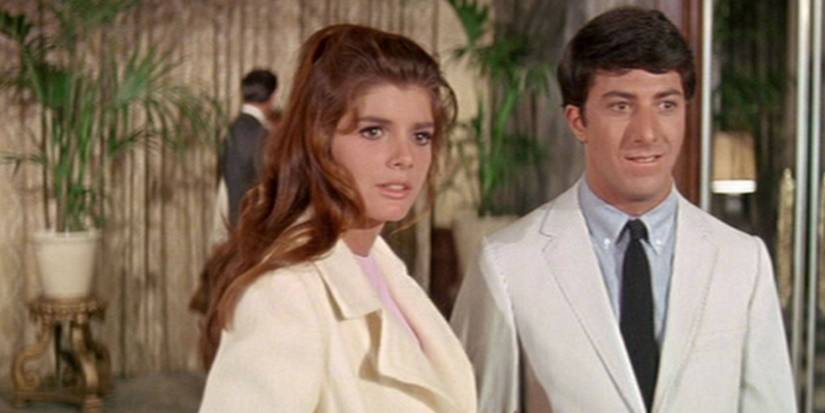
Elaine (Katharine Ross) and Ben (Dustin Hoffman) on a date in The Graduate
Image via Embassy Pictures
It's a close call between Bonnie and Clyde and The Graduate, but the latter probably stands nowadays as the best film of 1967. It was similarly boundary-pushing for its time, and while it didn't feature any graphic violence or criminal characters, it was quite racy and unafraid to deal with taboo topics through its story of a young man struggling to make the final jump from student to adult.
It's a testament to the movie's daringness that the central part of the story - involving the title character having an affair with an older married woman - still feels uncomfortable to watch today. It's a movie that's funny, dark, provocative, unnerving, and entertaining all at once. It's perfectly acted and sharply written to the point where it's easy to call The Graduate an untouchable classic.