Oppenheimer’ Ending Explained: Are We Past the Point of No Return? (original) (raw)

Cillian Murphy in Oppenheimer.
Image by Annamaria Ward

Updated Feb 16, 2024, 12:00 PM EST
Chase Hutchinson is a longtime editor and writer with more than a decade of experience in journalism. His work has appeared in a variety of publications including IGN, i-D, The Stranger, The Wrap, The Inlander, The Seattle Times, and The Boston Globe. With a deep foundation of knowledge on everything from blockbuster fare to arthouse film, he is never not looking for the next exciting cinematic vision to explore. He is an expert in everything from horror franchises like Saw and Scream to big sci-fi like Star Wars as well as smaller scale genre stories like The Beast. He has covered several film festivals for Collider including the Cannes Film Festival, the Toronto International Film Festival, the Sundance Film Festival, the Fantasia Film Festival, and the Venice Film Festival. He is also a member of the Seattle Film Critics Society. You can find him on Twitter and Bluesky at @EclecticHutch.
Sign in to your Collider account
Editor’s Note: The following contains spoilers for Oppenheimer.
Summary
- Oppenheimer explores the devastating consequences of creating the atomic bomb and its lasting impact on the world.
- The film depicts Oppenheimer's realization that their creation could destroy everything they know, leading to a horrifying reckoning when the bomb is dropped.
- The final scene between Oppenheimer and Einstein reveals the tragic truth that their self-centered pursuit and arrogance led to the destruction of the world.
When sizing up a film like Oppenheimer, a sprawling work about the man behind the creation of the first nuclear weapons that may just be writer-director Christopher Nolan’s most colossal and mature film yet, there is a temptation to pull on the many threads that unravel before us. True to the book on which it is based, the Pulitzer Prize-winning biography “American Prometheus,” it spans decades in the life of J. Robert Oppenheimer with the central focus being how he becomes the head of the Manhattan Project where he works to create the weapons of mass destruction that will kill hundreds of thousands of people when they are dropped over the Japanese cities of Hiroshima and Nagasaki in 1945. In doing so, he cemented a sordid legacy as being one of the men that forever reshaped the world in blood and pushed us to the now-constant brink of annihilation. It is in the final moments where Nolan makes this explicit, even going so far as to have a character imply that much of what preceded it was largely unimportant, making any discussion of the film itself require an in-depth read of this ending. Thus, if it wasn’t already clear, this piece contains complete spoilers so best bookmark this page and come back after you’ve seen it for yourself.
The closing scene is not actually the one furthest forward in time. Rather, it is one that we saw early on from a different perspective after Oppenheimer succeeded in his mission of making the atomic weapon that is now recontextualized. As played by a positively haunting Cillian Murphy in one of his best performances to date, we had previously observed the physicist meeting with Albert Einstein (Tom Conti) down by a small body of water while Lewis Strauss (Robert Downey Jr.) watches on. When the scene first occurs, the two men had what seemed like a serious albeit brief conversation that we did not get to hear the details of. All we knew is that Einstein walked away, ignoring Strauss as he did so, with a grim expression now etched on his face. The film then moves forward and backward from this moment, exploring in detail both how we got there as well as the aftermath of what followed. This includes the process of creating the Los Alamos Laboratory where Oppenheimer and his colleagues worked for years all the way through Strauss unsuccessfully attempting to become U.S. Secretary of Commerce. While Nolan explores both timelines, the key to it all keeps coming back to this one scene that we revisit one final time in the crushing closing moments.

Oppenheimer
Release Date
July 21, 2023
The story of American scientist, J. Robert Oppenheimer, and his role in the development of the atomic bomb.
Cast
Cillian Murphy, Emily Blunt, Matt Damon, Robert Downey Jr., Florence Pugh, Josh Hartnett, Casey Affleck, Rami Malek, Kenneth Branagh, Benny Safdie, Jason Clarke, Dylan Arnold, Tom Conti, James D'Arcy, David Dastmalchian, Dane DeHaan, Alden Ehrenreich, Tony Goldwyn, Jefferson Hall, David Krumholtz, Matthew Modine, Scott Grimes, Kurt Koehler, John Gowans, Macon Blair
Runtime
181 minutes
Director
'Oppenheimer' Is About the Death of the World by Man’s Hand
Early on in the process of trying to create the weapon, that they naively said would end all future wars, Oppenheimer and his colleagues were faced with the possibility that it may in fact destroy everything they had come to know. Though he would later assure those like Leslie "Dick" Groves(Matt Damon) that there was a non-zero chance of this occurring, all of this was theoretical and there was still a sense that pushing the button on their first test might be the last thing they ever did. The math presented the possibility that it could trigger a chain reaction until everything and anything was gone. This terrifying prospect is something we see playing out in Oppenheimer’s mind constantly as he imagines the world being consumed by fire, the sound of screams swallowing up everything around him in a frightening fashion.
That this doesn’t happen when they do their test seems to offer relief, as the world continues spinning just as it did before. However, while Oppenheimer tries to run from what he has created, the reality is that it has forever and fundamentally changed life for the worse. A scene where he gives a speech after the bomb is dropped is meant to be victorious, but it is horrifying as his delusions are obliterated. He tries to pretend this is something to celebrate only for us to hear the screams louder than ever before, see the flesh melting off of the faces of the audience, and even observe the body of someone burned beyond recognition crumble beneath his foot. The people in the room may not have been consumed by a hellfire of their own creation, but countless others were because of their actions. Their world was technically still intact, but for so many others it was snuffed out in an instant. Everything they had ever been and could be was now gone forever. No matter how much Oppenheimer tries to undo what he has done and argue against the further use of atomic weapons, it is a Pandora’s box that unleashes destructive forces he cannot close back up once he has pried it open.
When he then talks in that final scene with Einstein, who had himself initially tried to push for the program before by writing a letter to President Roosevelt before also turning against it and deeply regretting his initial support, the otherwise tranquil scene by the water is defined by tragedy. Both men, full of insights about the possibilities of the world, were now living in one that was worse off because of this same knowledge. When we come back to this moment in the end, we finally hear what it was that they said to each other that resulted in Einstein being shattered into silence. Oppenheimer asks him if he remembers when he had initially shown him the math that raised the concern that they might destroy the world. Einstein said he did. After all, how could one forget something like that? This holds even more true when Oppenheimer then says that they actually did do just that. The words linger in the air and Einstein turns away with nothing to say in response, the darkness consuming his face at the inescapable truth of what he just heard. While Strauss had speculated that the conversation had somehow been about him, the reality as we have now seen it was that both his and the ego of the men involved mattered little in the grand destruction they had created. It was precisely this self-centered pursuit and arrogance tied to their hollow accomplishments, no matter the immense cost they were all fully aware of, that led to our present broken world.
The Ending of 'Oppenheimer' Reveals the Lasting Legacy of the Man
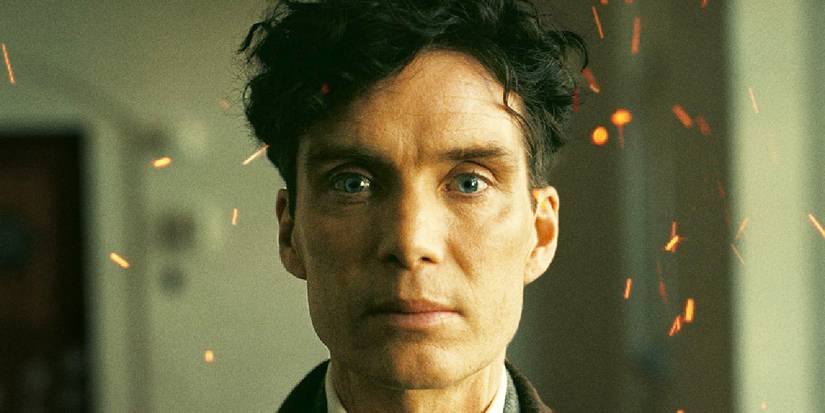
Cillian Murphy as a young Oppenheimer in Oppenheimer.
Image via Universal Pictures
When Oppenheimer then stands alone, with one final vision of the world being utterly and completely destroyed by his creation playing out fully, the unmitigated terror of what they’ve done is not tempered by his speaking it aloud. His empty acknowledgment came too late for the thousands who died and the many more who could in an instant. It is in this moment, without anything else to say, that his legacy is laid bare. There is no coming back from it, no salvation for him, only the looming specter of death that he brought down upon this world.
Oppenheimer is now available to stream on Peacock in the U.S.