With Ready Player One, Steven Spielberg Grappled With His Own Legacy (original) (raw)

Published Nov 14, 2022, 12:30 PM EST
Collier Jennings is an entertainment journalist with a substantial amount of experience under his belt. Collier, or "CJ" to his friends and family, is a dedicated fan of genre films - particularly science fiction, fantasy and comic book adaptations, not to mention all forms of animation animation. This stems from a close bond with his father, who introduced him to these genres via copies of X-Men comics and reruns of the original Ultraman series. Using his near-encyclopedic knowledge and bottomless love of genre, he's been able to tackle a wide variety of articles.
Ready Player One is a film that's sparked more than a fair amount of discourse. The Ernest Cline novel it's based on, once touted as a love letter to pop culture, was critically reappraised and found wanting in multiple areas. Cline also received less than flattering reviews for his follow-up novels Armada and Ready Player Two. And when it was announced that Steven Spielberg would be helming the live-action adaptation of Ready Player One, the reception was ... mixed, to say the least. However, upon a rewatch, the reason why Spielberg chose to helm the film is clear: He sees much of himself in a certain character.
Ready Player One, which is currently available to stream on HBO Max,takes place in the year 2045, as mankind spends most of its time in the virtual environment known as the OASIS (Ontologically Anthropocentric Sensory Immersive Simulation). The OASIS was co-created by the brilliant yet reclusive James Halliday (Mark Rylance), who launches a unique contest after his death. Whoever completes three challenges will receive three keys to unlock a series of gates, and the person who unlocks all three gates will gain control of Halliday's vast fortune as well as the OASIS itself. Wade Watts (Tye Sheridan) and his friends race to complete the challenges, all the while opposed by tech conglomerate Innovative Online Industries and its ruthless CEO Nolan Sorrento (Ben Mendelsohn).
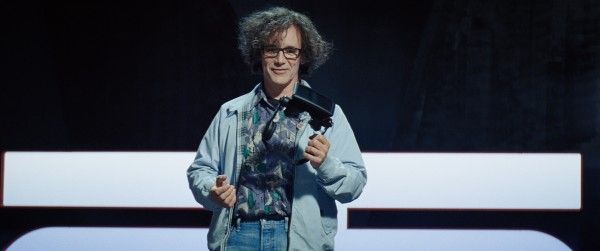 Spielberg Likely Sees Himself in Halliday
At first glance, one would think that the character Spielberg is connecting with is Wade. After all, it wouldn't be the first time that his movies featured an adolescent going through an extraordinary journey. But that isn't the case here. It's Halliday who the filmmaker seems to see most of himself in. Like Halliday, Spielberg is a major part of pop culture, having inspired scores of filmmakers, as well as the work they've turned out. And in the same way that Halliday uses the three challenges to work through his life's regrets, Spielberg sees Ready Player One as a vehicle with which to tackle his legacy, along with the goods and ills it may have conceived.
The first challenge serves as a great example. When looking for clues to overcome an impossible race, Wade ends up visiting the archives where every bit of information on Halliday is stored. There he witnesses a fight between Halliday and his co-collaborator Ogden Morrow (Simon Pegg). Morrow is pointing out that Halliday has to take responsibility for the OASIS and how people use it, but Halliday simply brushes him off and says, "Why don't we go backwards?" While this is the clue Wade needs to complete the race, the conversation also sounds like Spielberg is at war with himself. His movies are well known for having a sense of nostalgia around them, and he's also been labeled as a very sentimental filmmaker. However, he's also directed outright depressing films such as Schindler's List and Close Encounters of the Third Kind. It's as if he's shouting out to the world that he -- and by extent, other filmmakers -- shouldn't be boxed into making one type of film.
Halliday and Morrow would ultimately part ways, as Halliday was in love with Morrow's late wife Kira (Perdita Weeks). The second challenge expresses that sorrow the only way that Halliday knows how -- through the lens of pop culture. Specifically one piece of pop culture: the late Stanley Kubrick's adaptation of The Shining. When Wade and his fellow player/crush Art3mis (Olivia Cooke) discuss the clue to the second challenge -- "a creator that hates his own creation" -- they assume it refers to the fact that Stephen King despised Kubrick's film. Yet the truth cuts far deeper, as it turns out that Halliday grew to despise how the OASIS severed his bonds to the real world.
For Spielberg, the Shining sequence is a way to express his grief about losing Kubrick. The two were friends, and like Morrow and Halliday they were polar opposites in terms of filmmaking. Spielberg's films are warm and inviting, while Kubrick's are more cold and cerebral. Ironically, Spielberg would end up completing A.I.: Artifical Intelligence after Kubrick handed it to him, and dedicated the film to his late friend. In the same way that A.I. was a tribute to Kubrick, the Shining sequence was a way for Halliday to express regret over his suppressed feelings for Kira and the destruction of his friendship with Morrow.
 Image via Warner Bros.
Spielberg Cares More About Art Than Commerce
But the biggest moment comes in the conflict with Sorrento, who seeks to monetize the OASIS for all it's worth. In a scene early in the movie, Sorrento attempts to woo the other IOI board members with promises of flashy advertisements and priced tiers to get more bang for the user's buck. Spielberg and fellow filmmaker George Lucas grimly predicted that a similar fate would befall movie theaters and the films that played within them. Speaking at a panel at the Unviersity of Southern Carolina in 2020, Spielberg said, “You’re at the point right now where a studio would rather invest $250 million in one film for a real shot at the brass ring than make a whole bunch of really interesting, deeply personal — and even maybe historical — projects that may get lost in the shuffle because there’s only 24 hours.” His words echo Sorrento's plans and seem extremely prophetic in an age where blockbusters are the major draw of movie theaters while mid-budget movies are all but extinct and the independent film struggles to gain a foothold.
But Spielberg also loves movies the same way that Halliday loves pop culture, as during the beginning of the COVID-19 pandemic he gave an impassioned speech about the importance of movie theaters. "We’ve become a community, alike in heart and spirit, or at any rate alike in having shared for a couple of hours a powerful experience," he said. That same sentiment is echoed toward the end of Ready Player One when Wade, having won the contest, comes face to face with a remnant of Halliday who thanks him for playing the game. In the end, despite whatever flaws or failures he's encountered along the way, Spielberg wants the world to love movies as much as he does.