Love ‘Rosemary’s Baby’? This Haunting Descent Into Madness Should Be Your Next Watch (original) (raw)

Catherine Deneuve as Carole Ledoux looking at a mirror in Repulsion
Image Via Compton Films

Published Oct 20, 2024, 1:20 PM EDT
Thomas Randolph is a dynamic and multi-talented writer with a background in music and a deep love for all things history and sci-fi. With roots in Houston, Texas, Thomas received a bachelor's degree in music focusing on classical guitar performance. Music has been a part of Thomas' life since childhood, and has been a constant companion and creative outlet. In addition to music, Thomas has always had a passion for writing as a form of creative expression, and he enjoys writing about music, fantasy tabletop rpgs, and of course, movies.
Thomas' movie taste began to form with sci-fi action classics like The Terminator and Aliens, and he has never left that love behind. In addition, Thomas has an affinity for historical drama, historical fiction, westerns, and horror. Above all, he is a lover of compelling and powerful cinema of any genre, always tending toward more bleak and challenging films.
Thomas also runs his own YouTube channel primarily focused on nuclear weapons history called "Doomed to Repeat".
Sign in to your Collider account
**_Rosemary’s Baby_**— a true mainstay in the horror genre — has a complicated legacy due to the crimes of its director, Roman Polanski. What many viewers might not know is that it was actually the second film in an unofficial trilogy. Polanski’s “Apartment Trilogy,” as the name suggests, concerns three different horror movies that all take place in apartments. The trilogy begins in 1965 with Repulsion, Rosemary's Baby follows in 1968, and then The Tenant completes it in 1976. Repulsion sets a precedent for what Rosemary’s Baby would soon perfect: the portrayal of fear-soaked madness against a backdrop of uncertainty and terror. Catherine Deneuve’s Carol shows viewers the frightening world of Repulsion through paranoid eyes, betraying little through her subtly brilliant performance. At its heart, Repulsion is a story of trauma, fear, and mounting madness that meanders in horror rather than driving headlong into it, tempting audiences to follow along to whatever end.
What Is 'Repulsion' About?

Catherine Deneuve looking shocked in Repulsion.
Image via Columbia Pictures
The film centers on Carol, a young woman from Belgium who works as a beautician in London, where she shares a flat with her older sister Helen (Yvonne Furneaux). The film is quite stingy with backstory, and by the middle of it, we only know that Carol is a quiet, reclusive person, in stark contrast with her charming, happy-go-lucky sister. What is quite clear, however, is that Carol does not like men; in fact, she seems well and truly terrified of them. She is resentful and distrusted by her sister's paramore, Michael (Ian Hendry), and she is indifferent and seemingly annoyed by a man named Colin (John Fraser), who is utterly infatuated with her. Apart from these bare facts, Carol gives almost nothing else away about her character, at least, not at first glance. Helen ends up leaving London on a European vacation with Michael despite Carol’s pleading that she stay. Now, Carol is alone in a rather large apartment, a place that she not only resides in but that changes with her as her fear and paranoia grows.
 Related
‘Repulsion’s’ Setting Reflects the Main Character's Mental Health
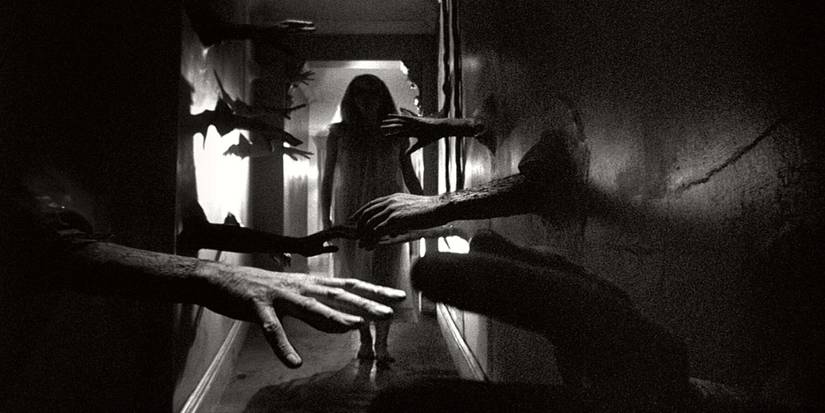
Catherine Deneuve walking on a hallway where hands are coming out of the walls.
Image via Columbia Pictures
Rather than a ham-fisted explanation via a psychiatrist, or even from self-report, Carol’s worsening delusion is shown via the decay of her living space. Cracks in the walls begin to form and as Carol’s delusions take a stronger hold, the place seems to expand and contract around her. This is not just a demonstration of physical neglect, but rather, it is an analogy for what is happening in Carol’s mind. In her flat, she has visions of nameless men attacking her in silence, and time seems to swirl about without direction. A clock ticks incessantly in some scenes, and sounds of bells and pianos waft through the halls as Carol hides away from the world. Eventually, Repulsion takes a terrifying step into the surreal as the apartment seems to come alive with masculine hands, groping aggressively for Carol’s body. All of these dramatic images serve to show viewers the slow decay of a troubled mind through the literal decay and distortion of the apartment.
Repulsion is a film that delights in its vagueness, epitomizing the principle of “show don’t tell.” Carol herself hardly tells anyone anything, but her apartment says it all. It's clear that Carol is completely dependent on her sister, who acts as a stabilizing influence on her. And when Helen leaves, the effects on Carol and the apartment are terribly negative. The place is rotting from neglect, closed off and isolated, and eventually snaps into absurd attacks on Carol. If seen as an analog to Carol’s psyche, it is obvious that the film is dealing with a neglected person who isolates herself out of fear, and eventually, lashes out in violence. Time becomes abstract in the flat, and that is because Carol seems to pay it no mind. And when the apartment is invaded by men, even the ones who seem to want to help her, she kills before allowing the invaders to stay very long. In a brilliant implementation of the setting, audiences get to know the state of Carol’s mind through the very place where she lives.
Is Carol’s RepulsionDelusional Paranoia, or Justified Fear?

Patrick Wymark as the landlord stares menacingly at Catherine Deneuve as Carol in Repulsion.
Image via Compton Films
Rosemary’s Babytells the story of a pregnant woman who grows increasingly fearful and paranoid that some cabal of villains has devious plans for her baby. And, spoiler alert... she is right in the end. At first glance, Repulsion might appear to invert that conclusion, with Carol being utterly horrified by men for seemingly no good reason. This fear drives her to madness and murder, but is there any justification for this fear? Again, Repulsion is not forthcoming with answers, but from the start, Carol hints at where her fear must have come from. In an early scene, Carol is perusing the knick-knacks on her mantle. The camera pans to an old photo, seemingly showing a younger Helen and Carol sitting outside with some adult family members. Carol is only a little girl in the photo, and she is not looking at the camera, but rather, she is glaring at an older man sitting to her right. Again, we are only shown a picture of an uncomfortable-looking young girl looking at an older man, but the implications of the photo are very telling. Carol was abused as a child.
This trauma is further demonstrated by Carol’s violent actions in the latter half of the film. Carol’s only victims in Repulsion are both men who enter her flat without her consent. One believes he is helping her, and the other most certainly means her harm. No matter the intention of the intruders, Carol reacts the same way, with fear and violence. It seems that Carol cannot conceive of a safe man, and the reason for this phobia lies in that seemingly innocuous picture. The film does not attempt to justify or condemn Carol’s actions, but rather, only shows them coldly for what they are, through the eyes of the little girl in the picture who has become a woman. In this sense, Carol could rightly be called paranoid, even delusional, but if the implications are true, she could hardly be blamed for her fear.
Unfortunately, a discussion about a Roman Polanski film can almost never escape the director’s own terrible crimes. In 1978, Polanski pleaded guilty to unlawful sex with a minor but fled the United States before being sentenced. To this day, he remains a fugitive from justice in the US and an extremely controversial figure in that never-ending argument about art and the artists who make it. It is doubly ironic to consider this subtle, meaningful story about abuse and trauma in light of its creator’s heinous crimes. In the end, it may be impossible to separate the art from the artist, but Repulsion is no less a triumph for the rest of its crew, and certainly, some value can be derived from its profound story.
Repulsion is a subtle film in its characterization, but rapturous in its setting and sounds. It does not spoon-feed meaning to its viewers, but it does invite them to see its world through Carol’s eyes. Those eyes that see men as terrifying aggressors, and that seek to shroud their vision in isolation, slowly slip into madness as that vision blurs. The terror in Repulsion is not experienced through the victims of the film’s protagonist but through Carol’s own perception of the surrounding events. It is perhaps all the more scary because, by the end, viewers might fully believe that, despite her obvious delusion, she has a reason to be repulsed.

Release Date
October 2, 1965
Runtime
105 Minutes
Director
Roman Polanski
Writers
Roman Polanski, Gerard Brach
Cast

Catherine Deneuve
Carole Ledoux
Repulsion is currently available to stream on Prime Video in the U.S.