Every Major Change ‘Spider-Noir’ Makes From Marvel Comics (original) (raw)

Nicolas Cage as Ben Reilly in 'Spider-Noir'
Image via Prime Video

Published Jun 6, 2026, 6:08 PM EDT
Eddie Possehl is a dynamic and driven writer/director with a passion for the written word and all things film, television, comics, and games. His passion for storytelling led him to establish his own production company in hopes of achieving his dreams.
His dedication to his craft has attracted renowned talent like Yuri Lowenthal to collaborate with him on his projects. As he grows and improves, Eddie is a shining example of a self-starter.
Sign in to your Collider account
Spoiler Alert: This list contains spoilers for Spider-Noir and Spider-Man Noir (2008).Spider-Noir is the newest Spider-Man-based project—**one of three in 2026**—and people are actually pretty pleased with it. For quite a bit, people have been saying Sony should be investing more in the alternate versions of Spider-Man for projects, rather than making stories about his villains, which is exactly what Spider-Noir accomplishes.
However, what a lot of fans of the show don't know is the fact that Spider-Noir is actually completely different from the Spider-Man Noir comic books. Some have even gone as far as to say that Disney and Sony have effectively "ruined" the character, and while that's a very extreme reaction, it's proof of the fact that there are some major changes in modern media—in this case, _Spider-Noir_—for the Noir iteration of the hero.
Spider-Man Noir Is a Murderer

Nicolas Cage in Spider-Noir
Image via Prime Video
Fans of the show can see that the Spider-Noir version of the Web-Slinger is actually way more in line with traditional Spider-Man when it comes to his moral compass. He only really commits one murder in the show, and that's ultimately to save Cat Hardy (Li Jun Li) and Flint Marko (Jack Huston). However, in the comics, Spider-Man Noir is a pretty seasoned killer.
This isn't to say that he is like The Punisher in any way, but, in the comics, he certainly has far fewer qualms about taking lives.While there does come a moment with Aunt May that causes him to put his gun away for good, for everything before that, Spider-Man Noir has little issues taking someone down, permanently.
He's a Journalist and a Photographer

Spider-Man Noir lurking in the shadows.
Image via Marvel Comics
While he may be a private eye in the Prime Video series, in the source material his occupation is far closer to traditional Spider-Man's. He is a journalist/photographer, so it maintains Peter's usual photo-taking job from the main 616 universe. So, while it keeps him in-tune with the crime of 1932 New York City.
While it's different, it's arguable that the private eye direction of the character in Spider-Noir is far more fitting for this version of the Wall-Crawler, as it connects him more to the criminal underworld, and makes him more of a detective type. It's proof that just because something is changed from the comics, that doesn't necessarily mean it's bad.
His Comics Costume Is Grittier

Nicolas Cage in Spider-Noir
Image via Prime Video
Anyone who has seen the comics, Spider-Man: Into the Spider-Verse, and Spider-Noir will see that the costumes of each are drastically different. Ever since the 2018 animated hit, Spider-Man: Into the Spider-Verse, he's taken on a far more detective-looking suit, which suits him quite well, given the new direction for the character.
In the books, though, he's got a much different, grittier-looking costume. Void of a slick fedora, Earth-90214's Spider-Man looks a lot more like a Batman-type of character than anything.While this fits the far darker tone of the comics, there's no doubt that the newer vibe for the hero feels far more unique in comparison to other universes of the webhead.
No J. Jonah Jameson

J. K. Simmons as J. Jonah Jameson in 'Spider-Man' (2002)
Image via Sony Pictures Releasing
Despite him being a private eye and part of the news cycle, thanks also to his pal Robbie Robertson (Lamorne Morris), there's a total absence of J. Jonah Jameson in Spider-Noir. In the comic books, Jameson is a prominent figure as the Daily Bugle's editor. He's actually crucial to the plot of the Goblin and Chameleon storylines, making him a mainstay of the Spider-Man Noir (2008) series.
While Robbie is in the series and is a reporter (kind of taking the occupation that Peter originally had in Spider-Man Noir (2008)), there's still no Jameson in the plot of Spider-Noir. While the story of the Prime Video series most likely doesn't have a ton of room for another reporter-esque character, the missing spot of Jameson is definitely felt by fans of the source material.
Collider Exclusive · Star Wars Quiz Which Force User
Are You? Light Side · Dark Side · Or Somewhere Between
The Force is not a binary. It is a spectrum — from the serene halls of the Jedi Temple to the shadowed corridors of Sith space. Ten questions will reveal where you truly fall. The Force has always known. Now you will too.
🔵Jedi Master
🟡Padawan
🔴Sith Lord
⚫Inquisitor
⚪Grey Jedi
IGNITE YOUR SABER →
01
What is the Force to you? Your relationship with the Force defines everything else.
AA living energy I must be worthy of — it is not mine to control. BSomething vast and mysterious I'm only beginning to understand. CNeither light nor dark — just a current I choose to ride. DPower. Pure and simple. The strong take it; the weak don't.
NEXT QUESTION →
02
When you feel strong emotions — anger, grief, love — what do you do? The Jedi suppress. The Sith feed. Others choose differently.
AAcknowledge them, then release them. Attachment leads to suffering. BFeel them fully, then decide what to do — they're not the enemy. CBury them. Emotion is a liability I can't afford to indulge. DUse them. Passion is the engine of the dark side for good reason.
NEXT QUESTION →
03
The Jedi Council gives you an order you disagree with. You: How you handle authority reveals your alignment.
AFollow it. The Council's wisdom surpasses my own perspective. BVoice my objection clearly, then defer to the decision. CComply outwardly while doing what I think is right. DIgnore it. The strong don't answer to committees.
NEXT QUESTION →
04
You are offered forbidden knowledge that could give you enormous power. The cost is crossing a moral line. You: The dark side's pull is never more than a choice away.
ARefuse without hesitation. There is no cost worth that price. BWeigh it carefully — sometimes darkness holds real answers. CFeel the pull but walk away — for now. DAccept it. Power justifies the method used to obtain it.
NEXT QUESTION →
05
Your approach to training and learning is: A student's habits become a master's character.
ADedicated but humble. There is always more to learn from my masters. BRigorous and patient. Mastery is earned through years of discipline. CEclectic — I draw from every tradition, not just one. DRelentless and brutal. Pain accelerates growth. Rest is weakness.
NEXT QUESTION →
06
In a duel, your lightsaber fighting style reflects: Combat is the purest expression of a Force user's philosophy.
ADefense and composure — I wait for my opponent to overcommit. BFast and instinctive — I trust the Force to guide my movements. CUnpredictable — I blend styles to keep enemies off-balance. DOverwhelming aggression — I end fights before they begin.
NEXT QUESTION →
07
A defeated enemy lies at your feet, powerless. You: Mercy — or its absence — is the truest test of alignment.
AStrike them down — compassion toward enemies is naïve and costly. BNeutralize them permanently. I can't afford loose ends. CSpare them if I can — but stay clear-eyed about the risks. DOffer them a chance to surrender. Every being deserves that.
NEXT QUESTION →
08
The Jedi Code forbids attachment. Your honest view on love and bonds: The source of the greatest falls in the galaxy.
AThe Code is right. Attachment clouds judgment and invites suffering. BLove is not a weakness — the Jedi Code got this one wrong. CI have no attachment — only loyalty to my master's mission. DI feel it deeply but struggle to reconcile it with my training.
NEXT QUESTION →
09
Why do you use the Force at all? What's the point? Purpose is the difference between a knight and a weapon.
ATo learn. I'm still figuring out what I'm capable of. BTo protect and serve. The Force is a responsibility, not a gift. CTo survive — and maybe carve out something worth having. DTo dominate. Strength demands to be expressed, not contained.
NEXT QUESTION →
10
At the final moment — light side or dark side pulling at you — what wins? In the end, every Force user faces this moment. What does yours look like?
AThe light. I choose peace, even when darkness would be easier. BNeither fully — I carve my own path through the middle. CWhoever I serve — my loyalty defines me more than my morality. DThe dark. Power is the only thing that's ever actually been real.
REVEAL MY ALIGNMENT →
Your Alignment Has Been Determined Your Place in the Force
The scores below reveal how the Force sees you. Your highest number is your true alignment. Read on to understand what that means — and what it will cost you.
🔵 Jedi Master
🟡 Padawan
🔴 Sith Lord
⚫ Inquisitor
⚪ Grey Jedi
Disciplined, compassionate, and deeply attuned to the living Force, you have walked the path long enough to understand its demands — and accept them. You lead not through authority alone, but through example. You have felt the pull of the dark side and chosen otherwise, every time. That is not certainty. That is courage.
You are earnest, powerful, and brimming with potential — and you know it, which is both your greatest asset and your most dangerous flaw. You act before you think, trust your gut over your training, and sometimes confuse impatience for bravery. The Masters see something in you, though. The question isn't whether you have what it takes — it's whether you'll be patient enough to find out.
You are not simply dangerous — you are certain, and that is worse. You have decided what the galaxy needs, and you have decided you are the one to deliver it. Your power is genuine and formidable, earned through sacrifice that would have broken lesser beings. But examine your victories carefully. Every Sith believed their cause was righteous. The dark side's cruelest trick is that it agrees with you.
You were forged in fire and reshaped by those who found you at your lowest. You serve, because service gave you structure when you had none. Your allegiance is not to an ideology — it is to survival and to the master who gave you purpose. But there is something buried beneath the conditioning. The Jedi you hunt? You recognize them. Because you remember what it felt like before the choice was taken from you.
You have looked at the Jedi Code and the Sith Code and found both of them incomplete. You walk the line not out of indecision but out of conviction — you genuinely believe both extremes miss something essential. The Jedi don't fully trust you. The Sith think you're wasting your potential. They're both partially right. But so are you.
↻ RETAKE THE QUIZ
Robbie Is Ben Urich (Sort Of)

Lamorne Morris smiling with a cigarette in Spider-Noir
Image via Prime Video
In the Spider-Man Noir (2008) comic line, rather than being close pals with Robbie Robertson, like in the live-action series, Peter Parker is actually tight with Ben Urich, who is more of a mentor figure to him. While Robbie isn't a mentor to Ben Reilly in Spider-Noir and more of a close friend, he is still taking the place of the "reporter that's closest to Spider-Man" in this universe.
Robbie also takes the place that Ben Urich has in most of the Spider-Man Noir (2008) plots, being kind of the lead reporter chasing down the stories happening in the universe. While Peter may be a journalist with him in the comic universe, Ben is the one chasing all the leads as a reporter, while Pete is typically suiting up to jump into the fold as the noir-themed Web-Slinger.
Black Cat Is Quite Different

Li Jun Li standing at a microphone in Spider-Noir
Image via Prime Video
When the Black Cat character is introduced in Spider-Noir, she's introduced as Cat Hardy. Rather than being a lounge singer connected to the likes of Flint Marko, with a plot connected to the Mayor of New York City, Alfred Morris (Michael Kostroff), Felicia Hardy of Earth-90214 is a facially disfigured owner of a nightclub and the former lover of Ben Urich. The classic Spider-Man villain/love-interest is quite different in both versions of the Noir universe.
In the comics, her alter-ego isn't Black Cat, though, but rather the White Widow. She owns the Black Cat Nightclub, instead. In the books, she has a heartbreaking plot of witnessing Urich be murdered by Chameleon, who was impersonating J. Jonah Jameson, and goes into a revenge story that is emotionally compelling. While Cat Hardy is a great addition to Spider-Noir, a version of the character more like this would have been pretty dang cool to see.
A New Characterization

“Ben Reilly” (Nicolas Cage) in a scene from Prime Video’s Spider-Noir (Courtesy of Prime Video)
Image via Prime Video
The massive change that has hit the Spider-Man Noir character since Spider-Man: Into the Spider-Verse is honestly very drastic. Before he became the detective type, the noir Wall-Crawler was far darker and a lot more vengeful. In the comics, his Uncle Ben story features his beloved father figure being eaten—yes, genuinely _eaten_—**by Earth-90214's Vulture.** This event sends him on a far darker path than the iteration of the character that people know now.
As stated, though, Spider-Man: Into the Spider-Verse reinvented the character to be who he is now,which is a much more classic detective type of character. He's quite comedic, older (more on that next), and a sleuthing type. While it's been a welcome change because of how fun it is, fans of the comic will say that this universe's Peter Parker is a completely different character than he used to be.
Comics Peter Is Only 19 Years Old

Nicolas Cage as Spider-Man Noir pointing in 'Spider-Man: Into the Spider-Verse'
Image via Sony Pictures Releasing
As aforementioned, the character in Spider-Noir is actually far older in age than his comic book counterpart. In the Spider-Man Noir (2008) comic storyline, Peter Parker is actually only 19 years old. While his age is never explicitly stated in Spider-Noir, audience members know that he is a World War I veteran, and with Nicolas Cage being 61 years old, it's assumed he's around a similar age.
The age difference is not only a huge part of the dissimilarity in the characters' characterization, but also crucial to how the plot lines in both character iterations are executed. In Spider-Noir, Ben, being a far more seasoned hero, allows him to experience things in a different light, which affects how he handles the plot points ahead of him.
A Shiny New Origin Story

Spider-Noir (Nicolas Cage) making his introduction in 'Spider-Man: Into the Spider-Verse'
Image via Sony Pictures Releasing
In the source material, Spider-Man Noir's powers are actually magic. Yes, magical. When Peter accidentally breaks an ancient magical spider idol, he sets free a group of supernatural spiders. One of said spiders, as assumed, bites Peter and gives him the powers of a spider after seeing a vision of a spider demigod.
In the show, viewers already know that he gained his abilities during a rescue operation, in which he discovers a mutated man who looks like a "man spider" of sorts. The man bites him, and gives him the powers of, you guessed it, a spider. So, to say that the origins between comics and television are different feels like a bit of an understatement.
Ben Reilly
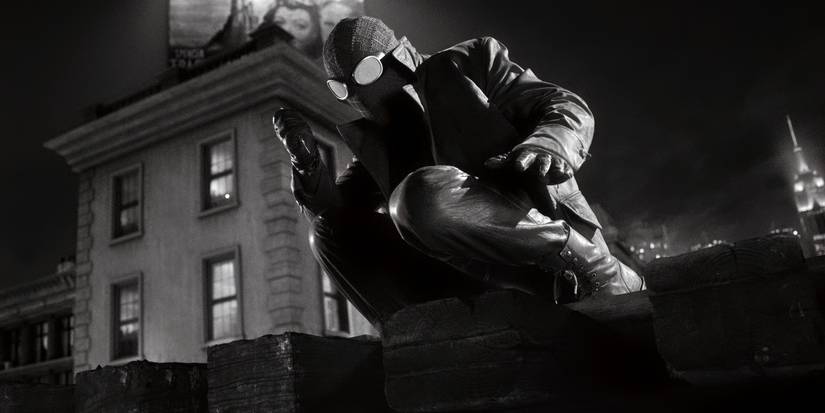
Spider-Noir
Image via Prime Video
What's arguably the most interesting change from comic to show is the fact that the Spider-Noir version of the character is actually known as Ben Reilly, and not Peter Parker. This, at first, confused pretty much everyone, especially after the most recent Spider-Man Noir still being a Peter Parker variant.
While it's eventually revealed later in the series—in Spider-Noir Season 1, Episode 6, "Nightmare on a Gurney"—that his true name actually is Peter Parker, he's still considered Ben Reilly for a majority of the show, and, on top of that, this is never a plot point in Spider-Man Noir (2008). After such a tumultus past, he changed his name to keep the government and others who knew him in his World War I days from knocking on his door.
Spider-Noir
Release Date
May 27, 2026
Network
MGM+

Showrunner
Oren Uziel, Steve Lightfoot
Directors
Harry Bradbeer
Franchise(s)
Main Genre
Seasons
1
Producers
Christopher Miller, Phil Lord, Amy Pascal, Steve Lightfoot
Creator(s)
Oren Uziel
Streaming Service(s)
Release Window
2026
Executive Producer(s)
Harry Bradbeer, Phil Lord, Christopher Miller, Aditya Sood, Amy Pascal, Dan Shear