The Babadook Ending Explained - What Does the Monster Represent? (original) (raw)


Updated Sep 19, 2024, 6:00 PM EDT
Sign in to your Collider account
10 years on, and we still can’t get rid of the Babadook – and that’s fantastic for horror lovers. IFC Films is giving Jennifer Kent’s The Babadook a 10th-anniversary re-release starting on September 19. Tackling tough themes of guilt, trauma, and depression, Kent’s bedtime-story-gone-wrong became an instant classic (as well as spawning an unexpected LGBTQ+ icon). The Babadook was a forerunner of the so-called “elevated horror” movement, and it remains a poignant look at a mother’s complicated relationship with her son and her own repressed emotions. Essie Davis stars as Amelia, the overworked single mother of the troubled Sam (Noah Wiseman). Sam’s father, Oskar, died in a car crash while he was driving Amelia to the hospital to give birth, leading to unresolved trauma for Amelia centering around her son.
After Sam finds a picture book called "Mister Babadook," the titular entity begins haunting him and his mother, andit eventually pushes Amelia to the breaking point of her sanity, putting her son and herself in danger. While the ending of The Babadook is fairly straightforward in terms of what literally happens, the metaphorical meaning of these events is unusually rich, hence why it’s made so many top-ten lists since its original release. As we head back to theaters to be tormented by the titular monster all over again, it's the perfect time to re-examine the ending’s compelling and complex ideas about motherhood, childhood, and how to come to terms with grief and trauma.
How Does ‘The Babadook’ End?
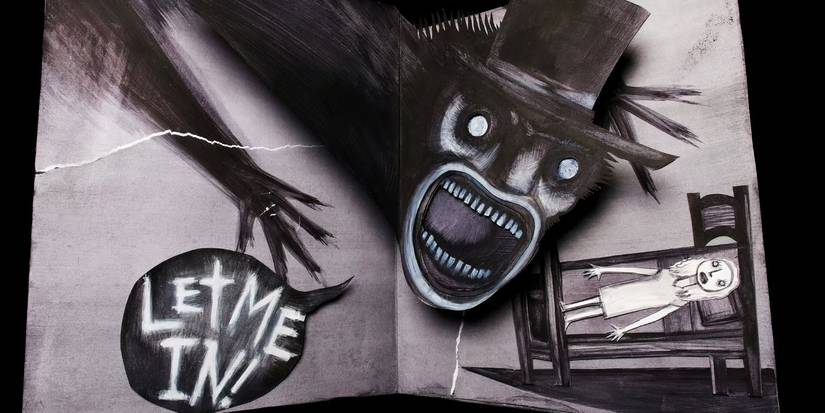
A page from a pop-up book featuring a black creature with a white face, white eyes and a large mouth, wearing a top hat, screaming "Let me in!" to a woman lying on a bed in "The Babadook"
Image via Umbrella Entertainment
The strength of the ending to The Babadook comes in part from the journey it takes to get there. After the death of her husband, Amelia works a service job at a retirement home while trying to take care of Sam, who’s exhibiting behavioral and emotional problems at school and with other children. Mother and son struggle daily because of the unreasonable demands of parenting placed on a single, working-class mother and Amelia's lingering trauma from the death of her husband. She avoids any discussion of the incident, even refusing to celebrate Sam's birthday on the actual day because of the association with Oskar's death. Things only get worse as Sam finds the creepy children’s book "Mister Babadook"and asks Amelia to read it to him. When she does, the book scares Sam, and Amelia suffers another sleepless night trying to quiet Sam's tears. She disposes of the book, but it reappears on their doorstep**.** She burns the book, and the same thing happens. Then, the Babadook (the monster from the children’s book, voiced by Tim Purcell) comes alive and haunts Amelia and Sam. As the book says, “You can’t get rid of the Babadook,” and the monster takes turns visiting Sam in haunting visions and possessing Amelia.
Sam’s behavior worsens, in part due to his terror of the Babadook; he yells, screams, and eventually pushes his cousin out of a multi-story treehouse in anger. Amelia isn’t having a much better time; when the Babadook possesses her, she kills their dog, disconnects the phone lines, puts broken glass in the soup, and attempts to kill Sam. The book prophesied that she would kill Sam and then take her own life afterward. At the end of the film, Sam has to restrain the possessed Amelia in the basement and expel the monster from her to save them both. But, of course, it does not die, because you can’t get rid of the Babadook.
Once the monster is expelled, Amelia and Sam run up the stairs and close the door, confining the Babadook to the basement. The film then flashes forward several months, to Sam’s birthday party – now held on his actual birthday. Amelia is shown calmly going down to the basement to check on the Babadook and to feed him. When he comes out of the shadows to get the food, Amelia recoils a bit in fear, but she stays in control of her fear. Later, her sister asks her how “it” was today. Amelia replies that it was quiet today, suggesting that the task of feeding/tending to the “monster” is harder on some days than others, but still showing that she's finally come to terms with the fact that she does have to tend to own emotions instead of ignoring them.
Ignoring the Babadook Only Gives It More Power
Monsters and ghosts often symbolize real traumas from the past that are “coming back to haunt” the characters. The Babadook certainly seems to symbolize Amelia and Sam’s shared grief/trauma over losing Oskar: the monster wears a suit just like the one he used to wear, and the monster even takes on the exact appearance of Oskar near the end of the film, attempting to trick Amelia into giving him the boy. Also, the monster is ultimately confined to the basement, which is where Amelia keeps all of her late husband’s clothing and other possessions. Early on in the film, Amelia does not like Sam playing in the basement (engaging with memories of his father). Throughout most of the film, Amelia wishes for Sam and herself to move on; she does not want to engage with the grief. She moves Sam’s birthday celebration every year to share it with his cousin, implying that her husband’s death still hangs over her head so much that she struggles to celebrate her own son.
 Related
Unfortunately, the more Amelia tries to ignore their grief and trauma, the worse things get. Sam repeatedly tells Amelia that the monster is real and that he needs to build weapons to protect them, but she either ignores him or begs him to stop telling stories. She tries multiple times to dispose of the book, resulting in the monster stepping out of the pages and into reality. When Sam is being terrorized by the monster, she has the doctor prescribe him sleeping pills so that they can both get some sleep, but it solves nothing. The monster appears to feed off of being ignored, growing stronger and more dangerous the longer its existence is denied. The book spells out what will happen if Amelia and Sam fail to gain control over the Babadook: they will both die (along with their dog). The book does not give away the secret to how they must approach the Babadook to avoid this fate; rather, it just repeats the phrase, “You can’t get rid of the Babadook.” Although Amelia and Sam try repeatedly to kill the monster to no avail, they eventually learn that if they can’t kill him, he is at least less dangerous when they confront him head-on and when he is confined to his own monster body. So, after expelling him for the final time from Amelia, they trap him in the basement to gain control over their own trauma and, more importantly, their own healing.
‘The Babadook’ Ending Represents How to Handle Emotional Trauma

Essie Davis and Noah Wiseman as Amelia and Sam sitting together on a couch in front of a birthday banner in "The Babadook"
Image via Umbrella Entertainment
Sam and Amelia must work together to take control of the Babadook. Some people might think that, because Amelia is the mother, it is her responsibility to provide a safe, happy life for Sam. However, Amelia is not able to best the Babadook alone. Sam is part of the family, and mother and son must work together in this film to find a healthy approach to their shared trauma. The most important part of the ending is that the monster must stay in their basement and that he is fed and tended to daily, rather than being ignored. This task is not super-pleasant, but it is not nearly as terrifying as facing the monster when he had free rein in the house, or when he was possessing either Sam or Amelia. Just like in real life, Sam and Amelia cannot simply ignore their trauma and hope that it will disappear. When they try to ignore their unhappy emotions, they grow into something bigger, scarier, and more sinister.
The only way Sam and Amelia can heal from their trauma is by actually facing it, but the film is aware that it needs to come in reasonable doses and over an extended period of time. Healing from serious traumas in real life does not happen overnight, it takes a lot of mental and emotional processing. The Babadook warns of the dangers of trying to avoid or “stuff” our traumas below the surface: this is the most dangerous place to put them, because that’s where we lose control of them, and they gain control over us.
Is The Babadook Real or All in Amelia’s Head?
Some viewers take the metaphor a step further and believe that the Babadook was never real in the first place: Amelia’s depression and trauma finally drove her over the edge for a brief period, and she alone is the cause of the movie’s terrors. And there is some evidence to support this (if you squint): Amelia used to write children’s books, which is how the Babadook first manifests; no one else ever witnesses the Babadook other than Sam and Amelia; and most of the supernatural elements (the visions, the book being repaired and returned to their doorstep) can be explained by hallucinations and blackouts. But there are a few problems with the idea that the Babadook isn’t real. For starters, if he doesn’t exist, the ending implies that whatever mental health disorder Amelia has will continue to be self-treated (which could be dangerous in real life, even if the movie shows her “winning” over it).
In addition, having the Babadook exist outside of Amelia makes him more universal; he isn’t a psychosis specific to one woman but can represent all kinds of trauma for the audience. He also externalizes trauma, which is key to understanding the real point of the film. As Jennifer Kent herself explained, it's about “connecting to [Amelia] and her journey towards staring something nightmarish in the face.” Amelia literally has to stop internalizing and suppressing her emotions in order to heal; if the Babadook is just a delusion, then he’s not truly an externalization. The general gist of the theory is correct: The Babadook is a metaphor. And there's indeed nothing that explicitly says the character itself isn't also a metaphor for Amelia and Sam in the movie. But by extending that metaphor to the entity in the universe of the film, instead of recognizing him as real and that the movie as a whole is the metaphor, the theory waters down the film’s message and gives it a cliché plot twist of “it was their imagination all along” it doesn’t need.
Overall, the ending of The Babadook offers a hopeful outlook for Sam and Amelia. Sam is getting along better with other kids. Amelia is connecting with her sister and seems to have a budding romance with her co-worker. They haven't completely processed and moved on from their trauma because the Babadook is still in their basement. It is unclear whether the Babadook will ever leave their basement, and whether they will ever be done feeding/tending to him. It is likely they will never be done, because “You can’t get rid of the Babadook,” and also because there are certain traumas that people may heal from, but they don’t completely forget about. Amelia and Sam will forever have to live with the fact that Oskar is dead. Even if Amelia remarries, this will not reverse the loss. Although the Babadook may never fully disappear, it is reasonable to assume that over time, the Babadook may need less daily attention and that the task of managing it may become less scary. Just like in real life, we may not be able to eradicate past traumas from our minds, but we can gain control over them so that they grow smaller and do not fully consume us.

Release Date
November 28, 2014
Runtime
94 Minutes
Director
Jennifer Kent
Writers
Jennifer Kent
Cast


Noah Wiseman
Samuel Vanek
The Babadook is back in theaters now for a limited run.