5 Universal Monster Movies That Are Timeless Classics (original) (raw)

Frankenstein's Monster looks at his bride, and she looks off camera with a confused look on her face in The Bride of Frankenstein.
Image via Universal Pictures

Published Sep 14, 2025, 10:42 AM EDT
Jeremy has more than 2500 published articles on Collider to his name, and has been writing for the site since February 2022. He's an omnivore when it comes to his movie-watching diet, so will gladly watch and write about almost anything, from old Godzilla films to gangster flicks to samurai movies to classic musicals to the French New Wave to the MCU... well, maybe not the Disney+ shows.
His favorite directors include Martin Scorsese, Sergio Leone, Akira Kurosawa, Quentin Tarantino, Werner Herzog, John Woo, Bob Fosse, Fritz Lang, Guillermo del Toro, and Yoji Yamada. He's also very proud of the fact that he's seen every single Nicolas Cage movie released before 2022, even though doing so often felt like a tremendous waste of time. He's plagued by the question of whether or not The Room is genuinely terrible or some kind of accidental masterpiece, and has been for more than 12 years (and a similar number of viewings).
When he's not writing lists - and the occasional feature article - for Collider, he also likes to upload film reviews to his Letterboxd profile (username: Jeremy Urquhart) and Instagram account.
He has achieved his 2025 goal of reading all 13,467 novels written by Stephen King, and plans to spend the next year or two getting through the author's 82,756 short stories and 105,433 novellas.
Sign in to your Collider account
If you want to count “Universal Monsters” as an ongoing cinematic franchise, then it’s about as long-running as they get. The first big movies classifiable as such pre-dated even the first King Kong, which came out in 1933. And Godzilla was still more than 20 years away around the time some of the Universal Monsters made their big-screen debuts, so even if Kong and Godzilla dominated pop culture eventually, at least as far as movie monsters go, you do have to give props to the genre’s originals. There were a few silent era movies that sometimes get called Universal Monster movies, but The Hunchback of Notre Dame (1923) and The Phantom of the Opera (1925) aren’t being included here. It’s not that they're bad, or ineffective as silent-era horror movies, but it feels a bit weird to call them monster movies, since the “monsters” are deformed people.
But by the 1930s, sound was a thing in cinema, and the Universal Monster movies also started focusing more on antagonists – or tragic individuals – who were more easily definable as monsters. Sure, not monsters like Godzilla is a monster; nothing that big, but definitely recognizable as things that weren’t human in the traditional sense. There were a bunch of these movies pumped out throughout the 1930s and 1940s, with various films getting a ton of sequels, though continuity within some of these series proved a bit all over the shop. Some of these Universal Monster movies lived on beyond those decades, thanks to solid films like The Mummy (1999) and The Invisible Man (2020), but it’s just that classic era that’s going to be focused on here (so, movies from the '30s or '40s). The following movies hold up the best, and are the ones worth checking out first if you're curious about classic Universal Monster movies, but have yet to check many/any out.
5 'Frankenstein' (1931)

Colin Clive as Henry Frankenstein and Dwight Frye as Fritz in Frankenstein 1931
Image via Universal
Is it still worth doing the whole “Um, actually, Frankenstein isn't the monster” thing? If you say you're dressing up as Frankenstein for Halloween, most people will picture the monster, but Frankenstein was the scientist who made the monster. And if you want to go further, maybe calling the monster a “monster” isn't entirely accurate, at least if you stick to the source material, where it was more often described as a “creature.” So can 1931’s Frankenstein even be counted here, when the topic at hand is classic Universal Monster movies? What existential despair, perhaps even more frightening in nature than the movie itself.
Frankenstein asks questions about existence, human nature, and alarming technological advancements, with it all being well-handled and effectively creepy for a film of its age.
As for the movie, it’s pretty damn good. There’s another 1931 release alongside Frankenstein that really made the Universal Monster series a big one right from (near) the start, but this is a strong take on the Mary Shelley novel of the same name. Well, it’s technically an adaptation of an adaptation, since this movie is more based on the 1927 play version of Frankenstein. There’s a sequel to this movie that’ll be mentioned a little later that’s arguably even better, but Frankenstein (1931) is still very good. It’s got familiar – maybe even expected – things here, you know, the questions about existence, human nature, and alarming technological advancements, but all well-handled and effectively creepy for a film of its age. You probably won’t be terrified by it if you watch it nowadays, but it’s easy to imagine this one alarming viewers back almost 100 years ago. And if you want more modern adaptations, you're in luck, because there are plenty, including Guillermo del Toro's take on the story, which is releasing in 2025.
4 'Dracula' (1931)

Abraham Van Helsing (Edward Van Sloan) shows Count Dracula (Bela Lugosi) the cross in 'Dracula' (1931).
Image via Universal Pictures
The aforementioned The Phantom of the Opera came out in 1925, with Dracula being the next of the potential Universal Monster movies, coming six years later and also being the first that wasn’t a silent film. It preceded Frankenstein by a matter of months, and also brought an iconic novel to the big screen… well, almost. Actually, like Frankenstein, it wasn’t a direct adaptation of the novel, and instead was based on a play that itself was based on Bram Stoker’s novel. Either this is an unusual coincidence, if you're looking at 1931 horror movies, or this was common practice for early talkies. If you want to research and get answers, uh, go for it. But that’s beyond the movies themselves.
And Dracula itself? It’s very good, and understandably kicked off a whole series of movies that brought back the titular character, but Bela Lugosi only played him one other time, beyond this 1931 film. Lugosi starred as Ygor (or Igor) in just as many Frankenstein films as he did Count Dracula in _Dracula_-related movies, and Lugosi also once played Frankenstein’s monster, specifically in Frankenstein Meets the Wolf Man. So that’s some fun trivia. Without trivia, this entry would just be saying things about Dracula (1931) that have already been said before. But now, with trivia, if you actually read this and don’t skim it, now you can surprise that “very smart” friend of yours this Halloween who wants to talk about “Frankenstein not being the monster” with a more interesting and less talked-about factoid. You’re welcome.
3 'Abbott and Costello Meet Frankenstein' (1948)
 Image via Universal Pictures
While Abbott and Costello Meet Frankenstein is not very scary at all, it’s not trying to be, and a Universal Monster movie doesn’t have to focus on horror to be great. If anything, leaning into the hammier side of things wholeheartedly worked here, and the film ends up being an enjoyable (and mostly gentle) kind of self-parody. Comedy duo Bud Abbott and Lou Costello are indeed the stars, and the title is not the 1940s equivalent of clickbait, because they really do meet Fra- ah, dammit. Maybe it is clickbait. They don’t meet Frankenstein. They meet Frankenstein’s monster/creature.
No, Universal! Not you falling victim to the Frankenstein/Dr. Frankenstein mix-up! But the title might not have been as snappy if it had been more accurate. Also, the title hides the fact that Abbott and Costello end up meeting a bunch of other Universal Monster characters in this film, making it one of the earliest crossover movies, done long before The Avengers made it cool. As for versus movies, there had been Universal Monster flicks that had gone there even earlier, including the aforementioned Frankenstein Meets the Wolf Man. Also, there were not-so-comedic crossover movies that pre-dated Abbott and Costello Meet Frankenstein, as demonstrated by House of Frankenstein, since that entry in the series/franchise also featured Count Dracula and the Wolf Man.
2 'Bride of Frankenstein' (1935)
Bride of Frankenstein is one of those rare sequels that’s often considered better than the original, which is extra impressive in this instance, since the aforementioned Frankenstein is indeed (already) a horror classic. But this one goes further in being a great and timeless piece of gothic horror specifically, ultimately being a little more frightening while also feeling very much more creative. Mary Shelley herself is a character here, at least in the framing device, and she’s played by Elsa Lanchester, who also plays the Bride: another monster designed to be a mate for the original monster.
It's strange that she’s not in the film a great deal, but Bride of Frankenstein works well regardless, and when that new monster does eventually appear, she is undoubtedly iconic. Making a sequel to Frankenstein, all the while also being inspired by parts of the original text, would’ve seemed like a wild idea on paper, but in execution, Bride of Frankenstein ends up working remarkably well. It was the first of the Universal Monster movie sequels, and easily the best of the bunch. In fact, many people would probably call this the best of the classic Universal Monster movies, so this part 2 being placed at #2 here might be something of a hot take, but…
1 'The Invisible Man' (1933)
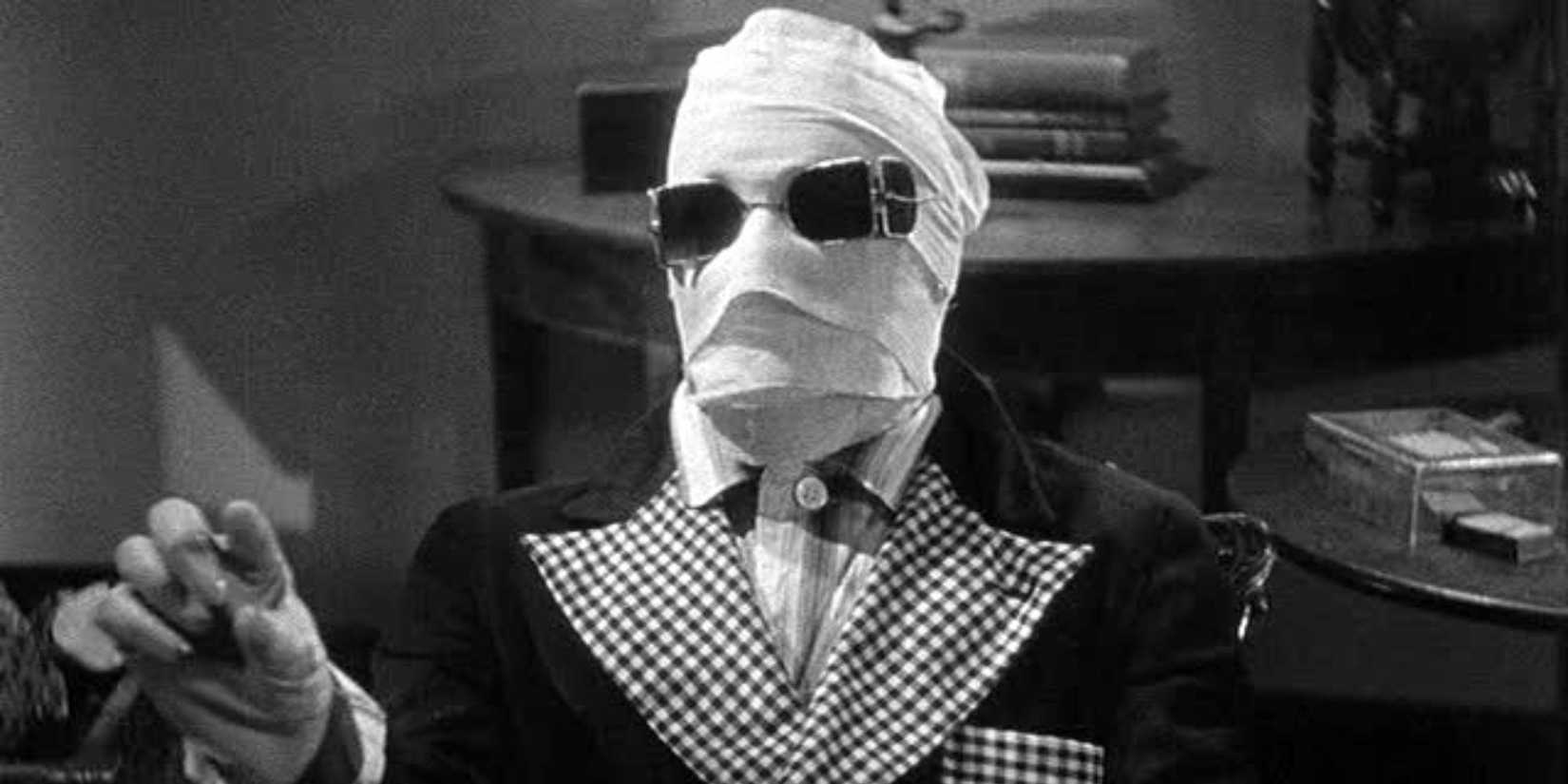
Dr. Jack Griffin (Claude Rains) with his head wrapped up in 'The Invisible Man'
Image via Universal Pictures
Yeah, so The Invisible Man is the best Universal Monster movie, both within the classic run of this series and overall (so, counting films made much later, including the pretty good 2020 version of The Invisible Man). It’s not a full-on comedy in the same way that those Abbott and Costello films are, but The Invisible Man is a little goofy at times, because it is ultimately about a guy who becomes invisible, and unless you're talking about the 2020 movie, that’s always going to have some humor attached to it. And The Invisible Man is funny and exciting until it’s not.
The tonal shifts here work, because like just about anything that could be called a superpower, there are positives and negatives to be found when one’s life is permanently altered by a new ability. The follow-ups to The Invisible Man, also released during the same “classic” period of Universal Monster movies, tend to be a bit more outwardly comedic, and they are all really weird and/or interesting, but the original is easily the best. It’s tonally more interesting, and it’s also paced remarkably well for a movie that’s not far off being a century old (and it’s not just the runtime of 71 minutes that makes this pass by in a flash). Also, becoming invisible is simple enough that plenty of the effects in The Invisible Man still hold up, and even if you technically don’t see Claude Rains’ face all that much, he still has a presence; that voice is enough. This is a funny, weird, occasionally unsettling, and surprisingly sad movie. It’s got it all, and it’s the best of the classic Universal Monster flicks.

The Invisible Man
Release Date
November 3, 1933
Runtime
71 minutes
Cast

Claude Rains
Dr. Jack Griffin
Gloria Stuart
Flora Cranley