12 Website Conversion Tips for the Roofing Industry – Contractor Calls (original) (raw)
12 Website Conversion Tips for the Roofing Industry

12 Website Conversion Tips for the Roofing Industry
Selling a roof requires a lot of free estimates, a lot of patience, and a lot of raw leads. But all the leads in the world won’t mean much without a good closer to seal the deal.
That’s true for your website, too. If you have too many users who visit your website for 10 seconds and leave without calling, contacting, or visiting any other pages, that’s a problem.
Today, we’re going to look at some of the ways you can boost your website conversion rates, so you can start turning more of those visitors into paying customers.
What is a Website Conversion?
Any time someone visits your website and takes a desired action, that’s a conversion.
For roofers, that usually means the visitor calls you or emails you, but a conversion can also be:
- Someone signs up for your newsletter
- Someone follows you on Facebook, Instagram or Twitter
- Someone downloads your white paper
- Someone visits more than one page of your website without exiting
Long story short, any action that takes a visitor one step closer to becoming a paying customer can be a website conversion.
Sure, a new Twitter follower doesn’t sound as interesting as a request for an estimate, but that follower can help share your content, connect you with other friends who could be in the market for a new roof, or be the first to see your next promotion.
All of these things are valuable to your business, so it’s worth trying to grow them.
Here’s how you can start getting more conversions from your website:
1. Boosting your Click Through Rate (CTR)
What happens when someone searches for “roofer near me” and your site shows up in Google’s search results?
Well, you have three options:
- They could click on your website
- They could click on someone else’s website
- They could click on nothing at all.
The more clicks you earn, the more opportunities for conversions you’ll have.
What is CTR?
Your click through rate, or CTR, is the number of clicks to your website divided by the number of total searches. If 1,000 people search for a “roofer near me” in your market and 50 of them click on your website, your CTR is 5%, or 50/1000.
How Can You Boost Your CTR?
The usual way to boost your CTR is by ranking higher. If someone searches for a “roofer near me” and your site shows up first, you’ll automatically get most of the clicks.
Ranking higher for any search requites SEO, and that’s a huge topic. You can learn how SEO works here, or learn about our SEO strategy for roofers here.
The other way to boost your CTR is to make users skip over other websites to click on yours instead.
Here are some of the tools that can help:
- Your title tag. Your page title tag is a critical SEO component – but it’s also the first thing users see about your website in search results.
- Your meta description. The description that appears under the title has no direct SEO impact, so you can edit it without risking your SEO.
- The URL. It’s easy to forget the role that the visible URL can have on expectations. What would you expect to see on a page like “SampleRoofer.com/flat-roof-repair”?
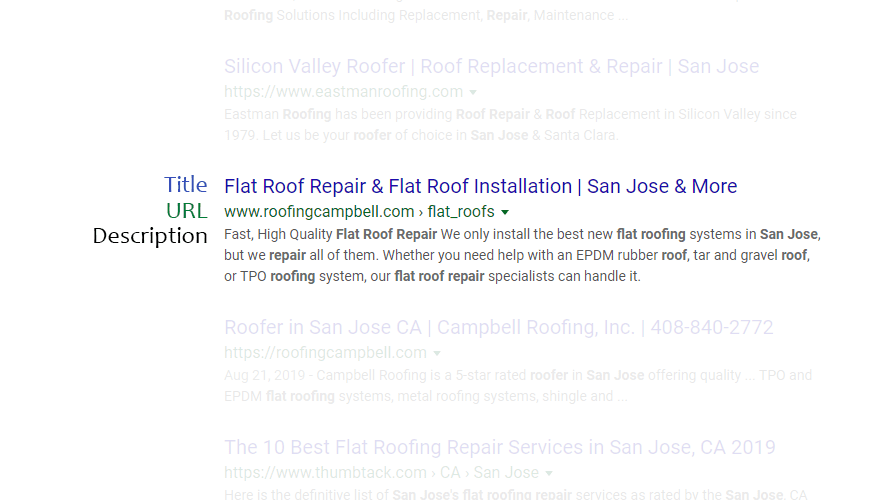
Now, here are a few tips for boosting CTR using those tools:
- Feature unique selling points about your business. Are you a 5-star rated Chamber of Commerce member with a BBB A+ rating? Do you offer 24 hour service and a veteran’s discount? If users have to click through to your website to learn about all of those things, then they’re not helping your CTR.
- Feature unique selling points about the page’s content. Do you have a pricing calculator or a gallery of shingle styles on your page? Tell users about it before they even see it.
- Expand your service area. If the competition says “roofer in San Jose,” try putting “roofer in San Jose & More.” It can help earn clicks from other nearby cities.
- Specify your relevant services. “Flat roof repair, installation and maintenance” is going to earn more clicks than “flat roofs.”
- Consider adding your phone number. Putting your phone number in the title tag or description will actually hurt your CTR, since they can call without clicking through to your site, but it also lets you skip straight to the conversion. It’s great for picking up emergency service calls and free estimate calls.
- Actually check out the search results. Want to get more clicks from “gutter installation Phoenix”? Start by actually searching for “gutter installation Phoenix.” Pay close attention to which selling points your competitors mention (like free estimates) and which ones they don’t. Capitalize on the places where they fall short.
Boosting your CTR will give you more high-quality traffic to play with. Even if everything else on your website stays exactly the same, it should still boost your website conversions.
2. Pick a Unique Selling Point and Stick to It
If you offer the quickest repairs in town, great. If you’re the top-reviewed roofer by a mile, great. And if you have more experience and awards than anyone else, that’s great too. But if you try to tell all three stories at the same time, you’ll just create noise.
Instead, pick one thing that you’re good at (and that customers actually care about) and feature it on your website. That clarity of messaging will help visitors better understand why they should call you, even if it doesn’t tell the whole story.
Here a few tips:
- Go through your reviews to see which words keep coming up.
- Go through your competitors bad reviews to see where they consistently fall short.
- Build visual elements that compliment your main selling point. If you offer the fastest repairs, a stopwatch is a quick visual metaphor that helps get that idea across.
- Create offers that compliment your main selling point. I would absolutely call a roofer that offered “same day service (or we’ll buy you dinner!)”
Sticking to a unique selling point can also let you charge higher prices or cut down operating expenses. Check out our article on building a brand to learn more.
3. Make Your Site Mobile Friendly
When most people hear “web design,” they think it’s all about making a website look good. In reality, it’s more about making sure your site serves your business.
With more and more people using smartphones and surfing the web on mobile devices, having a mobile-friendly website is basically required at this point. In fact, a study by Social Media Today discovered that 52% of online users said they are less likely to interact with a company if their mobile experience is bad.
You want to make sure the design of your website shows up just as nicely on a mobile device as it does on a computer screen and that the key information is easy to find. Don’t just assume that when the desktop version of your site is scaled down to fit a much smaller, mobile screen that everything will still look just as great.
Since Google now counts your mobile website as the “official” version of your website, be sure not to leave off any important content, media, or links. We strongly recommend building a website that uses responsive web design to accommodate any size device.
Relying on responsive web design for your main website, instead of building a separate mobile site, means that you’ll see fewer errors and have one less site to maintain.
Here are some more tips to make your site mobile friendly:
- Use “tel” links to make sure your phone numbers are click to call on all devices.
- Make sure your critical contact information, such as your office hours, are easy to find on mobile.
- Don’t hide pages or content on mobile. All of your site should be accessible from any device.
- Get rid of flash elements. They don’t work on iPhones.
- Be careful with animations, pop ups, and other disruptive elements, since they can make it harder (or just more annoying) to use your site on mobile.
- Make sure all of your links are big enough to be clickable.
4. Optimize Page Load Speed
Nobody likes a slow loading website. If a visitor spends 10 seconds waiting for your website to load, they’ll probably just find another website.
Just like that, you’ve lost another potential lead to one of your competitors.
Page load speed is also an SEO ranking factor, so fixing that will kill two birds with one stone.
The fastest way to make a big impact on a page’s load speed is by checking the website using Google’s PageSpeed Insights. This free tool helps you identify dozens of issues that can impact load speed, and also comes with some recommendations for fixing them.
Here are some more tips to speed up that website:
- Scale down your photos. Photos have big file sizes, and it’s easy to upload giant images that are displayed as tiny images. Resize them in a program like Photoshop before you upload them, and then use a tool like com to crunch the file sizes even more.
- Don’t install a ton of plugins. It can be tempting to try a bunch of plugins out on your website, but each one will slow your site down by degrees.
- Set up Cloudflare CDN. This free service will create clones of your website on multiple servers, and users will automatically load the fastest version for them.
5. Write Engaging and Valuable Content to Show Your Expertise
Did you know that 47% of buyers browse your website and consume around 3-5 pieces of content before they even think about calling you?
Not only is your website and blog a great opportunity to show that you are an expert in your field, but it also boosts conversions when you create high-quality, valuable content.
Here is some of the content you should focus on:
- If you get the same questions from clients all the time, make sure they’re answered on your website. It shows you care, makes the sales process shorter, and helps build common ground with your visitor.
- You’ll generally want a page for absolutely everything you offer, down to a separate page for each kind of roofing material you install. If someone is truly serious about getting a new roof, that’s the kind of content that can get their attention.
- City pages. If you service 12 different cities, you’ll want pages for at least some of them. Be sure to talk about big projects you’ve completed there, popular services in that city, and anything unique about what you do in that city, down to where you dispose of torn off roofing.
- About page. Take the opportunity to lay out exactly who you are and what experience you can offer.
You also want to make sure your content is engaging and easy to read. Use numbered lists, bullet points, and white space to make your content easy to skim. To make your content more engaging you can:
- Write shorter sentences
- Vary sentence length
- Use words that pack a punch
- Involve your audience with “you” and “your”
- Tell a story
If you want to learn more, start with Backlinko’s guide to copywriting.
6. Build Trust with Real Photos
You’ve probably seen websites or even TV commercials that are clearly using stock photos instead of their own images. Sometimes it’s good enough, but other times it can turn you off from a business entirely.
For the roofing industry, having too many fake photos on your site can easily lose trust and cost you conversions.
Here are some quick photography tips:
- Don’t take all of your photos from rooftops. Be sure to take them from the ground as well, since that’s the point of view that matters most to customers.
- Take photos of your team. Customers aren’t always thrilled to have strangers in (or on) their home, so helping them put face or two to your company is a subtle but powerful way of building trust.
- Make sure your web designer actually gets your photos. Setting up a shared Google Drive or Dropbox can make that part easy.
- Take before and after pictures, and keep them together. Showing an entire project from beginning to end can tell a powerful story.
- Variety is key. If a visitor sees a photo of a roof style that they love, your chances of earning a conversion skyrocket.
- Take photos of all of your services. That includes gutter installations, gutter cleaning, skylight installations, flat roof installations, tear offs, and everything else you offer.
7. Collect and Display Real Testimonials
If you collect handwritten testimonials, upload photos of them, put them all on a single page, and then bury them somewhere deep in your website, you’re missing out on a lot of conversions.
Instead, here’s how you should be using your testimonials:
- Add them to relevant service and city pages. If you get a testimonial from a customer in Aurora, add it to your Aurora page. If it’s about gutter repair, add it to the gutter repair page. This helps break up longer pages and helps validate what you’re talking about in the content.
- Create a reviews page and feature it. Create a single page called “reviews” and put all of your testimonials there, along with links to all of your profiles on sites like Yelp and Yellow Pages.
- Link back and forth. Link each of those individual testimonials to your reviews page using a “read more” button. You might also want to link testimonials from your reviews page back to their relevant city or service pages.
- Share your testimonials on social media. When your followers see how much you appreciate your reviews, some of them will also be inspired to go write their own.
Roofers don’t always have the best reputations, so if you’ve worked hard to earn yours, be sure to leverage it.
8. Show Off your Local Presence
Some customers will always be partial to companies that are truly “local,” down to the city level. Here are a few ways to communicate just how local you are:
- Include original photos of team members in front of local landmarks. Grabbing a photo of the local library off your city’s Wikipedia page doesn’t say much, but a picture of you or your employees in front of the same landmark says much more.
- Talk about highly visible jobs you’ve done. If you’ve re-roofed the local bowling alley that everyone knows, tell the world about it.
- Feature other local businesses. When customers see that you like the same coffee shop or auto mechanic, they’ll feel like they have more in common with you.
- Show off local associations. If you support any local charities, sponsor any little league teams, or are a member of any local associations, feature it on your site. Use their logos whenever possible to show your support without overdoing it.
9. Feature Industry Associations
If you have a designation such as CertainTeed ShingleMaster, that will always get visitors’ attention—even if they don’t know exactly what it means. Here are some ways to leverage your industry associations for better conversions:
- Always use the official, most recognizable version of their logos.
- Put the logos near your contact forms to build trust at a crucial moment.
- Put the logos in your website footer, so they can be found on any page.
- Use the associations’ own marketing materials for inspiration.
- Educate customers on exactly what those associations mean, and why they should care.
10. Push for More Microconversions
Have you ever rung a doorbell, said “hi I would like to sell you a roof,” and actually got a sale out of it?
Probably not.
Immediately pushing for sales and leads can turn some visitors off, but there are plenty of smaller conversions, such as joining a newsletter, that are much easier to “sell.”
Here are a few tips to get you started:
- Make sure all of your blog content is easy to share. Actually try sharing an article to Facebook or LinkedIn to make sure everything displays correctly, including your featured photo and supporting text. You would be surprised how often it doesn’t work.
- Create lots of freebies for visitors. Getting someone to download a white paper on gutter guards will get them one big step closer to buying them.
- Create more shareable content. Believe it or not, it’s perfectly okay to blog about local topics, like the best upcoming Halloween events near you, and you’re much more likely to get shares and social media follows that way. Here’s how to use local content in your content marketing.
11. Use Frequent and Specific Calls to Action
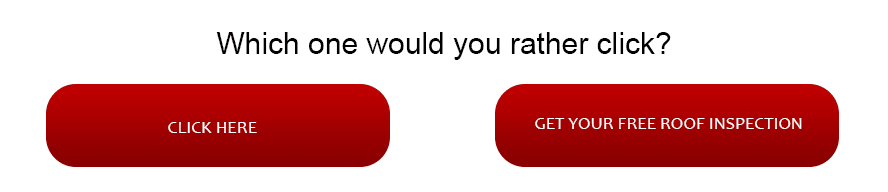
A call to action, or CTA, is any website element that suggests, or literally tells, the visitor to take a specific action. For roofers, that’s generally going to be a button, link, or a contact form.
This is an enormous topic, but here are a few tips to get you started:
- Use specific wording. A button that reads “click here” could do anything, but a button that reads “get my free roofing inspection” sets clear expectations.
- Customize your CTAs for different pages. “Get a free estimate on a new gutter system” looks great on a gutter installation page. It looks less good on a skylight installation page.
- Push for relevant micro-conversions. Suggest related articles and pages to keep users reading, offer relevant white papers to collect email addresses, and display relevant testimonials to get them interested in your other reviews.
- Phrase your CTAs many different ways. Some people just want a “next day estimate,” while others are more receptive to a “free 20 point roof inspection.”
- Don’t overdo your CTAs. You don’t need a giant, red, flashing button in the middle of your page. Put those CTAs only where they come naturally. If it doesn’t feel like enough, expand your definition of “naturally.”
12. Reduce Conversion Friction
This is one that a lot of roofers are guilty of—and it will absolutely kill your website conversions.
Which of these forms would you rather have a visitor fill out?
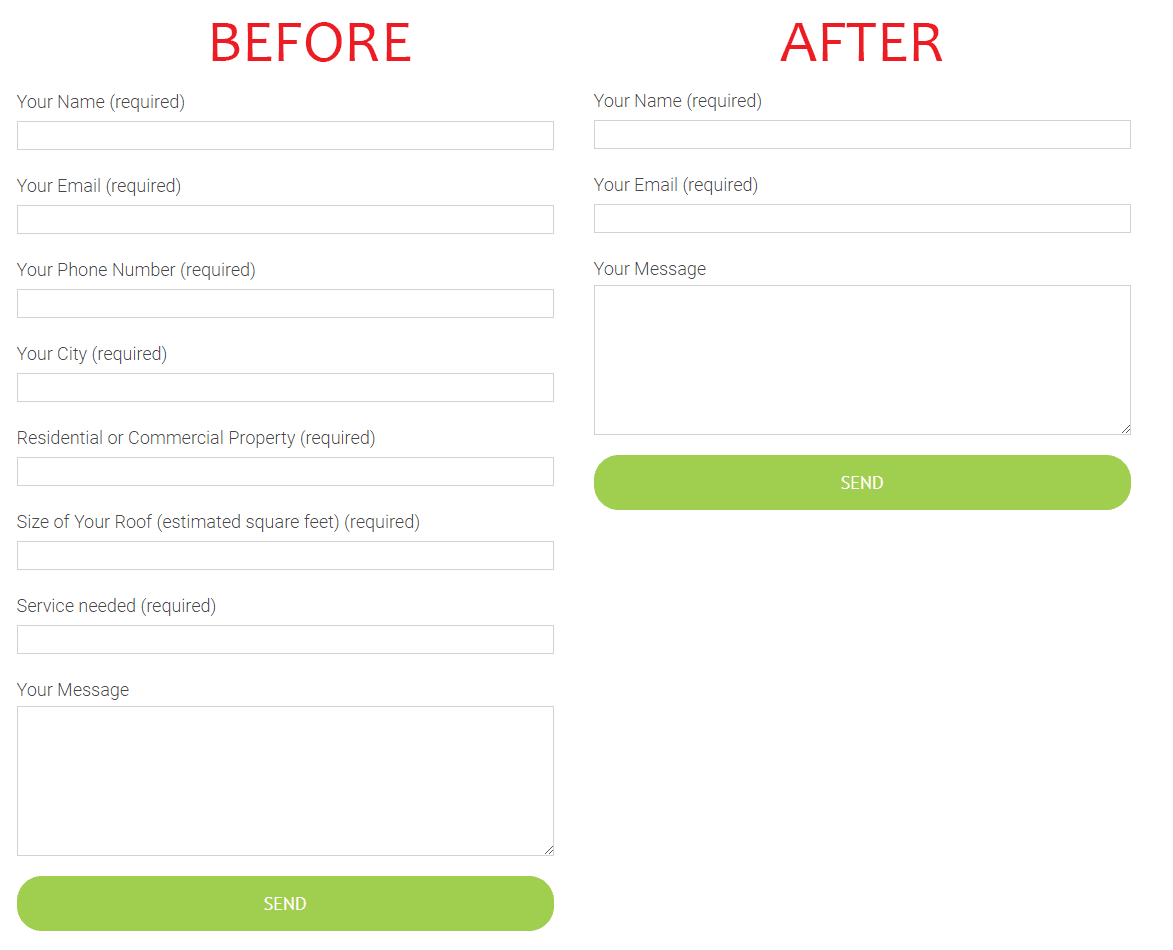
If you’re like most roofers, you probably want to have as much information about each lead as possible. But most visitors aren’t going to take the time to fill out a long contact form, or don’t immediately trust you with that much information.
Anything that stands between a visit and a conversion is called friction, and reducing that friction can have a massive impact on your conversion rates.
Here are a few tips to get you started:
- Don’t ask for too much all at once. Asking for too much information, too soon, will just scare them away. Make your contact forms shorter and get the rest of that information later.
- Make sure your contact forms work on mobile. If users have to fight with their phones just to fill out your contact form, they probably won’t fill it out.
- Give them multiple options for contacting you. Not everyone likes talking on the phone. If you’re not very email friendly, find someone in your office who is.
- Try out your own anti-spam features. Captchas can help reduce the spam you receive, but if they’re too annoying or too challenging, users will just leave your website.
That’s Just the Beginning
There are so many things you can do to increase conversions on your roofing company’s website, and even the 3,000 words you just soldiered through can’t begin to cover them all.
If your roofing company already has a website, contact us for a free consultation and we’ll show you exactly how to boost your conversions, starting today
Joe Goldstein grew up as "the computer guy" in a family full of contractors. Today, he's the director of SEO and operations for Contractor Calls. Joe's rare combination of a formal business education, self-taught web design and graphic design skills, dedication to results-driven marketing, and deep insights into the contractor service world together make him uniquely equipped to help our clients nationwide. Read more of his work at JoeAdamG.com.