Raven (original) (raw)
From Wikipedia, the free encyclopedia
Larger birds in the genus Corvus
This article is about species known as ravens in general. For the common raven of the Northern Hemisphere, see Common raven.

Common raven of California (Corvus corax clarionensis) in flight
A raven is any of several large-bodied passerine bird species in the genus Corvus. These species do not form a single taxonomic group within the genus. There is no consistent distinction between crows and ravens; the two names are assigned to different species mainly by size.
The largest species are the common raven and the thick-billed raven; these are also the largest passerine species.
Behavior and intelligence
[edit]
Ravens are highly intelligent birds known for problem solving and social behavior. Some species can mimic sounds, including human speech. Ravens and other corvids have also been shown to recognize and remember individual human faces and respond differently based on past interactions.[1]
The term raven originally referred to the common raven (Corvus corax), the widespread species of the Northern Hemisphere.
The modern English word raven has cognates in all other Germanic languages, including Old Norse (and subsequently modern Icelandic) hrafn[2] and Old High German (h)Raban,[3] both of which descend from Proto-Germanic *hrabanaz.[4]
Collective nouns for a group of ravens include a "conspiracy", a "treachery", a "rave" and an "unkindness".[5][6] In practice, most people use the more generic "flock".[7]
- Corvus albicollis – White-necked raven (East and Southern Africa)
- Corvus corax – Common raven (Northern Hemisphere)
- Corvus coronoides – Australian raven (Australia)
- Corvus crassirostris – Thick-billed raven (Horn of Africa)
- Corvus cryptoleucus – Chihuahuan raven (United States and Mexico)
- Corvus edithae – Dwarf raven (Horn of Africa)
- Corvus mellori – Little raven (southeastern Australia)
- Corvus rhipidurus – Fan-tailed raven (East Africa and Arabian Peninsula)
- Corvus ruficollis – Brown-necked raven (North Africa, Arabian Peninsula, greater Middle East)
- Corvus tasmanicus – Forest raven (Tasmania, southern Victoria and northeastern New South Wales in Australia)
Extinct species and color morphs
[edit]
- †Corvus moriorum – New Zealand raven
- †Corvus corax varius morpha leucophaeus – Pied raven (an extinct color morph of the North Atlantic subspecies of the common raven)
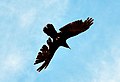
A raven with a damaged wing can still fly with apparent ease


- Cultural depictions of ravens
- Ravens of the Tower of London


- ^ "Ravens can remember people who have wronged them". National Geographic.
- ^ Oxford English Dictionary entry for "raven".
- ^ Simpson, J.; Weiner, E., eds. (1989). "Raven". Oxford English Dictionary (2nd ed.). Oxford: Clarendon Press. ISBN 0-19-861186-2.
- ^ "Raven". Online Etymology Dictionary. Retrieved 14 May 2007.
- ^ Lipton, James (1991). An Exaltation of Larks. Viking Press. ISBN 978-0-670-30044-0.
- ^ Walker, Niccoy (15 February 2023). "What is a Group of Ravens Called?". A-Z Animals.
- ^ "flock of ravens, unkindness of ravens, treachery of ravens, conspiracy of ravens". Google Books Ngram Viewer. Retrieved 5 January 2020.

Wikiquote has quotations related to Ravens.


Look up raven in Wiktionary, the free dictionary.
- Raven videos on the Internet Bird Collection
- North American ravens on eNature