Temporal variance of disturbance did not affect diversity and structure of a marine fouling community in north-eastern New Zealand (original) (raw)
Abstract
Natural heterogeneity in ecological parameters, like population abundance, is more widely recognized and investigated than variability in the processes that control these parameters. Experimental ecologists have focused mainly on the mean intensity of predictor variables and have largely ignored the potential to manipulate variances in processes, which can be considered explicitly in experimental designs to explore variation in causal mechanisms. In the present study, the effect of the temporal variance of disturbance on the diversity of marine assemblages was tested in a field experiment replicated at two sites on the northeast coast of New Zealand. Fouling communities grown on artificial settlement substrata experienced disturbance regimes that differed in their inherent levels of temporal variability and timing of disturbance events, while disturbance intensity was identical across all levels. Additionally, undisturbed assemblages were used as controls. After 150 days of experimental duration, the assemblages were then compared with regard to their species richness, abundance and structure. The disturbance effectively reduced the average total cover of the assemblages, but no consistent effect of variability in the disturbance regime on the assemblages was detected. The results of this study were corroborated by the outcomes from simultaneous replicate experiments carried out in each of eight different biogeographical regions around the world.
Access this article
Subscribe and save
- Starting from 10 chapters or articles per month
- Access and download chapters and articles from more than 300k books and 2,500 journals
- Cancel anytime View plans
Buy Now
Price excludes VAT (USA)
Tax calculation will be finalised during checkout.
Instant access to the full article PDF.
Fig. 1

The alternative text for this image may have been generated using AI.
Fig. 2

The alternative text for this image may have been generated using AI.
Fig. 3
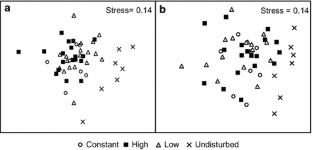
The alternative text for this image may have been generated using AI.
Fig. 4

The alternative text for this image may have been generated using AI.
Fig. 5

The alternative text for this image may have been generated using AI.
References
- Adams NM (1994) Seaweeds of New Zealand: an illustrated guide. Canterbury University Press, Chistchurch
Google Scholar - Anderson MJ (2001a) A new method for non-parametric multivariate analysis of variance. Austral Ecol 26:32–46
Article Google Scholar - Anderson MJ (2001b) Permutational test for univariate or multivariate analysis of variance and regression. Can J Fish Aquat Sci 58:626–639
Article Google Scholar - Anderson MJ, Gorley RN (2007) PERMANOVA+ for PRIMER: guide to software and statistical methods. PRIMER-E, Plymouth
Google Scholar - Anderson MJ, ter Braak CJF (2003) Permutation tests for multi-factorial analysis of variance. J Stat Comput Simul 73:85–113
Article Google Scholar - Atalah J, Anderson MJ, Costello MJ (2007) Temporal variability and intensity of grazing: a mesocosm experiment. Mar Ecol Prog Ser 341:15–24
Article Google Scholar - Ayling AM (1981) The role of biological disturbance in temperate subtidal encrusting communities. Ecology 62:830–847
Article Google Scholar - Benedetti-Cecchi L (2000) Variance in ecological consumer-resource interactions. Nature 407:370–374
Article PubMed CAS Google Scholar - Benedetti-Cecchi L (2003) The importance of the variance around the mean effect size of ecological processes. Ecology 84:2335–2346
Article Google Scholar - Benedetti-Cecchi L, Bertocci I, Vaselli S, Maggi E (2006) Temporal variance reverses the impact of high mean intensity of stress in climate change experiments. Ecology 87:2489–2499
Article PubMed Google Scholar - Benedetti-Cecchi L, Vaseli S, Maggi E, Bertocci I (2005) Interactive effects of spatial variance and mean intensity of grazing on algal cover in rock pools. Ecology 86:2212–2222
Article Google Scholar - Bertocci I, Maggi E, Vaselli S, Benedetti-Cecchi L (2005) Contrasting effects of mean intensity and temporal variation of disturbance on assemblages of rocky shores. Ecology 86:2061–2067
Article Google Scholar - Butler MJ (1989) Community response to variable predation: field studies with sunfish and freshwater invertebrates. Ecol Monogr 59:311–328
Article Google Scholar - Caswell H, Cohen JE (1995) Red, white and blue environmental variance spectra and coexistence in metapopulations. J Theor Biol 176:301–316
Article Google Scholar - Chesson P, Huntly N (1997) The roles of harsh and fluctuating conditions in the dynamics of ecological communities. Am Nat 150:519–553
Article CAS PubMed Google Scholar - Clarke KR (1993) Non-parametric multivariate analyses of changes in community structure. Aust J Ecol 18:117–143
Article Google Scholar - Clarke KR, Gorley RN (2001) PRIMER v5: user manual/tutorial, Plymouth
- Connell JH (1978) Diversity in tropical rain forest and coral reefs. Science 199:1302–1309
Article PubMed Google Scholar - Costello MJ, Myers AA (1996) Turnover of transient species as a contributor to the richness of a stable amphipod (Crustacea) fauna in a sea inlet. J Exp Mar Biol Ecol 202:49–62
Article Google Scholar - Costello MJ, Thrush SF (1991) Colonization of artificial substrata as an multispecies bioassay of marine environmental quality. In: Jeffrey DW, Madden B (eds) Bioindicators and environmental management. Academic, London, pp 401–418
Google Scholar - Crawley MJ (2004) Timing of disturbance and coexistence in a species-rich ruderal plant community. Ecology 85:3277–3288
Article Google Scholar - Dayton PK (1971) Competition, disturbance, and community organization: the provision and subsequent utilization of space in a rocky intertidal community. Ecol Monogr 41:351
Article Google Scholar - Evans JH, Ballantine WJ (1985) Leigh climate report—the climate in 1985. Leigh, Marine Laboratory, University of Auckland 111
- Grime JP (1977) Evidence for the existence of three primary strategies in plants and its relevance to ecological and evolutionary theory. Am Nat 111:1169–1194
Article Google Scholar - Hurlbert SH (1984) Pseudoreplication and the design of ecological field experiments. Ecol Monogr 54:187–211
Article Google Scholar - McArdle BH, Anderson MJ (2001) Fitting multivariate models to community data: a comment on distance-based redundancy analysis. Ecology 82:290–297
Article Google Scholar - McCabe DJ, Gotelli NJ (2000) Effects of disturbance frequency, intensity, and area on assemblages of stream macroinvertebrates. Oecologia 124:270–279
Article Google Scholar - Menge BA, Sutherland JP (1976) Species diversity gradients: synthesis of the roles of predation, competition and temporal heterogeneity. Am Nat 110:351–369
Article Google Scholar - Navarrete SA (1996) Variable predation: effects of whelks on a mid-intertidal successional community. Ecol Monogr 66:301–321
Article Google Scholar - Oden NL, Sokal RR (1986) Directional autocorrelation: an extension of spatial correlograms to two dimensions. Syst Zool 35:604–617
Article Google Scholar - Robinson JV, Sandgren CD (1983) The effect of temporal environmental heterogeneity on community structure: a replicated experimental study. Oecologia 57:98–102
Article Google Scholar - Sousa WP (1979) Experimental investigations of disturbance and ecological succession in a rocky intertidal algal community. Ecol Monogr 49:227–254
Article Google Scholar - Sousa WP (2001) Natural disturbance and dynamics of marine benthic communities. In: Bertness MD, Gaines SD, Hay ME (eds) Marine community ecology. Sinauer, Sunderland, pp 85–130
Google Scholar - Sugden H, Panusch R, Lenz M, Wahl M, Thomason JC (2007) Temporal variability of disturbances: is this important for the diversity of benthic subtidal assemblages? Mar Ecol (in press)
- Underwood AJ (1996) Spatial patterns of variance in density of intertidal populations. In: Floyd AW, Sheppard AW, De barro PJ (eds) Frontiers of population ecology. CSIRO, Melbourne, pp 369–389
Google Scholar - Underwood AJ, Chapman MG (2000) Variation in abundances of intertidal populations: consequences of extremities of environment. Hydrobiologia 426:25–36
Article Google Scholar - Valdivia N, Heidemann A, Thiel M, Molis M, Wahl M (2005) Effects of disturbance on the diversity of hard-bottom macrobenthic communities on the coast of Chile. Mar Ecol Prog Ser 299:45–54
Article Google Scholar - White PS, Pickett STA (1985) Natural disturbance and patch dynamics: an introduction. In: Pickett STA, White PS (eds) The ecology of natural disturbance and patch dynamics. Academic, Orlando, pp 3–13
Google Scholar
Acknowledgments
We thank L. Benedetti-Cecchi (University of Pisa) for helping with the experimental design and data analysis; W. Nelson (National Institute of Water and Atmospheric Research), D. G. Fautin (University of Kansas), V. Pearse (American Microscopical Society) and J. Buchanan (Victoria University of Wellington) for helping with the taxonomic identification. Thanks to Chloe Rich (University of Wollongong), Carmen Kamlah (University of Rostock), Tiago Porto (Universidade Federal Fluminense) and Mauricio Cifuentes (Universidad Católica del Norte) for helpful discussions. This study was part of the international research project GAME (Global Approach by Modular Experiments), funded by Stiftung Mercator.
Author information
Authors and Affiliations
- Leigh Marine Laboratory, The University of Auckland, P.O. Box 349, Warkworth, New Zealand
Javier Atalah & Mark J. Costello - Department of Biology, Humboldt University of Berlin, Unter den Linden 6, 10099, Berlin, Germany
Saskia A. Otto - Department of Statistics, Tamaki Campus, University of Auckland, Private Bag 92019, Auckland, New Zealand
Marti J. Anderson - IFM-Geomar Leibniz-Institut für Meereswissenschaften an der Universität Kiel, Duesternbrooker Weg 20, 24105, Kiel, Germany
Mark Lenz & Martin Wahl - School of Biology and Environmental Science, Science Centre West, University College Dublin, Belfield, Dublin 4, Ireland
Javier Atalah
Authors
- Javier Atalah
- Saskia A. Otto
- Marti J. Anderson
- Mark J. Costello
- Mark Lenz
- Martin Wahl
Corresponding author
Correspondence toJavier Atalah.
Additional information
Communicated by A. Atkinson.
Rights and permissions
About this article
Cite this article
Atalah, J., Otto, S.A., Anderson, M.J. et al. Temporal variance of disturbance did not affect diversity and structure of a marine fouling community in north-eastern New Zealand.Mar Biol 153, 199–211 (2007). https://doi.org/10.1007/s00227-007-0798-6
- Received: 14 May 2007
- Accepted: 17 August 2007
- Published: 06 September 2007
- Issue date: December 2007
- DOI: https://doi.org/10.1007/s00227-007-0798-6