Ancient DNA Clarifies the Evolutionary History of American Late Pleistocene Equids (original) (raw)
Abstract
Hippidions are past members of the equid lineage which appeared in the South American fossil record around 2.5 Ma but then became extinct during the great late Pleistocene megafaunal extinction. According to fossil records and numerous dental, cranial, and postcranial characters, Hippidion and Equus lineages were expected to cluster in two distinct phylogenetic groups that diverged at least 10 MY, long before the emergence of the first Equus. However, the first DNA sequence information retrieved from Hippidion fossils supported a striking different phylogeny, with hippidions nesting inside a paraphyletic group of Equus. This result indicated either that the currently accepted phylogenetic tree of equids was incorrect regarding the timing of the evolutionary split between Hippidion and Equus or that the taxonomic identification of the hippidion fossils used for DNA analysis needed to be reexamined (and attributed to another extinct South American member of the equid lineage). The most likely candidate for the latter explanation is Equus (Amerhippus) neogeus. Here, we show by retrieving new ancient mtDNA sequences that hippidions and Equus (Amerhippus) neogeus were members of two distinct lineages. Furthermore, using a rigorous phylogenetic approach, we demonstrate that while formerly the largest equid from Southern America, Equus (Amerhippus) was just a member of the species Equus caballus. This new data increases the known phenotypic plasticity of horses and consequently casts doubt on the taxonomic validity of the subgenus Equus (Amerhippus).
Access this article
Subscribe and save
- Starting from 10 chapters or articles per month
- Access and download chapters and articles from more than 300k books and 2,500 journals
- Cancel anytime View plans
Buy Now
Price excludes VAT (USA)
Tax calculation will be finalised during checkout.
Instant access to the full article PDF.
Fig. 1
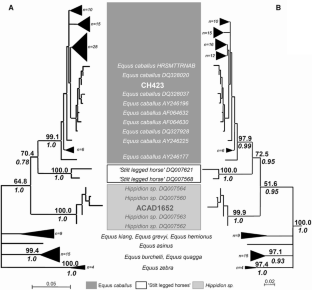
The alternative text for this image may have been generated using AI.
Fig. 2

The alternative text for this image may have been generated using AI.
References
- Alberdi MT, Cartelle C, Prado JL (2003) El registro Pleistoceno de Equus (Amerhippus) e Hippidion (Mammalia, Perissodactyla) de Brasil. Consideraciones paleoecológicas y biogeográficas. Ameghiniana 40:173–196
Google Scholar - Alberdi MT, Prado JL, Prieto A (2005) Considerations on the paper “Morphological Convergence in Hippidion and Equus (Amerhippus) South American Equids Elucidated by Ancient DNA Analysis,” by Ludovic Orlando, Véra Eisenmann, Frédéric Reynier, Paul Sondaar, and Catherine Hänni. J Mol Evol 61:145–147
Article PubMed CAS Google Scholar - Azzaroli A (1998) The genus Equus in North America. PalaeontographItal 85:1–60
Google Scholar - Bandelt H-J, Forster P, Röhl A (1999) Median-joining networks for inferring intraspecific phylogenies. Mol Biol Evol 16:37–48
PubMed CAS Google Scholar - Guindon S, Lethiec F, Duroux P, Gascuel O (2005) PHYML Online—a web server for fast maximum likelihood-based phylogenetic inference. Nucleic Acids Res 33:W557–W559
Article PubMed CAS Google Scholar - Hofreiter M, Jaenicke V, Serre D, Haeseler Av A, Pääbo S (2001) DNA sequences from multiple amplifications reveal artifacts induced by cytosine deamination in ancient DNA. Nucleic Acids Res 29:4793–4799
Article PubMed CAS Google Scholar - Huelsenbeck JP, Ronquist F (2001) MRBAYES: Bayesian inference of phylogenetic trees. Bioinformatics 17:754–755
Article PubMed CAS Google Scholar - MacFadden BJ (1997) Pleistocene horses from Tarija, Bolivia, and validity of the genus Onohippidium (Mammalia: Equidae). J Vertebr Paleontol 17:199–218
Google Scholar - Orlando L, Eisenmann V, Reynier F, Sondaar P, Hänni C (2003) Morphological convergence in Hippidion and Equus (Amerhippus) southern-american equids elucidated by ancient DNA analysis. J Mol Evol 57 (Suppl 1):S29–S40
Article PubMed CAS Google Scholar - Orlando L, Mashkour M, Burke A, Douady CJ, Eisenmann V, Hänni C (2006) Geographic distribution of an extinct equid (Equus hydruntinus: Mammalia, Equidae) revealed by morphological and genetical analyses of fossils. Mol Ecol 15:2083–2093
Article PubMed CAS Google Scholar - Posada D, Crandall KA (1998) MODELTEST: testing the model of DNA substitution. Bioinformatics 14:817–818
Article PubMed CAS Google Scholar - Prado JL, Alberdi MT (1994) A quantitative review of the horse genus Equus from South America. Palaeontology 37:459–481
Google Scholar - Prado JL, Alberdi MT (1996) A cladistic analysis of the horses of the tribe Equini. Palaeontology 39:663–680
Google Scholar - Rozas J, Sánchez-DelBarrio JC, Messeguer X, Rozas R (2003) DnaSP, DNA polymorphism analyses by the coalescent and other methods. Bioinformatics 19:2496–2497
Article PubMed CAS Google Scholar - Weinstock J, Willerslev E, Sher A, Tong W, Ho SY, Rubenstein D, Storer J, Burns J, Martin L, Bravi C, Prieto A, Froese D, Scott E, Xulong L, Cooper A (2005) Evolution, systematics, and phylogeography of pleistocene horses in the new world: a molecular perspective. PLoS Biol 3:e241
Article PubMed Google Scholar - Winans MC (1989) A quantitative study of the North American fossil species of the genus Equus. In: Prothero DR, RM RM Schoch (eds) The evolution of Perissodactyls. Oxford University Press, New York, pp 262–297
Google Scholar
Author information
Authors and Affiliations
- Université de Lyon, Paleogenetics and Molecular Evolution, Institut de Génomique Fonctionnelle de Lyon, CNRS UMR 5242 – INRA – Université Claude Bernard Lyon I–Ecole Normale Supérieure de Lyon, 46 Allée d’Italie, 69364, Lyon Cedex 07, France
Ludovic Orlando & Catherine Hänni - Australian Centre for Ancient DNA (ACAD), School of Earth and Environmental Sciences, University of Adelaide, Adelaide, SA, 5005, Australia
Dean Male & Alan Cooper - Departamento de Paleobiología, Museo Nacional de Ciencias Naturales, CSIC, José Gutiérrez Abascal 2, 28006, Madrid, Spain
Maria Teresa Alberdi - INCUAPA, Departamento de Arqueología, Universidad Nacional del Centro Del Valle, 5737, B7400JWI, Olavarría, Argentina
Jose Luis Prado - Centro de Estudios del Cuaternario, Instituto de la Patagonia, Universidad de Magallanes, Magallanes, Chile
Alfredo Prieto
Authors
- Ludovic Orlando
- Dean Male
- Maria Teresa Alberdi
- Jose Luis Prado
- Alfredo Prieto
- Alan Cooper
- Catherine Hänni
Corresponding author
Correspondence toLudovic Orlando.
Additional information
This is a reply to the Comment published by Alberdi et al. (2005).
Electronic supplementary material
Rights and permissions
About this article
Cite this article
Orlando, L., Male, D., Alberdi, M.T. et al. Ancient DNA Clarifies the Evolutionary History of American Late Pleistocene Equids.J Mol Evol 66, 533–538 (2008). https://doi.org/10.1007/s00239-008-9100-x
- Received: 16 April 2007
- Revised: 20 February 2008
- Accepted: 28 February 2008
- Published: 09 April 2008
- Issue date: May 2008
- DOI: https://doi.org/10.1007/s00239-008-9100-x