Niche divergence of Abies grandis–Abies concolor hybrids (original) (raw)
Abstract
Homoploid hybridization has increasingly been recognized as an important source of genetic variation to support adaptation to changing environmental conditions, the invasion of novel ecological niches and, ultimately, speciation. Although ecological selection pressures have been theorized to play a key role in the stabilization of homoploid hybrid lineages, surprisingly few detailed quantitative studies compare the realized ecological niches of hybrids and their progenitors. In this study, we compare twenty bioclimatic variables (Worldclim) at representative occurrence sites of Abies grandis, Abies concolor, and two classes of their natural hybrids, which are variably intergradient between their progenitors, to assess the potential role of ecological selection in the evolution of the observed morphological patterns of introgression. We find that both hybrid classes occupy distinct habitats that are variably intermediate between those associated with A. grandis and A. concolor for a majority of environmental variables, but with lower precipitation in the summertime in the southern Cascade, Siskiyou, and Sierra Nevada Mountains than associated with either progenitor. We hypothesize that moisture stress and high levels of solar insolation in the summertime associated with hybrid populations have played an important role in the observed patterns of introgression of key traits: leaf angle, specific leaf area, and abundance of adaxial stomates. Phenotypic plasticity in two of these traits may allow hybrids to adapt to an environment with a higher degree of variability in moisture stress. Moreover, in the context of moisture stress associated with predicted climate change, hybrids may have an adaptive advantage over A. grandis.
Access this article
Subscribe and save
- Starting from 10 chapters or articles per month
- Access and download chapters and articles from more than 300k books and 2,500 journals
- Cancel anytime View plans
Buy Now
Price excludes VAT (USA)
Tax calculation will be finalised during checkout.
Instant access to the full article PDF.
Fig. 1
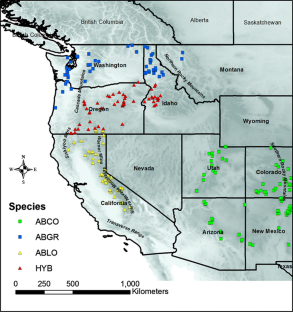
The alternative text for this image may have been generated using AI.
Fig. 2

The alternative text for this image may have been generated using AI.
References
- Anderson E (1949) Hybridization of the habitat. Evolution 2:1–9
Article Google Scholar - Arnold ML (1997) Natural hybridization and evolution. Oxford University Press, New York
Google Scholar - Barton N, Hewitt G (1985) Analysis of hybrid zones. Annu Rev Ecol Syst 16:113–148
Article Google Scholar - Berry A, Kreitman M (1993) Molecular analysis of an allozyme cline: alcohol dehydrogenase in Drosophila melanogaster on the east coast of North America. Genetics 134:869–893
PubMed Central CAS PubMed Google Scholar - Beurkle CA, Wolf DE, Rieseberg LH (2003) Population viability in plants. Ecological studies. Springer, Berlin, pp 117–141
Book Google Scholar - Buerkle CA, Morris RJ, Asmussen MA, Rieseberg LH (2000) The likelihood of homoploid hybrid speciation. Heredity 84:441–451
Article PubMed Google Scholar - Busby JR (1991) A bioclimatic analysis and prediction system. In: Margules CR, Austin MP (eds) Nature conservation: cost effective biological surveys and data analysis. CSIRO, Clayton South, pp 64–68
Google Scholar - Campbell DR, Wendlandt TC (2013) Altered precipitation effects plant hybrids differently than their parental species. Am J Bot 100:1322–1331
Article PubMed Google Scholar - Campbell DR, Galen C, Wu CA (2005) Ecophysiology of first and second generation hybrids in a natural plant hybrid zone. Oecologia 144:214–225
Article PubMed Google Scholar - Daniels JD (1969) Variation and intergradation in the grand fir-white fir complex. Dissertation. University of Idaho, Moscow
- Farjon A (1990) Pinaceae, drawings and descriptions of the genera: Abies, Cedrus, pseudolarix, Keteleeria, Nothotsuga, Tsuga, Cathaya, Pseudotsuga, Larix and Picea. Koeltz Scientific Books, Köenigstein
Google Scholar - Fisher RA (1936) The use of multiple measurements in taxonomic problems. Ann Eugen 7:179–188
Article Google Scholar - Fu P, Rich PM (1999) Design and implementation of the Solar Analyst: an ArcView extension for modeling solar radiation at landscape scales. Proceedings of the 19th annual ESRI user conference, San Diego
- Goudet J (1995) Fstat (version 1.2): a computer program to calculate F-Statistics. J Hered 86:485–486
Google Scholar - Gross BL, Rieseberg LH (2005) The ecological genetics of homoploid speciation. J Hered 96:241–252
Article PubMed Central CAS PubMed Google Scholar - Hamrick JL, Libby WJ (1972) Variation and selection in western U.S. montane species. Silvae Genet 21:29–36
Google Scholar - Hastie T, Tibshirani R, Friedman J (2001) The elements of statistical learning: data mining, influence and prediction. Section 4.3. Springer, New York
Book Google Scholar - Heiser CB (1951) Hybridization of the annual sunflower Helianthus annuus x H. debilis cucumerifolius. Evolution 5:42–51
Article Google Scholar - Hollander M, Wolfe DA (1999) Nonparametric statistical methods, 2nd edn. Wiley, New York
Google Scholar - Houkal DJ (1976) Terpene and morphological variation in the grand fir hybrid complex. Dissertation. University of Idaho, Moscow
- Hunt RS (1993) Abies. In: Morin RM (ed) Flora of North America. Oxford University Press, New York
Google Scholar - Lacaze JF, Tomassone R (1967) Contribution a letude de la variabilite infraspecifique d’Abies grandis Lindl. Caracteristiques juveniles. Ann des Sci For 24:277–325
Article Google Scholar - Lewontin RC, Birch LC (1966) Hybridization as a source of variation for adaptation to new environments. Evolution 20:315–336
Article Google Scholar - Liu TL (1971) A monograph of the genus Abies. National Taiwan University, Taipei
Google Scholar - Lusk CH, Warton D (2008) Global meta-analysis shows that relationships of leaf mass per area with species shade tolerance depends on habitat and ontogeny. New Phytol 176:764–774
Article Google Scholar - Niinemets Ü (2010) A review in light interception in plant stands from leaf to canopy in different plant functional types and in species with different shade tolerance. Ecol Res 25:693–714
Article Google Scholar - Ott (2014) The Geographic and ecological patterns of genetic variation in the Abies grandis_–_Abies concolor complex. Dissertation, University of Idaho, Moscow
- Phillips SJ, Anderson RP, Schapire RE (2006) Maximum entropy modeling of species geographic distributions. Ecol Model 190:231–259
Article Google Scholar - Rieseberg LH (1997) Hybrid origins of plant species. Annu Rev Ecol Evol Syst 28:359–389
Article Google Scholar - Rieseberg LH, Raymond O, Rosenthal DM, Livingstone K, Nakazato T, Durphy JL et al (2003) Major ecological transitions in wild sunflowers facilitated by hybridization. Science 301:1211–1216
Article CAS PubMed Google Scholar - Scholz F, Stephan BR (1982) Growth and reaction to drought of 43 Abies grandis provenances in a greenhouse study. Silv Genet 31:27–35
Google Scholar - Schwarzbach AE, Donovan LA, Rieseberg LH (2001) Transgressive character expression in a hybrid sunflower species. Am J Bot 88:270–277
Article CAS PubMed Google Scholar - Seehausen O (2004) Hybridization and adaptive radiation. Trends Ecol Evol 19:198–207
Article PubMed Google Scholar - Stebbins L (1959) The role of hybridization in evolution. Proc Am Philos Soc 103:231–251
Google Scholar - Swenson NG (2008) The past and future influence of geographic information systems on hybrid zone, phylogeographic and speciation research. J Evol Biol 21:421–434
Article CAS PubMed Google Scholar - Taiz L, Zeigler E (1998) Plant physiology. Sinauer Associates, Sunderland
Google Scholar - Velilla S, Hernandez A (2005) On the consistency of linear and quadratic discriminant analyses. J Multivar Anal 96:219–236
Article Google Scholar - Whitney KD, Randell RA, Rieseberg LH (2010) Adaptive introgression of abiotic tolerance traits in the sunflower Helianthus annuus. New Phytol 187:230–239
Article PubMed Google Scholar - Zobel DB (1973) Local variation in intergrading Abies grandis_–_Abies concolor populations in the central Cascades: needle morphology and periderm color. Bot Gaz 134:209–220
Article Google Scholar - Zobel DB (1974) Local variation in intergrading Abies grandis_–_Abies concolor populations in the central Oregon Cascades. II. Stomatal reaction to moisture stress. Bot Gaz 135:200–210
Article Google Scholar - Zobel DB (1975) Local variation in intergrading Abies grandis_–_Abies concolor populations in the Central Cascades. III. Timing of growth and stomatal characteristics in relation to environment. Bot Gaz 136:63–71
Article Google Scholar
Acknowledgments
We thank Dr. Steven Brunsfeld and Dr. Fred Johnson for insightful ideas long before spatial analysis and landscape scale niche modeling was technically possible; without their inspiration, this manuscript would not have been completed. This entire manuscript rests on their astute observations and profound understanding of intricate ecological and evolutionary patterns that characterize this complex. We thank Dr. John Marshall, Dr. George Newcombe, and anonymous reviewers for valuable comments that contributed to the quality of this manuscript.
Author information
Authors and Affiliations
- Department of Fish and Wildlife Sciences, University of Idaho, Moscow, ID, 83844, USA
Todd M. Ott & Cort L. Anderson - Department of Forest, Rangeland, and Fire Sciences, University of Idaho, PO Box 441135, Moscow, ID, 83844-1135, USA
Todd M. Ott & Eva K. Strand
Authors
- Todd M. Ott
- Eva K. Strand
- Cort L. Anderson
Corresponding author
Correspondence toEva K. Strand.
Additional information
Communicated by Brad Butterfield.
Electronic supplementary material
Rights and permissions
About this article
Cite this article
Ott, T.M., Strand, E.K. & Anderson, C.L. Niche divergence of Abies grandis_–_Abies concolor hybrids.Plant Ecol 216, 479–490 (2015). https://doi.org/10.1007/s11258-015-0452-1
- Received: 26 August 2014
- Accepted: 20 January 2015
- Published: 31 January 2015
- Issue date: March 2015
- DOI: https://doi.org/10.1007/s11258-015-0452-1