Innovative Method of Patent Design Around Guided by Technological Evolution (original) (raw)
Abstract
Patent design around can avoid infringement disputes, but it is hard for enterprises to use this method in the development of innovative products. This paper proposes an innovative method for the patent design around guided by laws of the technological system evolution. Functions of the product is firstly determined using a constructed function-need matrix of patents related to the target product. The potential state of technologies is then predicted according to laws of technological system evolution through analyzing the target function model. The patent design around is then conducted to search patents for relative functions. The solution is finally formed to circumvent any potential infringement. Feasibility of the proposed method is verified in the design of a mosquito catcher.
1 Introduction
With the international market competition, enterprises frequently face to the patent barriers in the product innovation [1]. In order to get a place in the market, it is of paramount importance to enhance competitiveness using the core technology with the independent patent. In view of that, the patent design around plays a very important role in the competition for the enterprises.
Schechter [2] explained that patent design around is a circuitous design process in order to avoid the obstruction or attack from other enterprises. At present, different methods have been proposed to implement the patent design around from various perspectives. For example, Liu et al. [3] recommended formulating functional requirements from the patented product using design around the patent by replacing, deleting, adding or combining function elements. Jiang et al. [4] used a function trimming method to construct the function model and built the trimming variation of the new product according to the principle of the component avoidance. Li et al. [5] proposed an evading method for timing, which decomposes technical characteristics in patent claims [6]. Xu et al. [7] proposed a method that combines patent information and axiomatic design. Jiang et al. [8] integrated patent’s IPC cluster analysis and technical maturity to determine the patent clusters and goal. Li et al. [9] constructed the function trimming paths of patent design around for mechanical products.
In this paper, laws of the technological system evolution are applied to guide the direction of patent design around. Patents related to the target product are analyzed by a function-need matrix for mining new requirements of customers and target functions. The future state of the existing technology with the target function could then be predicted by laws of the technological system evolution. In order to avoid the infringement, the patent design around is implemented for patents involved in the target function. TRIZ tools are used to solve derivative technical problems in the improvement design process [10]. The infringement determination is eventually made for the design scheme.
This approach provides new insight for patent design around, aiming at promising innovation for local enterprises. The remainder of this paper is organized as follows. Section 2 describes the method to obtain the target function. Section 3 specifies determination of the potential state as the goal of patent design around. Section 4 shows a procedure flow of the proposed method. Section 5 introduces a case study for design of a mosquito catcher to verify the method. Section 6 concludes the research by highlighting the findings.
2 Acquisition of Target Function Based on Patent Analysis
In the requirements analysis phase, main functions of a target product are first obtained by retrieving the relevant patents in the Patsnap patent database (http://www.zhihuiya.com), which are decomposed into sub-functions. The function flow model of each sub-function is then constructed. Functional keywords are added to the existing patent retrieval formula to study the technical background and claims in each patent. Corresponding technical solutions to sub-functions should be deduced. Based on the analysis of the existing invention patents, the relationship between the function category and patent quantity is obtained, as shown in Fig. 1, we can initially identify the function of the target product as the main demand for users. In a chronological order, the number of patents is counted corresponding to each function, and the function-need matrix is constructed to express changes of the demand visually as shown in Fig. 2.
Fig. 1.
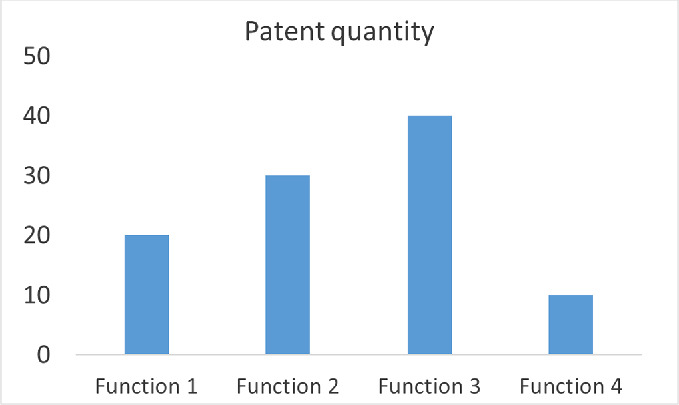
Function category and patent quantity from patent analysis stage
Fig. 2.
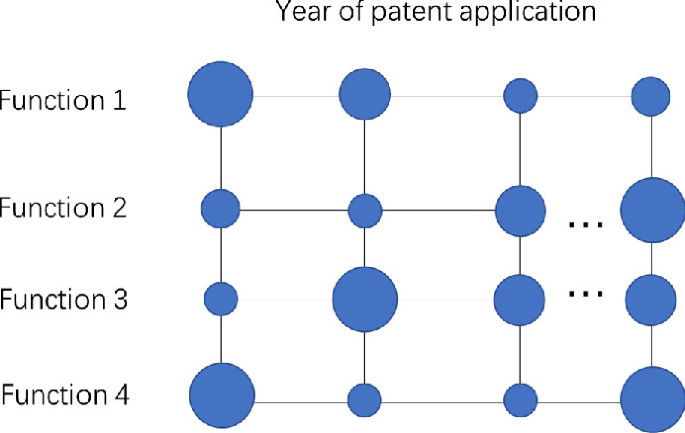
Function-need matrix
The relationship between the function category and patent quantity can help designers to obtain the importance of various functions to the product, which can be used as a preliminary understanding of the target function in the target product. Similarly, the function-need matrix is established to study the development of various functions. It is a mathematical matrix based on the year of patent application and the function realized by patent. This matrix can visually summarize the change of patent number of each function in the target product with time, so as to study the change of research investment in the target product function in the market, determine the valuable target function in the target product.
By analyzing the relationship between product function category and patent quantity and function-need matrix, it can be found that some functions with the large total number of patents (hot spots) are gradually decreased with time, while others are increased. The decreasing trend indicates a shrinking market share of this function or a technical bottleneck. On the other hand, an increase implies that the function’s demand expands. It has a great research and development value for the fierce competition. Additionally, some potential functions, where the total number of patents is small (sparse), indicating that this function is gradually discovered by the market. It has the research value for low-end market innovation.
According to the information implied in the two figures above, designers can determine functions with the development value from the target product and avoid the investment of functions without the research value. This helps the designers to provide objective data support when determining the target function and avoid mistakes of direction incurred by subjective judgment. In this paper, the function with the large market demand and increasing state is selected as the research object.
3 Derivation of Direction for Evading Design Based on Laws of Technological System Evolution
After determining the target function, the relevant patents are analyzed, and the laws of technological system evolution are selected according to the evolutionary state of the patent, the potential direction can be predicted. The target function is then improved along the evolution route, enhancing the innovation level using the patent design around. This can not only develop the future product concepts, but also implement the product development following the evolution route.
3.1 Functional Analysis of Target Function
The functional analysis analyzes the system, subsystem and components from the perspective of the function, rather than the technology. This operation is mainly to construct a function component model and a function flow model. The function flow model represents function elements and input/output flows that connect them. In contrast, the function flow model can get the working principle of the target function and provide a reliable basis for the following technological system evolution. In addition, in the process of patent design around, designers can creatively conceive the realization form of the target function at a high level of abstraction. Therefore, the function flow model is selected as the analysis tool in this paper.
Firstly, the target function (input/output relationship) of a product is abstracted. The input/output is composed of energy flow, material flow and signal flow. The general target function is usually not easy to achieve; thus, it should be decomposed into sub-functions until the end of the function element can be directly realized. The function element is concatenated with each flow, forming the function chain as shown in Fig. 3.
Fig. 3.

Function chain
3.2 Laws of Technological System Evolution
Laws of the technological system evolution [11] are a series of principles established by Altshuller for finding the existence operation and change of a system. He suggested that the same problem usually recurs in the different technology and corresponding solution as well. Laws of the technological system evolution are tools that improve technology from the current state [12, 13]. Fry and Rivin summarized laws of the technological system evolution into nine as follows [[14](#ref-CR14 "Fey, V.R., Rivin, E.I.: Guided technology evolution (TRIZ technology forecasting) [M/OL]. TRIZ J. (1999). http://www.triz-journal.com
")\].- (1)
Increasing degree of ideality; - (2)
Non-uniform evolution of sub-systems; - (3)
Increasing dynamism (flexibility); - (4)
Transition to a higher-level system; - (5)
Transition to micro-level; - (6)
Completeness; - (7)
Shortening of energy flow path; - (8)
Increasing substance–field interactions; - (9)
Harmonization of rhythms.
These laws of the technological system evolution indicate the general direction in which evolution routes qualitatively analyze the specific technology. The essence of the technology evolution is to transfer a core technology from the low level to high level. Laws and routes of the technological system evolution play a strong guiding role in the creation of innovative and competitive design concepts.
3.3 Evolutionary Potential of the Technology System
The technological evolution routes qualitatively identify specific stages of the technological system in each direction from a microscopic level. The possible structural states reveal the product realization to predict the evolutionary potential of products [15].
After understanding the realization of target function of product through the function analysis, the claims related to target function in the patents are then analyzed to determine the development trend. And match with the law of technological system evolution, select the corresponding evolution route, determine the current technical state of the product, and predict the potential evolution state, and get the innovation direction.
As shown in Fig. 4, there is an evolution route. The evolution route has 5 evolutionary states, with the initial state being state 1 and the highest state being state 5. According to the evolution route, the technical evolution level of the product is analyzed. If the technical level in the evolutionary state 3, the evolutionary state 3 is called the current evolutionary state. Evolutionary states 4 and 5 are the technological level that the product has not yet reached. The evolutionary potential of technology lies between the current state of evolution and the highest state of evolution. Each potential state implies the potential technology with a strategic decision, which can be analyzed to generate innovative ideas about the new generation of products to formulate the development strategy of products.
Fig. 4.
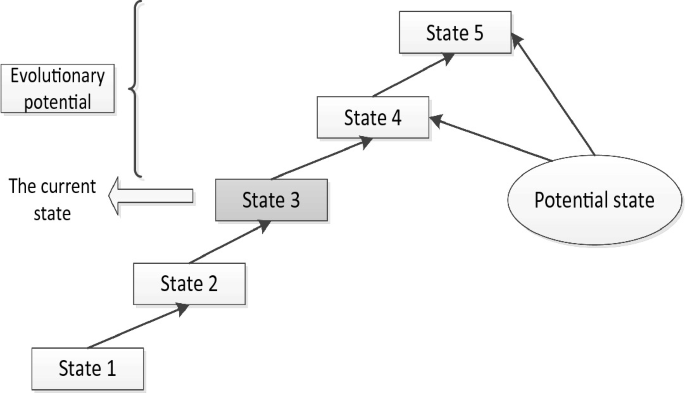
Evolutionary potential of technology system
4 Implementation of the Patent Design Around Method Guided by Laws of the Technological System Evolution
The patent design around guided by laws of the technological system evolution is divided into four stages:
- (1)
Retrieve and analyze relevant patents of the target product; derive the target function with the research value according to changes of patents with different functions. - (2)
Obtain the direction of patent design around based on laws of the technological system evolution by predicting the potential state of the existing technical structure of the target function and getting the innovative design direction of the product. - (3)
According to the direction and route of evolution, the patent design around related to target function is then implemented. There may be some derivative technical problems in the design, TRIZ tools are used to solve the problems one by one to obtain effective solutions. - (4)
Patent infringement determination [16, 17] according to the legal judgment process. A detailed operation process is shown in Fig. 5.
Fig. 5.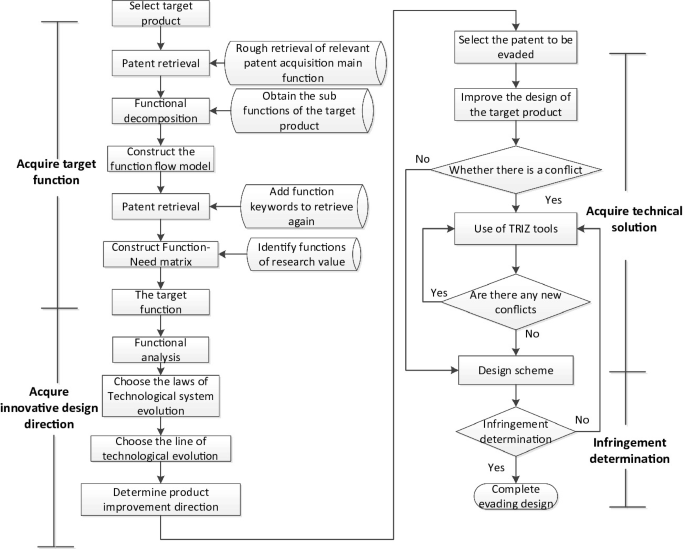
Implementation process of patent design around method guided by laws of technological system evolution
Full size image
5 Case Study
Mosquito catcher is a simple device that attract mosquitoes and catches them. After analyzing the related patents of the product, it is found that the market demand for cleaning the mosquito catcher is increasing gradually. The following will introduce the innovative design process of a mosquito catcher based on the patent design around guided by laws of the technological system evolution.
5.1 Acquire Target Function of Product
To start with, the relevant patents are retrieved, and main functions of the product are extracted for the target product of mosquito catchers. The main functions are then decomposed into sub-functions, and the function flow model of each sub-function is abstracted. The Keywords of sub-functions are added to the existing patent retrieval formula to obtain more relevant patents. After browsing the text in each patent, the relationship between the function category and patent quantity is obtained. In a chronological order, the number of patents corresponding to each function is counted, constructing the function-need matrix to express changes of the demand visually.
- (1)
Function decomposition and construction of the function flow model
In the Patsnap patent database (http://www.zhihuiya.com), relevant patents for the target product are searched to be extensively read. Main function of the mosquito catcher moves mosquitos from the activity space of people to a confined space. The main function is then decomposed into sub-functions of the mosquito catcher (Table 1). The function flow model of each sub function is abstracted as shown in Fig. 6. Due to limitation of the space, the function flow model is specified for the attract mosquitoes as an example. In the system of the target function, the mosquito belongs to the super system. The main function of the subjects is to convert material energy into substances that attract mosquitoes. The input material is organic and inorganic, and the input energy is electrical energy. The output material is ultraviolet ray and carbon dioxide, the output energy is heat energy.
Table 1. Function category of mosquito catcher
Fig. 6.
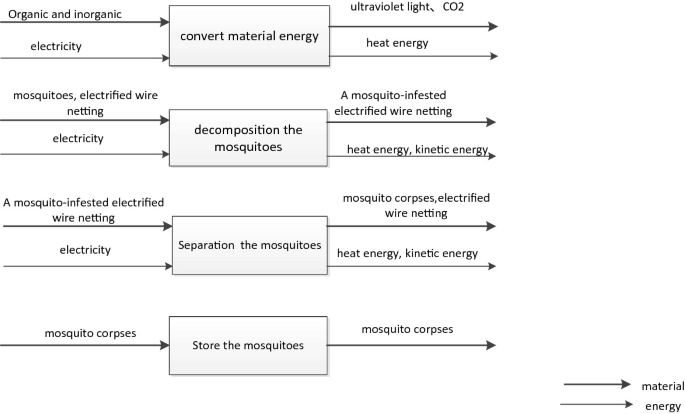
Function flow model for each sub-function
- (2)
Obtain the relationship between the function category and patent quantity
In the Patsnap patent database, functional keywords are added to the existing patent retrieval formula to retrieve the patent again with the time period from 2011 to 2019 and the patent type as an auxiliary filter. After the weight reduction and noise reduction, 108 patents are selected. The technical background and claims in each patent are studied to obtain corresponding technical solutions of sub-functions. The relationship between function category and patent quantity is then obtained as shown in Fig. 7. 25 patents, 31 patents, 49 patents and 3 patents are respectively involved to attract mosquitoes, kill mosquitoes, clean up mosquitoes and store mosquitoes.
Fig. 7.
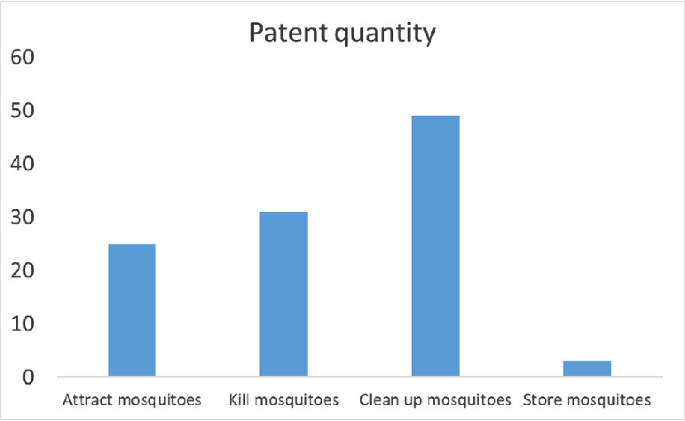
Function category and patent quantity of mosquito catcher from patent analysis
- (3)
Construction of function-need matrix
The selected patents are extracted according to the application year and functions to derive the extract form of relevant patents. Using the patent analysis function of Patsnap analyzes the matrix of the extracted form to obtain functional requirements of related patents since 2011, the function-need matrix is then constructed as shown in Fig. 8.
Fig. 8.
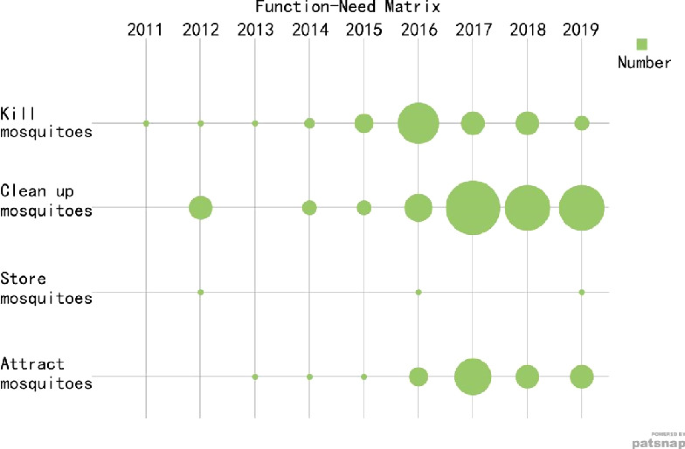
Function-need matrix of the mosquito catcher
Through the comprehensive analysis of the two figures, the market demand for cleaning mosquito is identified as the patent hot spot. The quantity of patents for the function has been steadily increasing since 2014. Therefore, the mosquito cleaning function of the mosquito catcher is the target function to be studied.
5.2 Acquisition of Innovative Design Direction
- (1)
Target functional analysis
The function, cleaning mosquito, is mainly achieving by the electric device, as the research object. The model about target function is constructed to further clarify the structural relationship and functional principle between components of the mosquito cleaning function. The working principle of this kind of mosquito catchers is to set up a cleaning mechanism between the lamp tube and electrified wire netting, and the power is provided to drive the transmission mechanism and cleaning mechanism. Mosquito corpses on the electrified wire netting will be swept off automatically. The function flow model of the automatic cleaning mosquito catcher is constructed based on the connection between structural elements in the patents as shown in Fig. 9.
Fig. 9.
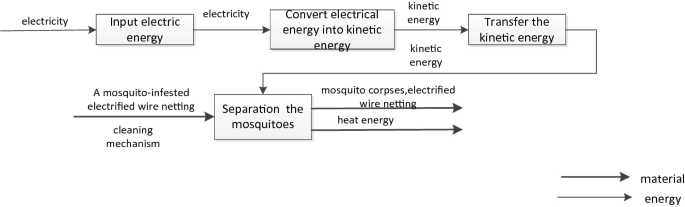
Function flow model for automatic cleaning mosquito catcher
The target function is decomposed to obtain function elements required to realize the function, which is the basis of product improvement. According to the target function of the product, it is divided into three parts: power mechanism, transmission mechanism and cleaning mechanism. Because the cleaning part driven by the power mechanism, the transmission mechanism and move the brush to sweep off the mosquito corpse on the electrified wire netting, the power mechanism, transmission mechanism and cleaning mechanism are parallel. But the rotating rod and brush are components of the cleaning mechanism, and the decomposition is shown in the Fig. 10.
Fig. 10.
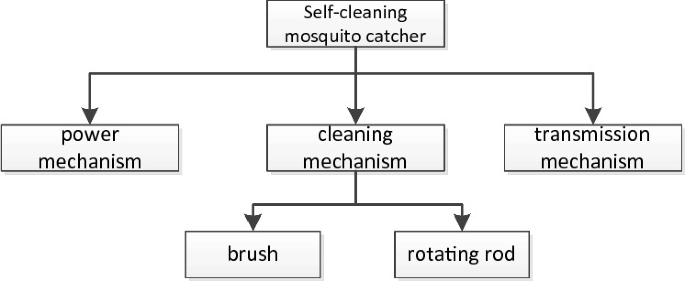
Functional decomposition of mosquito catcher
- (2)
Acquisition of new innovative design direction
After understanding the realization of target function of product through the function analysis, the claims related to target function in the patents are then analyzed to determine the development trend. According to the laws of technological system evolution, shortcomings of existing products are uncovered, which are the innovative direction. The specific process of the product innovation direction acquisition is specified as follows.
- Step 1: Select the target product and determine the target function. In Subsect. 5.1 we have obtained the target function for the mosquito cleaning function of the mosquito catcher.
- Step 2: Read the patent related to the target function, summarize and analyze the realization of the target function. After reading the patent literature related to mosquito cleaning, we have found that the mechanism to clean mosquito corpses as shown in Table 2. After comprehensive analysis, it is found that the existing cleaning methods have shortcomings of the low cleaning efficiency and cleanliness as shown in Table 2.
Table 2. Current cleaning methods and inadequacies
Full size table - Step 3: According to the analysis of the evolution trend of target function, we choose two laws as follows.
- ① Based on the direction of evolution of the cleaning function, the law of increasing dynamism (flexibility) is selected.
- ② For better control the cleaning, the law of completeness is selected.
- Step 4: Choose the routes of the evolution.
- ① Line 3-3 is selected for the cleaning mechanism which is evolved into fluid and field.
- ② Line 6-1 is selected for reducing human involvement.
- Step 5: Determine product improvement directions. By analyzing the realization mechanism of the target function, shortcomings of the target function are obtained. In order to solve the problem and deficiency, improvement directions of the product are obtained according to two technological evolution routes in Step 4 to design a self-cleaning mosquito catcher.
5.3 Patent Design Around of Mosquito Catcher
- (1)
Determination of evading the target patent
Following the product innovation design direction, on the premise of realizing the target function, the patent scheme that can be further improved is identified from retrieved product patents. Based on the existing patent technology of the product, the corresponding improvement design is carried out. In this paper, the improvement is based on the patent CN107751149A.
- (2)
Derivation of the technical solution
After summarizing cleaning methods of the mosquito catcher, we find the evolution process of the cleaning device of a brush-wind field. According to the line 3-3 of transition to fluids and fields, liquid photocatalysts can be used to help decompose corpses on the electrified wire netting. Because photocatalyst can stimulate the oxygen and water molecules attached to the surface of the substance to generate Oh - and O2 free ion groups, these free radicals with strong oxidizing can decompose almost all the organic substances and some inorganic substances harmful to human body or the environment, and finally decompose organic substances and bacteria into carbon dioxide and water. The photocatalyst provides the function of deodorization and self-cleaning.
The functional decomposition results of the cleaning function of the mosquito catcher are then analyzed according route 6-1, i.e. line of completion (dislodging of human involvement). The control mechanism is added for the liquid photocatalyst spraying to regularly clean the electrified wire netting.
Combining the above two directions, we get the following scheme. The motor drives the central guide rail by gear. It again drives the central guide rail to move in a circle by moving up and down as a guide rail. The base has a circular groove for a light that attracts mosquitoes. There is a groove in the central guide for placing the hose for spraying liquid photocatalyst, and the spray head is installed on the bracket. The electrified wire netting is composed of positive and negative roots with a circular and spiral structure, which is easier to clean than the parallel wire netting. When cleaning mosquitoes, a scraper is used to clean the large ones, and a liquid photocatalyst is sprayed at the same time. Under the sunlight, the organic pollutants on the surface of the electrified wire netting can be decomposed into carbon dioxide, which can attract mosquitoes at the same time. The control device can record the discharge times of the electrified wire netting and clean up after reaching a specified number of times. The final design results are shown in Fig. 11, 12, and 13.
Fig. 11.
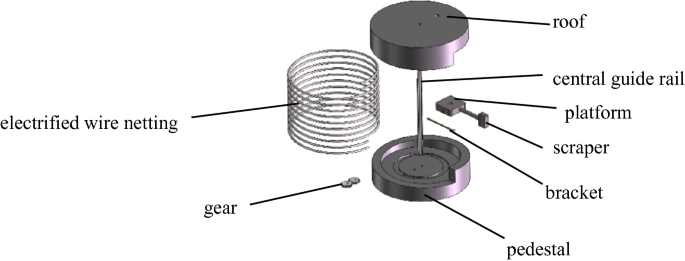
Explosion diagram of the mosquito catcher
Fig. 12.
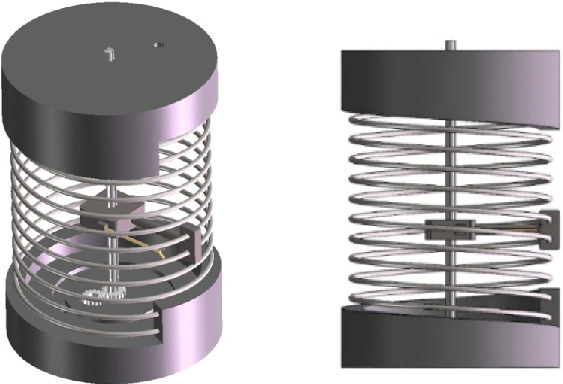
Top view of the mosquito catcher
Fig. 13.
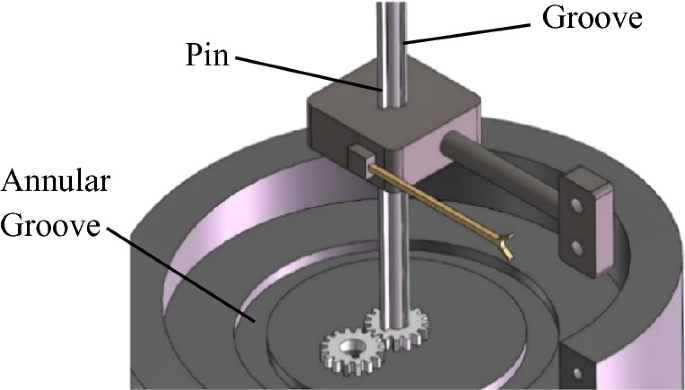
Zoomed-in view of the mosquito catcher
5.4 Infringement Determination
The new scheme is then compared with the existing technology in patents. The original patented core technology cleaning device is redesigned, adding the control device. According to the standard of patent infringement determination, it has successfully evaded the scope of protection of the original patent and formed innovative achievements that can be applied for new patents.
6 Conclusions
The current method of patent design around guided by laws of the technological system evolution has comprehended all types of analysis methods and tools of TRIZ to yield the very high success rate of circumvention. The potential development direction of the existing products is predicted by laws of the technological system evolution. The product development direction obtained is used to guide the improvement of the target product. Comparing with the traditional method of patent design around by simply looking for the patent literature language or technology application blank, this method amends defects of the previous patent circumvention design, which uses “accidental discovery of patent loopholes”, to render the design method of patent design around more perfect, efficient and accurate. In this paper, the hidden patent knowledge is explored in the relationship between function category and patent quantity and the coordinate matrix of the product function-need. The method of product patent design around is realized by combining laws of the technological system evolution and TRIZ theory. Feasibility of the proposed method is verified in the design of a mosquito catcher. However, there are some things that were not considered in this article and we hope to improve them in the future.
References
- Lei, Y.: Progress and prospect mechanical engineering in China. J. Mech. Eng. 45(05), 1–11 (2009)
Article Google Scholar - Schechter, R.E.: Intellectual Property: The Law of Copyrights, Patents and Trademarks. Thomson West, Minnesota (2003)
Google Scholar - Liu, Y., Jiang, P., Wang, W., Tan, R.: Integrating Requirements Analysis and Design Around Strategy for Designing Around Patents, Hebei University of Technology, School of Mechanical Engineering (2011)
Google Scholar - Jiang, P., Luo, P., Tan, R., et al.: Method about patent design around based on function trimming. J. Mech. Eng. 48(11), 46–54 (2012)
Article Google Scholar - Li, M., et al.: A TRIZ-based trimming method for patent design around. Comput.-Aided Des. 62, 20–30 (2015)
Google Scholar - Cascini, G., Russo, D.: Computer-aided analysis of patent and search for TRIZ contradictions. Int. J. Prod. Dev. 4(1/2), 52–67 (2007)
Article Google Scholar - Xu, Y., Xu, B., Hong, Y.: Development of a design methodology based on patent and axiomatic design. J. Qual. 16(3), 153–163 (2009)
Google Scholar - Jiang, P., Wang, C., Sun, J., et al.: Method and application of patented design around by combination of IPC cluster analysis and TRIZ. J. Mech. Eng. 51(07), 144–154 (2017)
Article Google Scholar - Li, H., Liu, L., Zhao, S., et al.: Study on function cutting paths of patent design around for mechanical products. China Mech. Eng. 26(19), 2581–2589 (2015)
Google Scholar - Tan, R.: TRIZ and Applications: The Process and Method of Technological Innovation. Higher Education Press, Beijing (2010)
Google Scholar - Altshuller, G.S.: The Innovation Algorithm. Technical Innovation Center, Worcester (2000)
Google Scholar - Tan, R., Zhang, Q.: The law and lines of system evolution in TRIZ and the application. Ind. Eng. Manag. 8(1), 34–36 (2003)
MathSciNet Google Scholar - Cavallucci, D., Lerch, C., Schenk, E.: Product lines innovation: on the use of technical laws of evolution. In: Thierry, B.H. (ed.) The Economics of Creativity: Ideas, Firms and Markets, pp. 41–57. Lineledge, London (2013)
Google Scholar - Fey, V.R., Rivin, E.I.: Guided technology evolution (TRIZ technology forecasting) [M/OL]. TRIZ J. (1999). http://www.triz-journal.com
- Zhang, J., Tan, R., Yang, B., et al.: Study on technique of product technology evolutionary. J. Eng. Des. 3, 157–163 (2008)
Google Scholar - Yang, M., Zheng, Z.: Indirect patent infringement and patent infringement determination principle. Intellect. Property Rights 79(4), 55–58 (2011)
MathSciNet Google Scholar - Chen, S.: Patent infringement determination is analysed. Household Electr. Appl. 286(8), 10–12 (2012)
Google Scholar
Acknowledgements
This research is supported by the National Innovation Method Fund of China (2017IM040100), National Natural Science Foundation of China (Grant No. 51675159), the National Special Project for Local Science and Technology Development (Grant No. 18241837G).
Author information
Authors and Affiliations
- Hebei University of Technology, Tianjin, 300401, China
Lulu Zhang, Runhua Tan, Hao-Yu Li, Fanfan Wang, Jianguang Sun & Kang Wang - National Engineering Research Center for Technological Innovation Method and Tool, Tianjin, 300401, China
Lulu Zhang, Runhua Tan, Hao-Yu Li, Fanfan Wang, Jianguang Sun & Kang Wang
Authors
- Lulu Zhang
- Runhua Tan
- Hao-Yu Li
- Fanfan Wang
- Jianguang Sun
- Kang Wang
Corresponding authors
Correspondence toLulu Zhang or Runhua Tan .
Editor information
Editors and Affiliations
- INSA Graduate School of Science and Technology of Strasbourg, Strasbourg, France
Denis Cavallucci - Technical University of Cluj-Napoca, Cluj-Napoca, Romania
Stelian Brad - Offenburg University of Applied Sciences, Offenburg, Germany
Pavel Livotov
Rights and permissions
Copyright information
© 2020 IFIP International Federation for Information Processing
About this paper
Cite this paper
Zhang, L., Tan, R., Li, HY., Wang, F., Sun, J., Wang, K. (2020). Innovative Method of Patent Design Around Guided by Technological Evolution. In: Cavallucci, D., Brad, S., Livotov, P. (eds) Systematic Complex Problem Solving in the Age of Digitalization and Open Innovation. TFC 2020. IFIP Advances in Information and Communication Technology, vol 597. Springer, Cham. https://doi.org/10.1007/978-3-030-61295-5\_32
Download citation
- .RIS
- .ENW
- .BIB
- DOI: https://doi.org/10.1007/978-3-030-61295-5\_32
- Published: 09 October 2020
- Publisher Name: Springer, Cham
- Print ISBN: 978-3-030-61294-8
- Online ISBN: 978-3-030-61295-5
- eBook Packages: Computer ScienceComputer Science (R0)Springer Nature Proceedings Computer Science