A generalized approximation framework for fractional network flow and packing problems (original) (raw)
Abstract
We generalize the fractional packing framework of Garg and Koenemann (SIAM J Comput 37(2):630–652, 2007) to the case of linear fractional packing problems over polyhedral cones. More precisely, we provide approximation algorithms for problems of the form \(\max \{c^T x : Ax \le b, x \in C \}\), where the matrix A contains no negative entries and C is a cone that is generated by a finite set S of non-negative vectors. While the cone is allowed to require an exponential-sized representation, we assume that we can access it via one of three types of oracles. For each of these oracles, we present positive results for the approximability of the packing problem. In contrast to other frameworks, the presented one allows the use of arbitrary linear objective functions and can be applied to a large class of packing problems without much effort. In particular, our framework instantly allows to derive fast and simple fully polynomial-time approximation algorithms (FPTASs) for a large set of network flow problems, such as budget-constrained versions of traditional network flows, multicommodity flows, or generalized flows. Some of these FPTASs represent the first ones of their kind, while others match existing results but offer a much simpler proof.
Access this article
Subscribe and save
- Starting from 10 chapters or articles per month
- Access and download chapters and articles from more than 300k books and 2,500 journals
- Cancel anytime View plans
Buy Now
Price excludes VAT (USA)
Tax calculation will be finalised during checkout.
Instant access to the full article PDF.
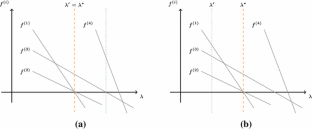
Fig. 1
Notes
- We use the notation \(B_{l\cdot }\) for a matrix B to denote the _l_-th row of the matrix.
- We will see how we can “filter out” vectors \(x^{(l)}\) with negative costs in the following sections.
- The sign function \({{\mathrm{sgn}}}:\mathbb {R} \mapsto \{-1,0,1\}\) returns \(-1\), 0, or 1 depending on whether the argument is negative, zero, or positive, respectively.
- Actually, since we do not have direct access to the set S, we need to obtain such a vector via an oracle access. However, by calling the oracle once more with a very large value for \(\lambda \) or by returning some vector found before, we obtain a certificate in S, which we can return.
- M denotes the largest absolute value of each number given in the problem instance, assuming gain factor are given as ratios of integers.
References
- Ahuja RK, Orlin JB (1995) A capacity scaling algorithm for the constrained maximum flow problem. Networks 25(2):89–98
Article MATH Google Scholar - Bienstock D (2006) Potential function methods for approximately solving linear programming problems: theory and practice, vol 53. Springer, New York
MATH Google Scholar - Bienstock D, Iyengar G (2006) Approximating fractional packings and coverings in o (1/epsilon) iterations. SIAM J Comput 35(4):825–854
Article MathSciNet MATH Google Scholar - Çalışkan C (2008) A double scaling algorithm for the constrained maximum flow problem. Comput Oper Res 35(4):1138–1150
Article MathSciNet MATH Google Scholar - Çalışkan C (2009) On a capacity scaling algorithm for the constrained maximum flow problem. Networks 53(3):229–230
Article MathSciNet MATH Google Scholar - Çalışkan C (2012) A faster polynomial algorithm for the constrained maximum flow problem. Comput Oper Res 39(11):2634–2641
Article MathSciNet MATH Google Scholar - Chazelle B (2000) A minimum spanning tree algorithm with inverse-ackermann type complexity. JACM 47(6):1028–1047
Article MathSciNet MATH Google Scholar - Cohen E, Megiddo N (1990) Maximizing concave functions in fixed dimension. World Scientific, Singapore
MATH Google Scholar - Cohen E, Megiddo N (1994) Improved algorithms for linear inequalities with two variables per inequality. SIAM J Comput 23(6):1313–1347
Article MathSciNet MATH Google Scholar - Cole R (1987) Slowing down sorting networks to obtain faster sorting algorithms. JACM 34(1):200–208
Article MathSciNet Google Scholar - Cunningham WH (1984) Testing membership in matroid polyhedra. J Comb Theory B 36(2):161–188
Article MathSciNet MATH Google Scholar - Dijkstra EW (1959) A note on two problems in connexion with graphs. Numer Math 1(1):269–271
Article MathSciNet MATH Google Scholar - Fleischer LK (2000) Approximating fractional multicommodity flow independent of the number of commodities. SIAM J Discrete Math 13(4):505–520
Article MathSciNet MATH Google Scholar - Fleischer LK, Wayne KD (2002) Fast and simple approximation schemes for generalized flow. Math Program 91(2):215–238
Article MathSciNet MATH Google Scholar - Gabow HN, Manu KS (1998) Packing algorithms for arborescences (and spanning trees) in capacitated graphs. Math Program 82(1–2):83–109
MathSciNet MATH Google Scholar - Garey MR, Johnson DS (1979) Computers and intractability—a guide to the theory of \({\cal{N}}{\cal{P}}\)-completeness. W. H. Freeman and Company, New York
Google Scholar - Garg N, Koenemann J (2007) Faster and simpler algorithms for multicommodity flow and other fractional packing problems. SIAM J Comput 37(2):630–652
Article MathSciNet MATH Google Scholar - Grigoriadis MD, Khachiyan LG (1994) Fast approximation schemes for convex programs with many blocks and coupling constraints. SIAM J Optim 4(1):86–107
Article MathSciNet MATH Google Scholar - Grigoriadis MD, Khachiyan LG (1996) Coordination complexity of parallel price-directive decomposition. Math Oper Res 21(2):321–340
Article MathSciNet MATH Google Scholar - Grötschel M, Lovász L, Schrijver A (1993) Geometric algorithms and combinatorial optimization, volume 2 of algorithms and combinatorics. Springer, Berlin
Book MATH Google Scholar - Hassin R (1992) Approximation schemes for the restricted shortest path problem. Math Oper Res 17(1):36–42
Article MathSciNet MATH Google Scholar - Holzhauser M, Krumke SO, Thielen C (2016) Budget-constrained minimum cost flows. J Comb Optim 31(4):1720–1745
- Holzhauser M, Krumke SO, Thielen C (2017a) On the complexity and approximability of budget-constrained minimum cost flows. Inf Process Lett 126: 24–29. doi:10.1016/j.ipl.2017.06.003
- Holzhauser M, Krumke SO, Thielen C (2017b) Maximum flows in generalized processing networks. J Comb Optim 33(4): 1226–1256. doi:10.1007/s10878-016-0031-y
- Karakostas G (2008) Faster approximation schemes for fractional multicommodity flow problems. ACM Trans Algorithms (TALG) 4(1):13
MathSciNet Google Scholar - Karp RM (1978) A characterization of the minimum cycle mean in a digraph. Discrete Math 23(3):309–311
Article MathSciNet MATH Google Scholar - Kellerer H, Pferschy U, Pisinger D (2004) Knapsack problems. Springer, Berlin
Book MATH Google Scholar - Lawler EL (2001) Combinatorial optimization: networks and matroids. Courier Corporation, New York
MATH Google Scholar - Megiddo N (1979) Combinatorial optimization with rational objective functions. Math Oper Res 4(4):414–424
Article MathSciNet MATH Google Scholar - Megiddo N (1983) Applying parallel computation algorithms in the design of serial algorithms. JACM 30(4):852–865
Article MathSciNet MATH Google Scholar - Oldham JD (2001) Combinatorial approximation algorithms for generalized flow problems. J Algorithms 38(1):135–169
Article MathSciNet MATH Google Scholar - Plotkin SA, Shmoys DB, Tardos É (1995) Fast approximation algorithms for fractional packing and covering problems. Math Oper Res 20(2):257–301
Article MathSciNet MATH Google Scholar - Schrijver A (2002) Combinatorial optimization: polyhedra and efficiency, vol 24. Springer, New York
MATH Google Scholar - Toledo S (1992) Maximizing non-linear concave functions in fixed dimension. In: Proceedings 33rd annual symposium on foundations of computer science, 1992. pp 676–685
- Toledo S (1993) Approximate parametric searching. Inf Process Lett 47(1):1–4
Article MathSciNet MATH Google Scholar - Wayne KD (1999) Generalized maximum flow algorithms. PhD thesis, Cornell University
- Wayne KD (2002) A polynomial combinatorial algorithm for generalized minimum cost flow. Math Oper Res 27(3):445–459
Article MathSciNet MATH Google Scholar - Young NE (1995) Randomized rounding without solving the linear program. SODA 95:170–178
MathSciNet MATH Google Scholar
Author information
Authors and Affiliations
- Department of Mathematics, University of Kaiserslautern, Paul-Ehrlich-Str. 14, 67663, Kaiserslautern, Germany
Michael Holzhauser & Sven O. Krumke
Authors
- Michael Holzhauser
- Sven O. Krumke
Corresponding author
Correspondence toMichael Holzhauser.
Additional information
This work was partially supported by the German Federal Ministry of Education and Research within the project “SinOptiKom—Cross-sectoral Optimization of Transformation Processes in Municipal Infrastructures in Rural Areas”.
Rights and permissions
About this article
Cite this article
Holzhauser, M., Krumke, S.O. A generalized approximation framework for fractional network flow and packing problems.Math Meth Oper Res 87, 19–50 (2018). https://doi.org/10.1007/s00186-017-0604-2
- Received: 08 December 2016
- Published: 28 July 2017
- Issue date: February 2018
- DOI: https://doi.org/10.1007/s00186-017-0604-2