Tactile acuity in experienced Tai Chi practitioners: evidence for use dependent plasticity as an effect of sensory-attentional training (original) (raw)
Abstract
The scientific discovery of novel training paradigms has yielded better understanding of basic mechanisms underlying cortical plasticity, learning and development. This study is a first step in evaluating Tai Chi (TC), the Chinese slow-motion meditative exercise, as a training paradigm that, while not engaging in direct tactile stimulus training, elicits enhanced tactile acuity in long-term practitioners. The rationale for this study comes from the fact that, unlike previously studied direct-touch tactile training paradigms, TC practitioners focus specific mental attention on the body’s extremities including the fingertips and hands as they perform their slow routine. To determine whether TC is associated with enhanced tactile acuity, experienced adult TC practitioners were recruited and compared to age–gender matched controls. A blinded assessor used a validated method (Van Boven et al. in Neurology 54(12): 2230–2236, 2000) to compare TC practitioners’ and controls’ ability to discriminate between two different orientations (parallel and horizontal) across different grating widths at the fingertip. Study results showed that TC practitioners’ tactile spatial acuity was superior to that of the matched controls (P < 0.04). There was a trend showing TC may have an enhanced effect on older practitioners (P < 0.066), suggesting that TC may slow age related decline in this measure. To the best of our knowledge, this is the first study to evaluate a long-term attentional practice’s effects on a perceptual measure. Longitudinal studies are needed to examine whether TC initiates or is merely correlated with perceptual changes and whether it elicits long-term plasticity in primary sensory cortical maps. Further studies should also assess whether related somatosensory attentional practices (such as Yoga, mindfulness meditation and Qigong) achieve similar effects.
Access this article
Subscribe and save
- Starting from 10 chapters or articles per month
- Access and download chapters and articles from more than 300k books and 2,500 journals
- Cancel anytime View plans
Buy Now
Price excludes VAT (USA)
Tax calculation will be finalised during checkout.
Instant access to the full article PDF.
Fig. 1
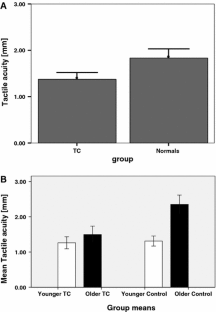
The alternative text for this image may have been generated using AI.
Fig. 2
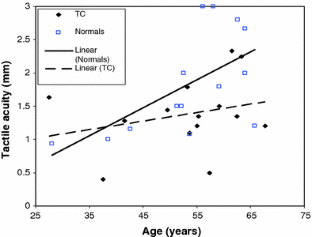
The alternative text for this image may have been generated using AI.
References
- Ahissar M, Hochstein S (1993) Attentional control of early perceptual learning. Proc Natl Acad Sci. 90(12):5718–5722
Article PubMed CAS Google Scholar - Braun C, Haug M, Wiech K, Birbaumer N, Elbert T, Roberts LE (2002) Functional organization of primary somatosensory cortex depends on the focus of attention. Neuroimage 17(3):1451–1458
Article PubMed Google Scholar - Cohen J (1988) Statistical power analysis for the behavioral sciences (2 edn). Erlbaum, Hillsdale
- Crist RE, Kapadia MK, Westheimer G, Gilbert CD (1997) Perceptual learning of spatial localization: specificity for orientation, position, and context. J Neurophysiol 78(6):2889–2894
PubMed CAS Google Scholar - Dupuis-Roy N, Gosselin F (2007) Perceptual learning without signal. Vision Res 47(3):349–356
Article PubMed Google Scholar - Frantzis B (1993) Opening the energy gates of your body. North Atlantic Books, Berkeley
Google Scholar - Frantzis B (2006) Tai Chi: health for life. Energy Arts, Fairfax, California
Google Scholar - Gibson G, Craig J (2006) The effect of force and conformance on tactile intensive and spatial sensitivity. Exp Brain Res 170(2):172–181
Article PubMed Google Scholar - Goldreich D, Kanics IM (2003) Tactile acuity is enhanced in blindness. J Neurosci 23(8):3439–3445
PubMed CAS Google Scholar - Goldreich D, Kanics IM (2006) Performance of blind and sighted humans on a tactile grating detection task. Percept Psychophys 68(8):1363–1371
PubMed Google Scholar - Hodzic A, Veit R, Karim AA, Erb M, Godde B (2004) Improvement and decline in tactile discrimination behavior after cortical plasticity induced by passive tactile coactivation. J Neurosci 24(2):442–446
Article PubMed CAS Google Scholar - Kerr CE, Wasserman RH, Moore CI (2007) Cortical dynamics as a therapeutic mechanism for touch healing. J Altern Complement Med 13(1): 59–66
Article PubMed Google Scholar - Lackner JR, Rabin E, DiZio P (2001) Stabilization of posture by precision touch of the index finger with rigid and flexible filaments. Exp Brain Res 139(4):454–464
Article PubMed CAS Google Scholar - Noppeney U, Waberski T, Gobbele R, Buchner H (1999) Spatial attention modulates the cortical somatosensory representation of the digits in humans. Neuroreport 10(15):3137–3141
Article PubMed CAS Google Scholar - Ragert P, Schmidt A, Altenmuller E, Dinse HR (2004) Superior tactile performance and learning in professional pianists: evidence for meta-plasticity in musicians. Eur J Neurosci 19(2):473–478
Article PubMed Google Scholar - Recanzone G, Merzenich MM, Jenkins WM, Grajski KA, Dinse HR (1992) Topographic reorganization of the hand representation in cortical area 3b owl monkeys trained in a frequency discrimination task. J Neurophysiol 67(5):1031–1056
PubMed CAS Google Scholar - Recanzone GH, Schreiner CE, Merzenich MM (1993) Plasticity in the frequency representation of primary auditory cortex following discrimination training in adult owl monkeys. J Neurosci 13(1):87–103
PubMed CAS Google Scholar - Sathian K, Zangaladze A (1997) Tactile learning is task specific but transfers between fingers. Percept Psychophys 59(1):119–128
PubMed CAS Google Scholar - Sathian K, Zangaladze A (2002) Feeling with the mind’s eye: contribution of visual cortex to tactile perception. Behav Brain Res 135(1–2):127–132
Article PubMed CAS Google Scholar - Schoups A, Vogels R, Qian N, Orban G (2001) Practising orientation identification improves orientation coding in V1 neurons. Nature 412(6846):549–553
Article PubMed CAS Google Scholar - Seitz AR, Dinse HR (2007) A common framework for perceptual learning. Curr Opin Neurobiol 17(2):148–153
Article PubMed CAS Google Scholar - Stevens J, Alvarez-Reeves M, Dipietro L, Mack G, Green B (2003) Decline of tactile acuity in aging: a study of body site, blood flow, and lifetime habits of smoking and physical activity. Somatosens Mot Res 20(3–4):271–279
Article PubMed Google Scholar - Tremblay F, Wong K, Sanderson R, Cote L (2003) Tactile spatial acuity in elderly persons: assessment with grating domes and relationship with manual dexterity. Somatosens Mot Res 20(2):127–132
Article PubMed Google Scholar - Tremblay F, Mireault AC, Dessureault L, Manning H, Sveistrup H (2004) Postural stabilization from fingertip contact: I. Variations in sway attenuation, perceived stability and contact forces with aging. Exp Brain Res 157(3):275–285
Article PubMed Google Scholar - Tremblay F, Mireault AC, Dessureault L, Manning H, Sveistrup H (2005) Postural stabilization from fingertip contact II. Relationships between age, tactile sensibility and magnitude of contact forces. Exp Brain Res 164(2):155–164
Article PubMed Google Scholar - Van Boven R, Johnson K (1994) A psychophysical study of the mechanisms of sensory recovery following nerve injury in humans. Brain 117(Pt 1):149–167
Article PubMed Google Scholar - Van Boven R, Hamilton R, Kauffman T, Keenan J, Pascual-Leone A (2000) Tactile spatial resolution in blind braille readers. Neurology 54(12):2230–2236
PubMed Google Scholar - Vega-Bermudez F, Johnson KO (2004) Fingertip skin conformance accounts, in part, for differences in tactile spatial acuity in young subjects, but not for the decline in spatial acuity with aging. Percept Psychophys 66(1):60–67
PubMed Google Scholar - Wright BA, Sabin AT (2007) Perceptual learning: how much daily training is enough? Exp Brain Res 180(4):727–736
Article PubMed Google Scholar - Wolf SL, Barnhart HX, Kutner NG, McNeely E, Coogler C, Xu T (2003) Atlanta FICSIT group. Selected as the best paper in the 1990s: Reducing frailty and falls in older persons: an investigation of tai chi and computerized balance training. J Am Geriatr Soc. 51(12):1794–1803
Google Scholar
Acknowledgments
The lead author (CK) is supported by NIH NCCAM career award K01 AT003459–01. The research was carried out at the Harvard-Thorndike General Clinical Research Center at the Beth Israel Deaconess Medical Center, which is funded by grant M01 RR01032. The authors are grateful to Christopher Moore for his mentorship and guidance, to Robert Van Boven for his technical assistance with the JVP domes, to Dan Kleiman, Alan Dougall and Marie Helene Jouvin from Brookline Tai Chi for their work in orienting the scientific team to the practice of Tai Chi, to Alfred Luk for his assistance in conducting the research, and to Christina Tognoni for her role in proofreading the manuscript.
Author information
Authors and Affiliations
- Harvard Osher Research Center, Harvard Medical School, Boston, MA, 02215, USA
Catherine E. Kerr, Jessica R. Shaw, Vanessa W. Chen, Alok Kanojia & Thomas Bayer - Department of Psychology, The Pennsylvania State University, State College, PA, USA
Rachel H. Wasserman - Endicott College, Beverly, MA, USA
John M. Kelley - Harvard Medical School, Boston, MA, USA
John M. Kelley
Authors
- Catherine E. Kerr
- Jessica R. Shaw
- Rachel H. Wasserman
- Vanessa W. Chen
- Alok Kanojia
- Thomas Bayer
- John M. Kelley
Corresponding author
Correspondence toCatherine E. Kerr.
Rights and permissions
About this article
Cite this article
Kerr, C.E., Shaw, J.R., Wasserman, R.H. et al. Tactile acuity in experienced Tai Chi practitioners: evidence for use dependent plasticity as an effect of sensory-attentional training.Exp Brain Res 188, 317–322 (2008). https://doi.org/10.1007/s00221-008-1409-6
- Received: 25 January 2008
- Accepted: 26 April 2008
- Published: 30 May 2008
- Issue date: June 2008
- DOI: https://doi.org/10.1007/s00221-008-1409-6