The role of group membership on the modulation of joint action (original) (raw)
Abstract
Two experiments were conducted to assess whether the emergence of shared representations, as indexed by the joint Simon effect, is modulated by perceived group membership. In both experiments, participants were required to perform a Simon task along another person who was perceived as belonging either to the same group or to a different group. In Experiment 1, ingroup–outgroup discrimination was obtained by dividing participants into two groups based on a superficial criterion; in Experiment 2, it was obtained by manipulating the interdependence experienced by the two acting individuals. The mere social categorization of co-acting participants into groups did not modulate the joint Simon effect which was observed even when participants believed to perform the task along with an individual belonging to a different social group (Experiment 1). On the contrary, the effect was modulated by perceived interdependence, with a null effect when participants experienced negative interdependence (Experiment 2). These results suggest that when acting in a social context, by default, individuals may perceive positive interdependence with co-acting individuals, even when cooperation is not explicitly requested.
Access this article
Subscribe and save
- Starting from 10 chapters or articles per month
- Access and download chapters and articles from more than 300k books and 2,500 journals
- Cancel anytime View plans
Buy Now
Price excludes VAT (USA)
Tax calculation will be finalised during checkout.
Instant access to the full article PDF.
Fig. 1
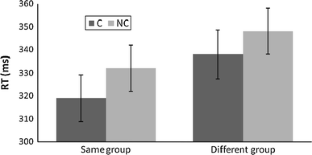
The alternative text for this image may have been generated using AI.
Fig. 2

The alternative text for this image may have been generated using AI.
Notes
- According to the literature on achievement goals (see Poortvliet and Darnon 2010 for a review), people whose aim is to outperform others, as occurs in competitive situations, develop an “other-referenced focus” since, to monitor their progress toward the goal, they tend to compare their performance with the performance of others. On the contrary, people whose aim is to improve one’s own performance develop a “self-referenced focus” since they tend to compare their present performance with their previous performances.
References
- Allen VL, Wilder DA (1975) Categorization, belief similarity, and intergroup discrimination. J Pers Soc Psychol 32:971–977
Article Google Scholar - Allen VL, Wilder DA (1979) Group categorization and attribution of belief similarity. Small Group Behav 10:73–80
Article Google Scholar - Aron A, Aron EN, Tudor M, Nelson G (1991) Close relationships as including the other in the self. J Pers Soc Psychol 60:241–253
Article Google Scholar - Atmaca S, Sebanz N, Prinz W, Knoblich G (2008) Action co-representation: the joint SNARC effect. Soc Neurosci 3:410–420
Article PubMed Google Scholar - Billig M, Tajfel H (1973) Social categorization and similarity in intergroup behavior. Eur J Soc Psychol 3:27–52
Article Google Scholar - Cadinu MR, Rothbart M (1996) Self-anchoring and differentiation processes in the minimal group setting. J Pers Soc Psychol 70:661–677
Article PubMed CAS Google Scholar - De Jong R, Liang C-C, Lauber E (1994) Conditional and unconditional automaticity: a dual-process model of effects of spatial stimulus-response correspondence. J Exp Psychol Hum 20:731–750
Article Google Scholar - Deutsch M (1949) A theory of cooperation and competition. Hum Relat 2:129–152
Article Google Scholar - Deutsch M (1962) Cooperation and trust: some theoretical notes. In: Jones MR (ed) Nebraska symposium on motivation. University of Nebraska Press, Lincoln, pp 275–320
Google Scholar - Doise W, Deschamps JC, Meyer G (1978) The accentuation of intra-category similarities. In: Tajfel H (ed) Differentiation between social groups. Academic Press, London
Google Scholar - Hommel B, Colzato LS, van den Wildenberg WPM (2009) How social are task representations? Psychol Sci 20:794–798
Article PubMed Google Scholar - Kelley JJ, Thiabut JW (1969) Group problem solving. In: Lindzey G, Aronson E (eds) Handbook of social psychology vol 4, 2nd edn. Addison-Wesley, Reading, pp 1–101
Google Scholar - Kuhbandner C, Pekrum R, Maier MA (2010) The role of positive and negative affect in the “mirroring” of other person’s actions. Cognition Emotion 24:1182–1190
Article Google Scholar - Lewin K (1948) Resolving social conflicts. Selected papers on group dynamics. Harper & Row, New York
Google Scholar - Milanese N, Iani C, Rubichi S (2010) Shared learning shapes human performance: transfer effects in task sharing. Cognition 116:15–22
Article PubMed Google Scholar - Poortvliet PM, Darnon C (2010) Toward a more social understanding of achievement goals: the interpersonal effects of mastery and performance goals. Curr Dir Psychol Sci 19:324–328
Article Google Scholar - Proctor RW, Vu K-PL (2006) Stimulus–response compatibility principle: data, theory, and application. Taylor & Francis, Boca Raton
Google Scholar - Rabbie JM, Horwitz M (1969) Arousal of ingroup–outgroup bias by a chance win or loss. J Pers Soc Psychol 13:269–277
Article PubMed CAS Google Scholar - Rubichi S, Pellicano A (2004) Does the Simon effect affect movement execution? Eur J Cogn Psychol 16:825–840
Article Google Scholar - Rubichi S, Nicoletti R, Umiltà C, Zorzi M (2000) Response strategies and the Simon effect. Psychol Res 63:129–136
Article PubMed CAS Google Scholar - Ruys KI, Aarts H (2010) When competition merges people’s behavior: interdependency activates shared action representations. J Exp Soc Psychol 46:1130–1133
Article Google Scholar - Sebanz N, Knoblich G, Prinz W (2003) Representing others’ actions: just like one’s own? Cognition 88:11–21
Article Google Scholar - Sebanz N, Knoblich G, Prinz W (2005) How two share a task: corepresenting stimulus-response mappings. J Exp Psychol Hum 31:1234–1246
Article Google Scholar - Sebanz N, Bekkering H, Knoblich G (2006a) Joint actions: bodies and minds moving together. Trends Cogn Sci 10:70–76
Article PubMed Google Scholar - Sebanz N, Knoblich G, Prinz W, Wascher E (2006b) Twin peaks: an ERP study of action planning and control in co-acting individuals. J Cogn Neurosci 18:859–870
Article PubMed Google Scholar - Sebanz N, Rebbechi D, Knoblich G, Prinz W, Frith CD (2007) Is it really my turn? An event-related fMRI study of task sharing. Soc Neurosci 2:81–95
Article PubMed Google Scholar - Simon JR, Rudell AP (1967) Auditory S-R compatibility: the effect of an irrelevant cue on information processing. J Appl Psychol 51:300–304
Article PubMed CAS Google Scholar - Smith ER, Henry S (1996) An ingroup becomes part of the self: response time evidence. Pers Soc Psychol B 22:635–642
Article Google Scholar - Tajfel H (1970) Experiments in intergroup discrimination. Sci Am 223:96–102
Article Google Scholar - Tajfel H, Billig M (1974) Familiarity and categorization in intergroup behavior. J Exp Soc Psychol 10:159–170
Article Google Scholar - Tajfel H, Billig M, Bundy RP, Flament C (1971) Social categorization and intergroup behaviour. Eur J Soc Psychol 2:149–178
Article Google Scholar - Tomasello M, Carpenter M, Call J, Behne T, Moll H (2005) Understanding and sharing intentions: the origins of cultural cognition. Behav Brain Sci 28:675–735
PubMed Google Scholar - Tsai C-C, Kuo WJ, Jing JT, Hung DL, Tzeng OJL (2006) A common coding framework in self-other interaction: evidence from joint action task. Exp Brain Res 175:353–362
Article PubMed Google Scholar - Tsai CC, Kuo WJ, Hung DL, Tzeng OJL (2008) Action co-representation is tuned to other humans. J Cogn Neurosci 20:2015–2024
Article PubMed Google Scholar - Welsh TN, Higgins L, Ray M, Weeks DJ (2007) Seeing vs. believing: is believing sufficient to activate the process of response co-representation? Hum Mov Sci 26:853–866
Article PubMed Google Scholar
Author information
Authors and Affiliations
- Dipartimento di Comunicazione e Economia, Università di Modena e Reggio Emilia, Via Allegri, 9, 42100, Reggio Emilia, Italy
Cristina Iani & Sandro Rubichi - Dipartimento di Discipline della Comunicazione, Università di Bologna, Bologna, Italy
Filomena Anelli & Roberto Nicoletti - Dipartimento di Psicologia dello Sviluppo e della Socializzazione, Università di Padova, Padova, Italy
Luciano Arcuri
Authors
- Cristina Iani
- Filomena Anelli
- Roberto Nicoletti
- Luciano Arcuri
- Sandro Rubichi
Corresponding author
Correspondence toCristina Iani.
Rights and permissions
About this article
Cite this article
Iani, C., Anelli, F., Nicoletti, R. et al. The role of group membership on the modulation of joint action.Exp Brain Res 211, 439–445 (2011). https://doi.org/10.1007/s00221-011-2651-x
- Received: 14 December 2010
- Accepted: 20 March 2011
- Published: 07 April 2011
- Issue date: June 2011
- DOI: https://doi.org/10.1007/s00221-011-2651-x