Evidence of reverse development in Leptomedusae (Cnidaria, Hydrozoa): the case of Laodicea undulata (Forbes and Goodsir 1851) (original) (raw)
Abstract
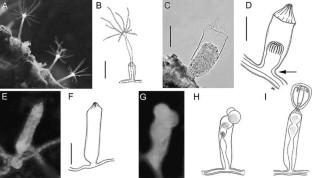
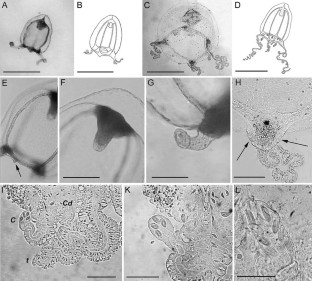
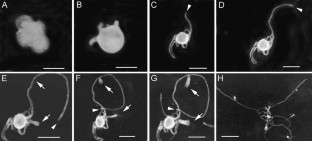
Laboratory rearing and reconstruction of Laodicea undulata (Hydrozoa) life cycle led to the discovery for the first time in Leptomedusae of the potential for ontogeny reversal, i.e. the medusa stage can asexually transform back into the polyp stage. In turn, each rejuvenated polyp stage can newly activate the standard developmental programme towards colony morphogenesis and budding of secondary medusae. These can be considered as clonemates of the initial medusa batch, since they originate by asexual processes. In combination with the ordinary medusa budding process, the potential for reverse development might represent a tool to increase jellyfish population growth rate during the favourable season, but eventually it does not avoid jellyfish to die. Comparably to polyembryony, reverse development leads to offspring multiplication from a single fertilization event, with a wider dispersal of each single genotype; eventually, it favours the enhancement of the overall genetic diversity at small spatial scale. The life cycle of L. undulata from the Mediterranean Sea is re-described, linking previously uncoupled descriptions of either the polyp or the early medusa stages. Taxonomic considerations of the genus Laodicea and a comparison among the known Mediterranean species are also provided.
Access this article
Subscribe and save
- Starting from 10 chapters or articles per month
- Access and download chapters and articles from more than 300k books and 2,500 journals
- Cancel anytime View plans
Buy Now
Price excludes VAT (USA)
Tax calculation will be finalised during checkout.
Instant access to the full article PDF.
Fig. 1
The alternative text for this image may have been generated using AI.
Fig. 2
The alternative text for this image may have been generated using AI.
Fig. 3
The alternative text for this image may have been generated using AI.
References
- Agassiz L (1860) Contributions to the Natural History of the United States of America. Second monograph 3:i–xi, 1–301
- Agassiz A, Mayer AG (1899) Acalephs from the Fiji Islands. Bull Mus comp Zool Harv 32:157–189
Google Scholar - Babnik P (1948) Hidromeduze iz srednjega in junega Jadrana v letih 1939 in 1940 Hydromedusae from the middle and South Adriatic 1939 and 1940. Acta Adriat 3:275–340
Google Scholar - Bavestrello G, Sommer C, Sarà M (1992) Bi-directional conversion in Turritopsis nutricula (Hydrozoa). In: Bouillon J, Boero F, Cicogna F, Gili JM, Hughes RG (eds) Aspects of Hydrozoan biology. Sci Mar 56:137–140
- Berrill NJ (1953) Growth and form in gymnoblastic hydroids. VII. Growth and reproduction in Syncoryne and Coryne. J Morphol 92:273–302
Article Google Scholar - Boero F (1984) The ecology of marine hydroids and effects of environmental factors: a review. Pubbl Stn Zool Napoli I Mar Ecol 5:93–118
Article Google Scholar - Boero F, Sarà M (1987) Motile sexual stages and evolution of Leptomedusae (Cnidaria). Boll Zool 54:131–139
Article Google Scholar - Boero F, Balduzzi A, Bavestrello G, Caffa B, Cattaneo Vietti R (1986) Population dynamics of Eudendrium glomeratum (Cnidaria: Anthomedusae) on the Portofino promontory (Ligurian Sea). Mar Biol 92:81–85
Article Google Scholar - Boero F, Bouillon J, Piraino S (1992) On the origins and evolution of hydromedusan life cycles (Cnidaria, Hydrozoa). In: Dallai R (ed) Sex origin and evolution. Selected symposia and monographs UZI 6:59–68
- Boero F, Gravili C, Pagliara P, Piraino S, Bouillon J, Schmid V (1998) The cnidarian premises of metazoan evolution: from triploblasty, to coelom formation, to metamery. Ital J Zool 65:5–9
Article Google Scholar - Boero F, Bouillon J, Piraino S, Schmid V (2002) Asexual reproduction in the Hydrozoa (Cnidaria). In: Hughes RN (ed) Reproductive biology of invertebrates. Volume XI: Progress in asexual reproduction. Oxford and IBH, New Delhi, pp 141–158
- Bouillon J, Boero F (2000) Phylogeny and classification of Hydroidomedusae. The Hydrozoa: a new classification in the light of old knowledge. Thalassia Salentina 24:1–46
Google Scholar - Bouillon J, Medel MD, Pagès F, Gili JM, Boero F, Gravili C (2004) Fauna of the Mediterranean Hydrozoa. Sci Mar 68(2):1–449
Google Scholar - Brinckmann-Voss A (1970) Anthomedusae/Athecata (Hydrozoa, Cnidaria) of the Mediterranean. Part I. Capitata. Fauna Flora Golfo di Napoli, Stazione Zoologica Anton Dohrn, Napoli, 39:1–96
- Browne ET (1907) A revision of the medusae belonging to the family Laodiceidae. Ann Mag Nat Hist 20:457–480
Article Google Scholar - Cornelius PFS (1995) North-West European Thecate Hydroids and their medusae. Part 1. Laodiceidae to Haleciidae. In: Barnes RSK, Crothers JH (eds) Synopses of the British fauna (new series). The Linn Soc London and Est Coas Sci Assoc Field Studies Council, Shrewsbury, 50:1–347
- Craig SF, Slobodkin LB, Wray GA, Biermann CH (1997) The ‘paradox’ of polyembryony: a review of the cases and a hypothesis for its evolution. Evol Ecol 11:127–143
Article Google Scholar - Forbes E, Goodsir J (1851) On some remarkable marine Invertebrata new to the British Seas. Trans R Soc Edinb 20:307–315
Article Google Scholar - Frey J (1968) Die Entwicklungsleistungen der Medusenknospen und Medusen von Podocoryne carnea M Sars nach Isolation und Dissoziation. Wilhelm Roux’ Arch Entwicklungsmech Org 160:428–464
Article Google Scholar - Giard A (1898) Sur l’éthologie du Campanularia caliculata Hincks (Stolonisation et allogonie). C R Soc Biol 5:17–20
Google Scholar - Gili JM, Hughes RG (1995) The ecology of marine benthic hydroids. Oceanogr Mar Biol Annu Rev 33:351–426
Google Scholar - Gravier N (1970) Libération des médusoides par Macrorhynchia philippina Kirchenpauer, 1872 (Hydrozoa, Plumulariidae). Recl Trav Stn Mar Endoume 10:253–257
Google Scholar - Hadzi J (1909) Einige Kapitel aus der Entwicklungsgeschichte von Chrysaora. Arb Zool Inst Univ Wien 17:17–44
Google Scholar - Hincks T (1868) A history of the British hydroid zoophytes. John Van Voorst, Paternoster Row, London
Book Google Scholar - Kramp PL (1927) The hydromedusae of the Danish waters. K Dan Vidensk Selsk Biol Skr Afd 8(12):1–290
Google Scholar - Kramp PL (1959) The Hydromedusae of the Atlantic Ocean and adjacent waters. Dana-Reports Carlsberg Found 46:1–283
Google Scholar - Kubota S (2005) Distinction of two morphotypes of Turritopsis nutricula Medusae (Cnidaria, Hydrozoa, Anthomedusae) in Japan, with reference to their different abilities to revert to the hydroid stage and their distinct geographical distributions. Biogeography 7:41–50
Google Scholar - Kubota S, Mizutani S (2003) Strange fates of degenerated medusae of Turritopsis nutricula (Hydrozoa, Anthomedusae, Clavidae) from northern Japan. Nanki Seibutu 45:107–109
Google Scholar - Metschnikoff E (1886) Embryologische Studien an Medusen. Ein Beitrag zur Genealogie der Primitiv-Organe. Verlag Alfred Hölder, k.k. Hof-u Universitäts-Buchhändler, Wien
- Piraino S, Todaro C, Geraci S, Boero F (1994) Ecology of the bivalve-inhabiting hydroid Eugymnanthea inquilina in the coastal sounds of Taranto (Ionian Sea, SE Italy). Mar Biol 118:695–703
Article Google Scholar - Piraino S, Boero F, Aeschbach B, Schmid V (1996) Reversing the life cycle: medusae transforming into polyps and cell transdifferentiation in Turritopsis nutricula (Cnidaria, Hydrozoa). Biol Bull 190:302–312
Article CAS Google Scholar - Piraino S, De Vito D, Schmich J, Bouillon J, Boero F (2004) Reverse development in Cnidaria. Can J Zool 82:1748–1754
Article Google Scholar - Russell FS (1936) On the hydroid of Laodicea undulata (Forbes and Goodsir). J Mar Biol Assoc UK 20:581–588
Article Google Scholar - Russell FS (1938) The Plymouth offshore medusae fauna. J Mar Biol Assoc UK 22:411–440
Article Google Scholar - Russell FS (1953) The medusae of the British Isles. Anthomedusae, Leptomedusae, Limnomedusae, Trachymedusae and Narcomedusae. Cambridge University Press, Cambridge
Google Scholar - Schmid V (1972) Untersuchungen über Dedifferenzierungsvorgänge bei Medusenknospen und Medusen von Podocoryne carnea M Sars. Wilhelm Roux’ Arch Entwicklungsmech Org 169:281–307
Article Google Scholar - Schmid V (1992) Transdifferentiation in medusae. Int Rev Cytol 142:213–261
Article CAS Google Scholar - Schmidt HE (1973) Hydromedusae from the eastern Mediterranean Sea. Isr J Zool 22:151–167
Google Scholar - Schuchert P (2004) Revision of the European athecate hydroids and their medusae (Hydrozoa, Cnidaria): families Oceanidae and Pachycordylidae. Rev Suisse Zool 111:315–369
Article Google Scholar - Spring J, Yanze N, Middel AM, Stierwald M, Gröger H, Schmid V (2000) The mesoderm specification factor twist in the life cycle of jellyfish. Dev Biol 228:363–375
Article CAS Google Scholar - Stefani R (1959) Sulla variabilità ecologica di un Idrozoo (Campanularia caliculata Hincks). Boll Zool 26:115–120
Article Google Scholar - Yanze N, Spring J, Schmidli C, Schmid V (2001) Conservation of Hox/ParaHox-related genes in the early development of a cnidarian. Dev Biol 236:89–98
Article CAS PubMed Central Google Scholar - Werner B (1954) On the development and reproduction of the anthomedusan, Margelopsis haeckeli Hartlaub. Trans NY Acad Sci 16:143–146
Article Google Scholar - Werner B (1963) Effect of some environmental factors on differentiation and determination in marine Hydrozoa, with a note on their evolutionary significance. Ann NY Acad Sci 105:461–488
Google Scholar
Acknowledgments
Financial supports were provided by MURST (60%, COFIN, and FIRB Projects), the Administration of the Province of Lecce, ICRAM (Project “Identificazione e distribuzione delle specie non indigene nel Mediterraneo”), the European Union (Marie Curie contract no. HPMD-CT-2001-00099, and the MARBEF network), the NSF of the USA (PEET project on the Hydrozoa). We are grateful to Cristina Di Camillo for drawings of L. undulata. Special thanks are due to Adam Benovic and Alenka Malej for their kind translation of part of the original paper by Babnik (1948).
Author information
Authors and Affiliations
- Dipartimento di Scienze e Tecnologie Biologiche ed Ambientali, Università di Lecce, via per Monteroni, 73100, Lecce, Italy
D. De Vito, S. Piraino, J. Schmich, J. Bouillon & F. Boero
Authors
- D. De Vito
- S. Piraino
- J. Schmich
- J. Bouillon
- F. Boero
Corresponding author
Correspondence toS. Piraino.
Additional information
Communicated by R. Cattaneo-Vietti, Genova
Rights and permissions
About this article
Cite this article
De Vito, D., Piraino, S., Schmich, J. et al. Evidence of reverse development in Leptomedusae (Cnidaria, Hydrozoa): the case of Laodicea undulata (Forbes and Goodsir 1851).Marine Biology 149, 339–346 (2006). https://doi.org/10.1007/s00227-005-0182-3
- Received: 16 July 2005
- Accepted: 13 September 2005
- Published: 29 November 2005
- Issue date: May 2006
- DOI: https://doi.org/10.1007/s00227-005-0182-3