The influence of rainstorm pattern on shallow landslide (original) (raw)
Abstract
In this study, the influence of the rainstorm pattern on shallow landslide is examined. The physically-based shallow landslide model is used to conduct this examination with considering four representative rainstorm patterns including uniform, advanced, central, and delayed rainstorms. The results show that in spite of the rainfall duration and the rainfall pattern, the rainstorm with less than the minimum landslide-triggering rainfall amount will not trigger landslide. However, for the rainstorm with greater than the minimum landslide-triggering rainfall amount, the occurrence of landslide significantly depends not only on the rainfall duration but also on the rainfall pattern. Among the four representative rainstorm patterns, the delayed rainstorm has the greatest rainfall duration threshold for landslide occurrence, followed by the central rainstorm, and then the uniform rainstorm. In addition, for each rainstorm pattern, the corresponding rainfall duration threshold for landslide occurrence decreases with the increase of rainfall amount, and seems to be constant for large rainfall amount.
Fig. 1

The alternative text for this image may have been generated using AI.
Fig. 2

The alternative text for this image may have been generated using AI.
Fig. 3

The alternative text for this image may have been generated using AI.
Fig. 4

The alternative text for this image may have been generated using AI.
Fig. 5
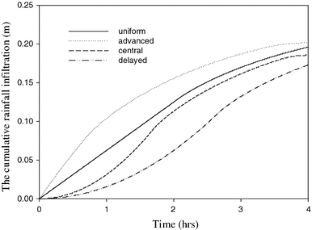
The alternative text for this image may have been generated using AI.
Fig. 6

The alternative text for this image may have been generated using AI.
Fig. 7

The alternative text for this image may have been generated using AI.
Abbreviations
C :
the change in volumetric water content per unit change in pressure head
C 0 :
the minimum value of C
c :
soil cohesion
D 0 :
\({K_{{\rm sat}} } \mathord{\left/ {\vphantom {{K_{{\rm sat}} } {C_{0} }}} \right. \kern-\nulldelimiterspace} {C_{0} }\)
d Z :
water depth
d LZ :
slope depth
FS:
factor of safety
I Z :
rainfall intensity
K sat :
saturated hydraulic conductivity
T :
rainfall duration
Z :
the coordinates
ψ :
groundwater pressure head
θ :
soil volumetric water content
α :
slope angle
φ :
soil friction angle
_γ_sat and _γ_w:
the unit weights of saturated soil and water
References
- Baum RL, Savage WZ, Godt JW (2002) TRIGRS-a Fortran program for transient rainfall infiltration and grid-based regional slope-stability analysis, Virginia, US Geological Survey Open file report 02-424
- Borga M, Fontana GD, De Ros D, Marchi L (1998) Shallow landslide hazard assessment using a physically based model and digital elevation data. Environ Geol 35:81–88
Article Google Scholar - Brand EW, Premchitt J, Phillipson HB (1984) Relationship between rainfall and landslides in Hong Kong. In: Proceedings of the IV international symposium on landslides, Toronto 1:377–384
- Brooks SM, Richards KS (1994) The significance of rainstorm variations to shallow translational hillslope failure. Earth Surf Process Landforms (19):85–94
- Caine N (1980) The rainfall intensity duration control of shallow landslides and debris flow. Geogr Ann 62(1):23–27
Article Google Scholar - Campbell RH (1975) Debris flow originating from soil slip during rainstorm in southern California. Q Eng Geol 7:339–349
Article Google Scholar - Cannon SH, Ellen SD (1985) Rainfall conditions for abundant debris avalanches, San Francisco Bay region, California. Calif Geol 38(12):267–272
Google Scholar - Collins BD, Znidarcic D (2004) Stability analyses of rainfall induced landslides. J Geotech Geoenviron Eng 130(4):362–372
Article Google Scholar - Crosta GB, Frattini P (2003) Distributed modeling of shallow landslides triggered by intense rainfall. Nat Hazards Earth Syst Sci 3:81–93
Article Google Scholar - Dhakal AS, Sidle RC (2004) Distributed simulations of landslides for different rainfall conditions. Hydrol Process 18:757–776
Article Google Scholar - D’Odorico P, Fagherazzi S, Rigon R (2005) Potential for landsliding: Dependence on hyetograph characteristics. J Geophys Res Earth Surf 110(F1)
- Frattini P, Crosta GB, Fusi N, Negro PD (2004) Shallow landslides in pyroclastic soil: a distributed modeling approach for hazard assessment. Eng Geol 73:277–295
Article Google Scholar - Glade T (2000) Modelling landslide-triggering rainfalls in different regions of New Zealand- the soil water status model. Z Geomorphol NE 122:63–84
Google Scholar - Govi M, Mortara G, Sorzana P (1985) Eventi idrologici e frane. Geol Appl Idrogeol 20(2):395–401
Google Scholar - Hsu SH, Ni CF, Hung PF (2002) Assessment of three infiltration formulas based on model fitting on Richards’ equation. J Hydrol Eng 7(5):373–379
Article Google Scholar - Iverson RM (2000) Landslide triggering by rain infiltration. Water Resour Res 36:1897–1910
Article Google Scholar - Jibson RW (1989) Debris flow in southern Porto Rico. In: Schultz, Jibson (eds) Landslide processes of the eastern United States and Puerto Rico. Geological Society of American Special Paper 236:29–55
- Keim RF, Skaugset AE (2003) Modelling effects of forest canopies on slope stability. Hydrol Processes 17:1457–1467
Article Google Scholar - Lan HX, Lee CF, Zhou CH, Martin CD (2005) Dynamic characteristics analysis of shallow landslides in response to rainfall event using GIS. Environ Geol 47:254–267
Article Google Scholar - de Lima JLMP, Singh VP (2002) The influence of the pattern of moving rainstorm on overland flow. Adv Water Resour 25:817–828
Article Google Scholar - Montgomery DR, Dietrich WE (1994) A physically based model for the topographic control on shallow landslide. Water Resour Res 30:83–92
Google Scholar - Morrissey MM, Wieczorek GF, Morgan BA (2001) A comparative analysis of hazard models for predicting debris flows in Madison County, Virginia. US Geological Survey Open file report 01-67
- Ng CWW, Wang B, Tung YK (2001) Three-dimensional numerical investigation of groundwater responses in an unsaturated slope subjected to various rainfall patterns. Can Geotech J 38:1049–1062
Article Google Scholar - Richards LA (1931) Capillary conduction of liquids in porous mediums. Physics 1:318–333
Article Google Scholar - Tsai TL, Yang JC (2006) Modeling of rainfall-triggered shallow landslide. Environ Geol 50(4):525–534
Article Google Scholar - Wallach R, Grigorin G, Rivlin J (1997) The errors in surface runoff prediction by neglecting the relationship between infiltration rate and overland flow depth. J Hydrol 200:243–259
Article Google Scholar - Wieczorek GF, Morgan BA, Campbell RH (2000) Debris flow hazards in the Blue Bridge of Central Virginia. Environ Eng Geosci 1(1):11–27
Google Scholar - Wu W, Slide RC (1995) A distributed slope stability model for steep forested basins. Water Resour Res 31:2097–2110
Article Google Scholar
Author information
Authors and Affiliations
- Department of Civil and Water Resources Engineering, National Chiayi University, 300 Sefu Road, Chiayi City, 60004, Taiwan
Tung-Lin Tsai
Corresponding author
Correspondence toTung-Lin Tsai.
Rights and permissions
About this article
Cite this article
Tsai, TL. The influence of rainstorm pattern on shallow landslide.Environ Geol 53, 1563–1569 (2008). https://doi.org/10.1007/s00254-007-0767-x
- Received: 11 January 2007
- Accepted: 18 April 2007
- Published: 10 May 2007
- Issue date: February 2008
- DOI: https://doi.org/10.1007/s00254-007-0767-x